Expert College Basketball Picks Against the Spread
By Sports Betting TikTok
College basketball picks are expert daily selections across the 358-team Division I landscape, priced with adjusted efficiency ratings, four-factors analysis, tempo-control matchups, venue-specific home court math, and conference travel data. The Best Bet on Sports delivers NCAAB picks backed by 20 years of documented results from November opening night through the March Madness National Championship — a track record that six major sportsbooks have moved to restrict.
College basketball is the highest-volume, least-efficient major betting market in American sports. With 358 Division I teams and roughly 5,500 regular-season games packed between early November and Selection Sunday, no sportsbook trading desk can sharpen every line. That bandwidth gap, combined with extreme tempo variance and venue-specific home edges, is where 20 years of NCAAB handicapping turns into repeatable profit on Tuesday-through-Saturday cards.
Membership
Get the picks
Live betting picks across NFL, NCAAF, NBA, NCAAB, MLB and WNBA — delivered by Email and Discord the moment we spot value.
● Get The Picks
Choose your package
Tap any tier to select · Subscribe in one tap
👇 Tap any package to select it
✓ You're selecting
25 Units · $99.95/month
25 unit picks per month. Sweet spot for most bettors — plenty of action without going all-in.
- ✓25 live betting selections/month
- ✓Email + Discord delivery
- ✓All sports (NFL, NCAAF, NBA, NCAAB, MLB)
- ✓Mix of 1, 2, 3, 5-unit rated plays
- ✓Cancel anytime
Secure PayPal · Cancel anytime · No hidden fees · 21+ · +$367K verified
358 D-I Teams, Roughly 60 Games a Night — and Limited Sportsbook Bandwidth
College basketball runs from early November through early April with a typical weeknight card carrying 30-to-50 D-I games and Saturdays often pushing past 90. No NFL Sunday produces that kind of volume, and no sportsbook trading desk can give a 7:00 PM Patriot League total the same modeling depth that a Sunday afternoon NFL line receives. The result is a tiered market: Duke at North Carolina gets sharpened constantly; a Tuesday Colonial Athletic Association total often sits at the opening number until tip-off.
That bandwidth gap is the foundation of every profitable NCAAB picks service. The mid-major and small-conference lines move slowly because the public action is thin, the sportsbook attention is thinner, and the sharp money has to choose between hundreds of games. We are systematic in the conferences where the market lags — A-10, Mountain West, AAC, WCC, MAC, and the entire mid-major Saturday morning window — because that is where the gap between fair value and posted number is most repeatable.
Public Bias on Blue Bloods Inflates Lines All Season
Recreational money chases brand recognition. Duke, Kentucky, Kansas, North Carolina, UConn, Gonzaga, and Michigan State get bet by the public regardless of opponent strength, which inflates their spreads against properly rated teams. When Kansas opens at -14.5 against a quality Big 12 opponent and the line drifts to -16 by tip-off on public action, the +16 underdog carries an implied edge that did not exist at the open. We take those points when the matchup math supports it, and the bias is permanent enough that the angle has produced multi-year ROI across two decades.
The flip side is that mid-major favorites are often undervalued. A Saint Mary's or a Drake or a UAB priced at a fair number against a Power Six road opponent in November will frequently see the line move in the wrong direction as public money piles on the brand-name underdog. We track those reverse line moves and use them as confirmation when our model already likes the mid-major favorite.
Inside Our NCAAB Card-Building Process
Every morning at 7:00 AM Eastern, our adjusted efficiency ratings update for all 358 Division I teams off the previous night's box scores. Each team gets a single rating built on opponent-adjusted offensive and defensive efficiency per 100 possessions, projected tempo, and the four factors — effective field goal percentage, turnover rate, offensive rebounding rate, and free throw rate. That single rating produces a projected spread and total for every game on that day's board.
Games where our projected number differs from the market by 2 points or more on the spread, or 3 points or more on the total, enter a second analytical layer. That layer adds tempo-control matchup analysis (a 67-possession defensive team versus an 80-possession Houston-style team is decided by who controls pace), specific venue home-court coefficients, travel and time-zone math, and the day's sharp-money flow. By 1:00 PM Eastern, the card is finalized — typically three to six plays drawn from the 30-to-50 games on the nightly board.
Why Tempo Is the Hidden Variable in Every NCAAB Pick
Pace is the multiplier on every other input. A team rated 10 points better than its opponent will project to win by a different margin at 80 possessions versus 60 possessions, because the talent gap compounds with each trip down the floor. The market prices the projected total in a separate column, but the spread and total interact — slow-pace games compress spreads and create underdog cover value, while fast-pace games expand spreads and create favorite value.
We model expected possessions for every game based on the weighted average of both teams' tempo, adjusted for prior matchup history when available. When two teams disagree dramatically on preferred pace — a 70-possession defensive-minded team hosting a 78-possession transition team — whichever team forces its preferred tempo usually wins outright at a rate the spread does not reflect. That tempo-control battle is one of the cleanest edges in college basketball.
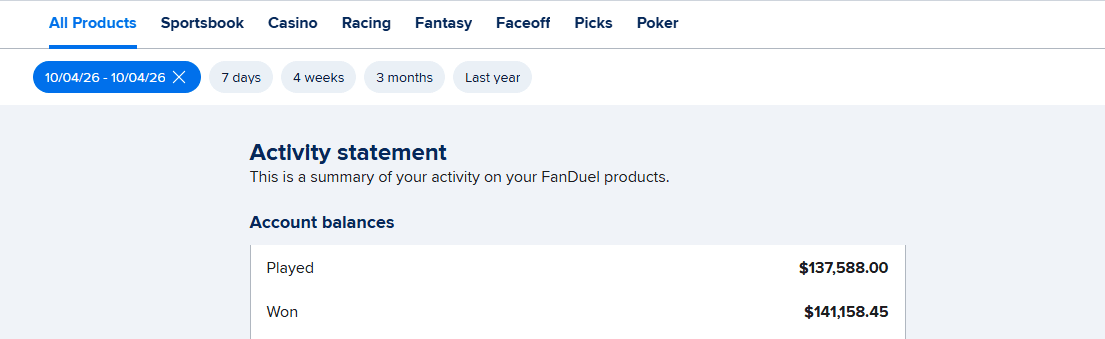
What separates The Best Bet on Sports from every other college basketball picks service is verifiable on every sportsbook account we hold: FanDuel, DraftKings, Caesars, BetMGM, Fanatics, and ESPN BET have all restricted our action because our live NCAAB betting — particularly second-half totals after foul trouble develops and momentum runs late — generated $367,520-plus in across-sport verified profit. Books limit winners. That history is the credential behind every CBB pick we release.
What Every College Basketball Pick from The Best Bet on Sports Includes
Each pick arrives by email well before tip with the team, the spread or total we are taking, the unit rating, and the matchup-specific reasoning behind it. You will know whether the edge is on the efficiency disagreement, the tempo-control matchup, the venue-specific home court, or a public-fade situational play.
Feast Week Through the National Championship — Six Months of Coverage
NCAAB picks ship daily from early November through April. The calendar breaks into distinct phases — non-conference November and December where Feast Week tournaments like Maui Invitational, Battle 4 Atlantis, and the PK85 create compressed three-game-in-four-day windows that produce fatigue edges; conference play from late December through early March where familiarity changes the matchup dynamics and second meetings price differently than firsts; conference tournament week where bubble teams play with their NCAA Tournament lives on the line; then the Big Dance itself from Selection Sunday through the National Championship in early April.
Looking for additional coverage across the year? Our NBA picks cover professional basketball, and the college football picks page handles the Saturday football slate. Our sports handicappers hub covers the full multi-sport operation, and basketball betting strategy content covers four-factors analysis and tempo handicapping concepts.
Full season-by-season NCAAB results are documented on our results page.
Get Tonight's NCAAB Card Before Lines Move
Six U.S. sportsbooks have moved to limit our accounts. $367,520-plus in verified profit. Subscribe and get tonight's college basketball card delivered before tip-off.
View College Basketball PackagesWhy Venue-Specific Home Court Math Beats a Flat 3-Point Adjustment
Most NCAAB handicappers, including most computer ratings, apply a flat home-court adjustment of three points. That is fine for the average game on the board. It is materially wrong for the games that actually decide a card. Rupp Arena at Kentucky shows a sustained home edge above five points across two decades of data. Allen Fieldhouse at Kansas runs even higher in conference play because the crowd and arena acoustics specifically affect free throw shooting at the visitor's end of the floor. Cameron Indoor Stadium at Duke produces a documented home edge that has barely changed across coaching eras.
The flip side matters just as much. A handful of neutral or low-end home courts in the Power Six show home edges below two points across the past five seasons. Treating those venues as if they deliver standard home advantage overprices the home team every time. Our model carries a separate home-court coefficient for every D-I venue updated weekly, and the largest situational profit in our regular-season records consistently traces back to two spots: backing road teams at low-edge home venues, and backing favorites at the elite home courts where the flat adjustment underprices the real advantage.
McKale Center at Arizona, The Pit at New Mexico, Hinkle Fieldhouse at Butler, the Carrier Dome at Syracuse, and Mackey Arena at Purdue all produce measurable home edges that the market only partly prices. When our power rating already favors the home team at one of those venues, the play graduates from a 1-unit lean to a 2-or-3-unit confidence rating because the venue input alone adds 1.5 to 2 points of expected margin beyond the standard adjustment.
Picks Are Released Early Because NCAAB Lines Move Faster Than Any Other Sport
Picks are emailed by 1:30 PM Eastern for evening tip-offs and by 9:00 PM Friday for the Saturday-morning slate. Each release covers the team, the spread or total, the unit rating, and a written breakdown explaining the matchup dynamics, tempo expectations, and the specific edge driving the play. You will always know why a pick was released, not just what the pick is.
Early delivery matters more in NCAAB than any other sport. A mid-major conference game can see the spread move two full points between 2:00 PM and 6:00 PM as public money trickles in, while small line moves through key numbers — 4, 7, and especially the soft college-basketball numbers around 9 and 11 — change the math significantly. We recommend maintaining accounts at three or more sportsbooks specifically for college basketball, where a half-point on a small-conference total often determines whether you cash or push. Line shopping plus early delivery is the cleanest free edge any NCAAB bettor has access to.
NCAAB Bankroll Management: Sized for a 5,500-Game Marathon
College basketball offers more betting opportunities than any other major American sport — and that volume is the trap. A bettor who plays every Tuesday and Wednesday mid-major card bleeds out by late January regardless of analytical skill. The single biggest discipline in profitable NCAAB handicapping is passing on the nights where the projected spreads match the market within a point on every matchup. On a 35-game Tuesday board, that often means we release one play or zero. Passing preserves bankroll for the Thursday-and-Saturday windows where three or four games simultaneously create real edges.
We recommend flat unit betting at 1 to 2 percent of bankroll per unit. On a $5,000 bankroll, that means $50 to $100 per 1-unit play, scaling to $250 to $500 for our highest-conviction 5-unit selections. This sizing absorbs the two-week cold stretches that occur even in profitable seasons and keeps the bankroll fully funded entering March, when bracket-season opportunities pay multiples of regular-season edges. Long-term NCAAB profitability is about being present for the best spots, absent for the rest, and sized correctly throughout.
Five NCAAB Angles That Have Produced for Two Decades
Two decades of NCAAB handicapping has surfaced a repeatable set of structural edges in the college basketball market. These angles do not expire with coaching turnover or NIL-era roster changes because they reflect how the market consistently mispriced a knowable input.
1. Mid-major home dog catching 6 to 10 against a Power Six brand
The Saint Joseph's, San Diego State, Murray State, and Davidson type of program at home against an Alabama or a Wisconsin in late November is the single most consistent angle on our card. The Power Six visitor is playing its fourth game in eight days during a Feast Week stretch, the mid-major has had a week to prepare specifically for this opponent, and the home crowd is electric for the biggest non-conference game of their season. The market overvalues the talent gap and underprices the motivation-plus-rest gap.
2. Second conference meeting after a blowout loss
When two Big Ten or ACC teams meet for the second time and the first meeting was a 15-plus-point blowout, the team that lost the first matchup covers at an elevated rate. The coaching staff has specific film to adjust from, the players want a measure of revenge, and the market anchors to the previous result rather than projecting the adjustment. Tom Izzo and Bill Self programs are particularly notable here — both coaches are famously systematic about second-meeting adjustments.
3. Conference tournament desperation underdog
A bubble team in its conference tournament quarter or semifinal playing for its NCAA Tournament life brings an intensity that a team already locked into a top-four seed cannot match. The spread rarely accounts for the desperation. The lower-seeded team that needs to win to dance covers the spread above 55 percent of the time in elimination games across our 20-year sample — that edge is one of the cleanest of the entire calendar.
4. The 5-vs-12 and 7-vs-10 March Madness lines
The two most consistently profitable spots on the bracket are the 5-12 and 7-10 first-round games. The market overweights seed line and underprices tempo-control matchups. A slow-pace, half-court, defensive 12-seed forcing a fast-pace 5-seed into a 60-possession game generates exactly the kind of variance the favorite cannot absorb. The 12-seed does not need to be more talented. They need to control pace and let randomness do the rest. Twenty years of bracket data show 5-12 unders and 12-seed-on-the-spread cover at rates well above market expectation.
5. Saturday morning Big East and Big 12 early window
Noon Eastern tip-offs on Saturday mornings, particularly in Big East and Big 12 conference play, consistently produce edges that the market does not sharpen the way it does prime-time games. CBS and Fox push these early windows for ratings reasons, but the public action waits for the afternoon and evening slate. Lines that opened Friday afternoon and saw minimal action through Saturday morning often carry mispricings of 1.5 points or more at tip-off. We are systematic about playing those early-window games when our model has a clear lean.
NCAAB Track Record and Documentation
Full season-by-season college basketball results are documented on our results page with every pick timestamped before tip-off. We do not selectively publish winning weeks; the full record — including losing stretches and our bracket-by-bracket March Madness performance — is public across two decades of handicapping.
College basketball is a marathon with 30-plus games on most weeknights, and the right way to evaluate a service is across at least one full season. Review the documented records, compare them against the cost of a subscription, and decide whether the math fits your bankroll. The selectivity-and-tempo-aware approach has produced consistent positive ROI across two decades, and the documentation is open for inspection.
The Best Bet on Sports · 1.5M followers on TikTok
Sports Betting TikTok is the live betting account behind The Best Bet on Sports, covering NFL, NCAAF, NBA, NCAAB, MLB and WNBA markets in real time. The account has been limited on all six major U.S. sportsbooks — FanDuel, DraftKings, Caesars, BetMGM, Fanatics and ESPN BET — for winning on live betting, with $367,520 in verified profit since 2005. View full profile →
Past results do not guarantee future performance. Must be 21 or older to wager.
Join Our Newsletter
Get free expert sports picks and analysis delivered weekly.
Frequently Asked Questions
When are your college basketball picks released each day?
Daily NCAAB picks are released by 1:30 PM Eastern for evening tip-offs, which gives subscribers four-plus hours before the typical 6:30 PM and 7:00 PM windows where the bulk of nightly action lives. Saturday slates with noon Eastern tip-offs are released Friday by 9:00 PM. During conference tournament week and March Madness, picks for each session ship 90 minutes before the first game of that session.
Which conferences and games are on the card?
The card covers the Power Six leagues — SEC, Big Ten, Big 12, ACC, Big East, and the Mountain West — plus every mid-major where we have a genuine power-rating disagreement with the market. We play more A-10, WCC, AAC, and MAC games than most services because that is where line bandwidth runs thin and tempo mispricings concentrate. The standard is the size of the edge, not the prestige of the conference.
What metrics actually drive your NCAAB picks?
Adjusted offensive and defensive efficiency per 100 possessions sit at the core, but the four factors — effective field goal percentage, turnover rate, offensive rebounding rate, and free throw rate — drive the deeper analysis. We weight tempo separately because pace is the multiplier on every other metric. A 65-possession game cuts variance roughly 25 percent versus an 80-possession game, and that matters enormously on small spreads.
How do you handle March Madness and the NCAA Tournament?
Bracket season gets a separate analytical model. Regular-season efficiency is only one input; we add tempo-control matchup math (slow-pace mid-majors disrupting fast-pace high seeds), bench-fatigue projections for compressed Thursday-Saturday turnarounds, and historical seed-line performance. The 5-vs-12 and 7-vs-10 lines are the most consistently profitable bracket spots in our 20-year data — that is where bracket popularity diverges from actual matchup math.
How is NCAAB different from NBA handicapping?
Three structural differences. First, the market: 358 D-I teams means sportsbooks cannot sharpen every line, especially on weeknight mid-major totals. Second, tempo variance: NCAAB ranges from 58-possession Princeton-style offenses to 80-possession Memphis tempos, while the NBA is compressed into a much tighter band. Third, home court: Allen Fieldhouse and Cameron Indoor are worth four to six points in college, versus a flat 2.5-to-3 point NBA home edge that no longer varies much by venue.
What is the 'true home court' angle you keep referring to?
Home-court advantage in college basketball is not uniform. A team that is 14-2 at home and 6-9 on the road is functionally two different teams, and the market often anchors to the season-long power rating instead of pricing the venue. Rupp Arena, Allen Fieldhouse, Cameron Indoor, the Carrier Dome, Hinkle Fieldhouse, McKale Center, and The Pit in Albuquerque all show measurable home edges above the standard adjustment. We track each venue's home cover rate as its own input.
Why has The Best Bet on Sports been limited on every major sportsbook?
FanDuel, DraftKings, Caesars, BetMGM, Fanatics, and ESPN BET have all restricted our action because in-game NCAAB live betting — especially second-half totals after foul trouble develops on one side — generated profit the books could not absorb. Verified across-sport profit sits at $367,520-plus. Sportsbooks do not limit recreational play. They limit winners. That history is the credential behind every college basketball pick we release.