Expert Baseball Picks Today and the Math That Makes Them Profitable
By Sports Betting TikTok
Baseball is the only major American sport bet almost entirely on the moneyline instead of a point spread, which means the price you pay swings from -220 on a heavy favorite to +150 on a live underdog, and your real dollar risk changes with every play. Profitable baseball betting is therefore an economics problem before it is a scouting problem: convert each line to an implied probability, size positions by dollars at risk, and only fire when your projection beats the no-vig number. The Best Bet on Sports has done exactly that for 20 years — a track record so profitable that six U.S. sportsbooks moved to limit our accounts.
Almost everyone bets baseball backwards. They watch our MLB picks desk break down a starting-pitcher matchup, pick a side, stake a flat unit, and never notice that a -200 favorite and a +130 dog carry completely different risk. Over a 2,430-game regular season, that single blind spot quietly drains more bankrolls than bad handicapping ever does. This page is about the other half of the job — the market math that turns a good read into a paid one.
Where the MLB picks page covers how a game is scouted — starters, bullpen, park, and weather — this page covers how the bet itself is priced and sized. They are two different skills, and you need both to survive the summer.
Membership
Get the picks
Live betting picks across NFL, NCAAF, NBA, NCAAB, MLB and WNBA — delivered by Email and Discord the moment we spot value.
● Get The Picks
Choose your package
Tap any tier to select · Subscribe in one tap
👇 Tap any package to select it
✓ You're selecting
25 Units · $99.95/month
25 unit picks per month. Sweet spot for most bettors — plenty of action without going all-in.
- ✓25 live betting selections/month
- ✓Email + Discord delivery
- ✓All sports (NFL, NCAAF, NBA, NCAAB, MLB)
- ✓Mix of 1, 2, 3, 5-unit rated plays
- ✓Cancel anytime
Secure PayPal · Cancel anytime · No hidden fees · 21+ · +$367K verified
Baseball Is a Moneyline Sport, and That Changes the Entire Bet
In football and basketball the point spread does a quiet favor for you: it flattens almost every game to roughly -110 on both sides, so a unit is a unit and the only question is which side. Baseball removes that guardrail. A Braves-Rockies game might list Atlanta at -235 while a coin-flip matchup between two mid-table clubs sits at -115 and +105. Bet those two games for the same dollar amount and you are not making the same bet twice — you are risking twice as much on the first one, whether you meant to or not.
That is the structural fact everything else on this page follows from. The moneyline is not a nuisance to translate around; it is the product you are actually buying, and its price is the single largest variable in whether a season finishes green. A 55 percent hit rate on -180 chalk loses money. A 48 percent hit rate on +140 dogs prints. In baseball the win-loss record tells you almost nothing until you know the prices attached to it.
The Run Line Is Not a Spread — It Is a Leverage Choice
The -1.5 run line looks like a football spread and gets bet like one, but it behaves differently because baseball scoring is low and clustered. A favorite you like at -180 can often be taken at -1.5 for plus money, which converts a laydown chalk price into a bet that pays you to be right by two. The trade is real: roughly one in four one-run games flips a moneyline winner into a run-line loser. We move to the run line only when the matchup projects a multi-run gap — a dominant starter against a bottom-five offense — not as a blanket way to cheapen a favorite.
Implied Probability Is the Only Language Baseball Betting Speaks
Every baseball line is a probability in disguise. -150 implies the favorite wins 60 percent of the time. +130 implies the dog wins 43.5 percent of the time. -110 implies 52.4 percent. If you cannot convert a price to a probability in your head, you are guessing at value instead of measuring it, and the summer will find you out. The first thing our model does with any game is strip the price back to its implied number so we can compare it against our own projection on equal footing.
The two-sided prices never add to 100 percent — the overage is the vig. A game hung at -120 / +100 implies 54.5 and 50 percent, which sums to 104.5 percent; that extra 4.5 points is the book's hold. Removing it gives the “no-vig” fair line, and the no-vig number, not the posted one, is what a projection has to beat. A dog posted at +130 might carry a no-vig fair price closer to +120. If our model projects that side at +105, the edge is real and sized. If it projects +125, the game is a pass no matter how much we like the team, because the market has already priced our opinion.
The Expected-Value Threshold, Not the Win Rate
Our release rule is a gap, not a feeling: a play needs at least four percentage points of edge between our projected win probability and the market-implied probability, and it needs a positive expected-value figure once the vig is accounted for. Below that line there is no bet, even on a team we would happily watch win. Most of our documented profit comes from small, repeatable EV gaps stacked across hundreds of games, not from calling upsets. That discipline is also why some days the baseball card is empty and we say so out loud.
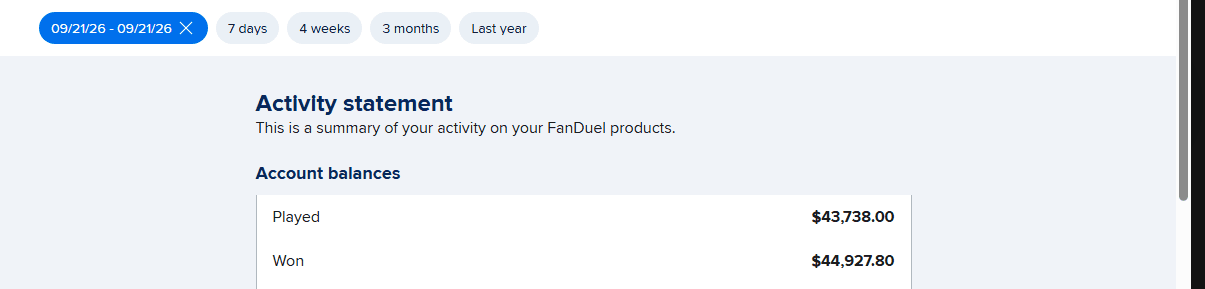
The reason any of this math is worth trusting is not a marketing claim — it is a decision the sportsbooks made about us. All six major U.S. books, FanDuel, DraftKings, Caesars, BetMGM, Fanatics, and ESPN BET, have limited our accounts after our live betting produced more than $367,520 in verified profit. Books do not restrict customers who lose. The limits are the proof that the price-first approach on this page actually beats their numbers over time.
Risk-Based Unit Sizing: Why “One Unit” Is a Different Dollar Amount Every Night
The most expensive habit a baseball bettor can carry over from football is fixed-return sizing — betting to win the same amount every time. Bet to win $100 on a -200 favorite and you are risking $200. Do the same on a +140 dog and you are risking about $71. Chain a few heavy favorites together on a rough night and a “normal” card can put four or five percent of your bankroll in the fire without you ever deciding to gamble that much.
We size by dollars at risk instead. A one-unit play is a fixed amount of money exposed, full stop, whether the price is -190 or +125. That keeps daily downside flat and stops the moneyline structure from silently inflating position size on chalk-heavy slates. Every release includes the specific dollar figure to risk against a $1,000 reference bankroll, not a vague “1 unit,” because the translation from unit to dollars is exactly where undisciplined baseball bettors go broke.
- Risk-based sizing that fixes dollars exposed, not dollars to win, across every moneyline price
- No-vig fair-line conversion on every game so the projection beats the real number, not the padded one
- A minimum four-point edge and positive expected value required before any play is released
- Run-line conversion reserved for projected multi-run mismatches, not used to cheapen chalk
- A hard cap on daily baseball exposure so one ugly slate cannot erase a profitable month
Get Priced-Right Baseball Picks All Season Long
Opening Day through the World Series. Every play converted to a no-vig number, sized by dollars at risk, and released only when the expected value clears our threshold. Six sportsbooks limited our accounts; here is what those numbers look like on your side.
View Packages & PricingThe Six-Month Arc: April and September Are Different Betting Sports
Baseball is the only major sport with a six-month regular season, and the market is not the same market in month one as it is in month six. April lines lean heavily on preseason projections because two weeks of games cannot outvote a winter of modeling — which is exactly why April prices are soft and why we bet it lightly and skeptically. By late May the market has calibrated to real performance and the fattest edges thin out. June and July are the grind: modest, repeatable EV plays at volume, where discipline compounds and boredom is the enemy.
Then the roster math fractures. In August and especially September, contenders run their best arms on full rest while eliminated clubs hand innings to September call-ups and rest veterans for next year. The talent gap between two rosters wearing the same uniforms as they did in June can be enormous, and the moneyline is often slow to fully price it. Our release frequency deliberately tracks that curve — cautious in April, disciplined through the summer, most aggressive in September when the widest inefficiencies of the year open up.
Where Baseball Value Actually Lives: The Plus-Money Underdog Band
If you plotted our profit by price range, it would spike hard in one place: underdogs priced between about +110 and +150. These are not hail-mary upsets. They are close matchups where the favorite holds a genuine but modest edge that the market has rounded up a little too far, usually because a recognizable team or a name-brand starter is drawing casual money. At +130 the implied number is 43.5 percent; if our projection lands the dog at 48 or 49 percent, the expected value is large and the downside is a single unit of risk.
The mirror image is the heavy-favorite trap. A -230 favorite has to win 70 percent of the time just to turn a real profit after the vig, and almost no baseball matchup is that lopsided over one game — the worst team in the league still beats the best a third of the time on any given night. We rarely touch anything priced at -180 or higher on the moneyline; when we love a favorite that big, the run line or a first-five-innings play usually offers a far better number for the same read.
Five Market-Structure Angles That Have Paid for Two Decades
These are not scouting reads — the MLB picks desk owns pitcher and park analysis. These are structural quirks of how the baseball market is priced, and each one has survived because it rests on a knowable number the closing line still rounds wrong.
1. Bet the first five innings to isolate the pitcher you actually rated
When our edge is the starting pitcher, the full-game moneyline forces us to also bet two shaky bullpens we have no opinion on. The first-five-innings (F5) market removes that noise entirely — you get graded on the starters and the top of the order, the exact matchup we handicapped. On the days our read is “this arm is badly mispriced,” F5 is often a cleaner number than the nine-inning line and keeps a seventh-inning meltdown from erasing a correct call.
2. Fade the public over-lean on marquee offenses
Recreational money loves the over and loves watching stars hit, so totals in nationally followed games — Yankees, Dodgers, Braves — get nudged up by sentiment more than by run environment. The unders in those spots carry small, persistent value, especially in pitcher- friendly parks and cooler months. It is not a scouting edge; it is a standing bias in where the public's money goes.
3. Attack the trade-deadline pricing lag in early August
The late-July deadline reshuffles rosters faster than the market re-rates them. Sellers field lineups with three unfamiliar names; buyers slot new arms into the rotation mid-week. For a few days in early August the moneyline is still quoting the pre-deadline roster, and that lag between the transaction and the re-priced line has been one of our most reliable windows of the year.
4. Shop the number harder than in any other sport
Because baseline prices are so wide, the gap between the best and worst available number on the same game is larger in baseball than anywhere else. Taking a dog at +145 instead of +135 across a full season is worth more than most bettors' entire handicapping edge. We flag the target price on every release, but line shopping across multiple books is the single most valuable free habit a baseball bettor can build.
5. Wait for the lineup card — always
A projected lineup is worthless. A rest day for a middle-of-the-order bat, a backup catcher who cannot hit big-league pitching, or a reshuffled order can move a run-total projection by five to ten percent. We never release a baseball play before the lineup is confirmed, and we hold explicit alerts to revoke a pick if a starter is scratched after posting. In baseball, the lineup is the bet.
What Lands in Your Inbox
Baseball picks release after lineup cards are confirmed — typically between 1:00 and 2:30 PM Eastern for night games and by 10:30 AM for day-game slates. Each one carries the recommended side and bet type, the market-implied probability of the price, our projected probability, the expected-value figure, and the exact dollar amount to risk against a $1,000 reference bankroll. Nobody should place a baseball bet without seeing the number that justifies it.
You will also see, in plain language, whether the edge lives on the moneyline, the run line, a first-five-innings play, or a total, and why one market was chosen over the others for that specific game. When the whole board prices out inside our threshold, the card is empty — and an empty card is a result, not a failure. For a single-ticket swing on the same games, the parlay picks page covers how we combine plays without giving the edge back to the book.
Read the Record in ROI, Not Win-Loss
Our baseball results live on the results page and we publish them in dollar-adjusted ROI on purpose, because a win-loss record is close to meaningless in a moneyline sport. A 51-49 season at an average price of +125 is wildly profitable. The identical 51-49 at -150 is a disaster. We show both the record and the ROI so you can audit us through the only lens that matters over 162 games: the dollars actually compounded. Losing weeks are published next to winning ones, because a record with the bad stretches removed is a highlight reel, and the industry is full of them.
Baseball is a long-sample sport — judge it across a season, not a weekend, and compare the documented ROI against the cost of a subscription. For the game-by-game scouting behind the numbers, the MLB picks page covers the pitcher, bullpen, and park work; for how baseball fits a year-round card, the sports picks hub lays out every sport we cover.
The Best Bet on Sports · 1.5M followers on TikTok
Sports Betting TikTok is the live betting account behind The Best Bet on Sports, covering NFL, NCAAF, NBA, NCAAB, MLB and WNBA markets in real time. The account has been limited on all six major U.S. sportsbooks — FanDuel, DraftKings, Caesars, BetMGM, Fanatics and ESPN BET — for winning on live betting, with $367,520 in verified profit since 2005. View full profile →
Past results do not guarantee future performance. Must be 21 or older to wager.
Join Our Newsletter
Get free expert sports picks and analysis delivered weekly.
Frequently Asked Questions
What factors matter most for baseball picks today?
Starting pitching is the single biggest factor in any baseball game. Beyond the starters, bullpen availability over the previous three days, platoon splits against left-handed and right-handed lineups, ballpark dimensions, altitude, and real-time weather data like wind direction and humidity all influence the outcome. At The Best Bet on Sports, every baseball pick weighs each of these elements before a recommendation is released.
Are moneyline or runline bets better for MLB games?
Moneyline bets are the standard approach because so many baseball games are decided by one or two runs. Runline bets at -1.5 can offer strong plus-money value on heavy favorites, but they carry more risk. We analyze each matchup individually and recommend the bet type that presents the best expected value rather than defaulting to one approach.
How many baseball picks do you release per day?
During the MLB season we typically release between one and three baseball picks per day. With up to fifteen games on a full slate, selectivity is everything. We only release plays where our analysis shows a clear edge over the posted line rather than forcing action on every game.
How does weather affect MLB betting picks?
Wind direction and speed at outdoor stadiums significantly influence game totals. Outward-blowing wind at a park like Wrigley Field can add multiple runs to the final score, while inward wind suppresses scoring. Humidity and temperature also affect ball flight distance. We incorporate real-time weather data into our projections for every outdoor game on the slate.
When is the best time to bet on baseball games?
Line movement in baseball tends to be sharpest in the morning once lineup cards are confirmed and late-breaking injury news hits the wire. We release picks after lineups are posted so our subscribers get analysis based on the actual players in the game, not projected lineups that can change at the last minute.
Do you cover MLB playoffs and World Series?
Absolutely. Our MLB coverage runs from Opening Day through the World Series. Postseason baseball requires different analysis because bullpen usage changes, travel days affect pitching rotations, and the pressure of elimination games introduces situational factors that do not exist during the regular season. We adjust our models accordingly for every round of the playoffs.