How to Choose a Live Betting Service: A Buyer's Guide for $199+ Monthly Subscriptions

Choosing a live betting service requires evaluating five concrete criteria — verified profit history, delivery speed, sportsbook coverage breadth, transparent pricing, and whether the operators are limited by the books. Most paid pick services fail at least three of these tests, which is why most subscribers churn within two months. The Best Bet on Sports clears all five and has built +$367,520 in verified profit across two decades.
Choosing a live betting service is a buyer's-guide decision that comes down to five concrete criteria — verified profit history, delivery speed, sportsbook coverage breadth, transparent pricing without bait-and-switch upsells, and whether the operators are actually limited by the major books for winning too much. Most paid pick services fail at least three of those five tests, which is the structural reason most subscribers churn within two months. The Best Bet on Sports clears all five criteria and has built +$367,520 in verified profit across two decades of sports handicapping — the longest-running record any retail subscriber can audit before signing up for the $199 first month.
The retail sports betting market is now larger than the U.S. movie box office, and the live betting subscription category is the fastest-growing slice of that market. Hundreds of services advertise live picks. Most of them are recreational-handicapper Discord rooms with no verified track record, no real sportsbook exposure, and no infrastructure to deliver picks fast enough for live betting to actually work. A small number of services have real handicapping infrastructure built around live betting. The difference between the two groups is enormous, and the cost of getting the choice wrong is two months of $199 subscription fees plus the bankroll damage from picks that arrive after the line has moved.
This guide walks through the five criteria that actually separate a real live betting service from a recreational pick room, the questions to ask before paying for any subscription, and what a $199-per-month live betting product should actually deliver in practice. For broader context, see our free vs paid sports picks comparison, our is paying for sports picks worth it breakdown, and the sports picks service vs doing it yourself framework.
The Five Criteria That Actually Matter
The live betting service market is dense with marketing claims and thin on auditable data. The five criteria below cut through the noise because each one is either verifiable independently or directly impacts whether a live pick actually has betting value when it arrives in your phone.
| Criterion | What to Verify | Red Flag |
|---|---|---|
| Verified profit history | Multi-year audited track record with screenshots | Vague "winning record" claims, no documentation |
| Delivery speed | Sub-30-second alert to phone via Email and Discord | Email-only delivery, no Discord option |
| Sportsbook coverage | Operators limited at all six major U.S. books | Service still betting freely on FanDuel/DraftKings |
| Transparent pricing | Fixed monthly price, no upsell tiers | $25 "trial" that converts to $300+ monthly |
| Live betting infrastructure | Real-time pick delivery during games | Pregame picks repackaged as "live" |
A service that clears all five criteria is rare. A service that clears three of five is the realistic ceiling for most paid services on the market. A service that clears one or fewer should be skipped regardless of the marketing copy.
Criterion 1: Verified Profit History
The single most important criterion in any live betting service evaluation is whether the operators can show you a multi-year verified profit record. The verification has to be auditable — sportsbook screenshots with date stamps, multi-year totals, win-loss documentation at the individual pick level. A "we have been profitable for years" claim with no documentation is the equivalent of no claim at all.
The reason this matters is that live betting is a high-variance subset of an already high-variance business. A single profitable month is statistical noise. A single profitable year is meaningful but not proof. A multi-year verified record that survived multiple sports seasons, multiple market structures, and multiple sportsbook adjustments is the only sample size that establishes actual edge.
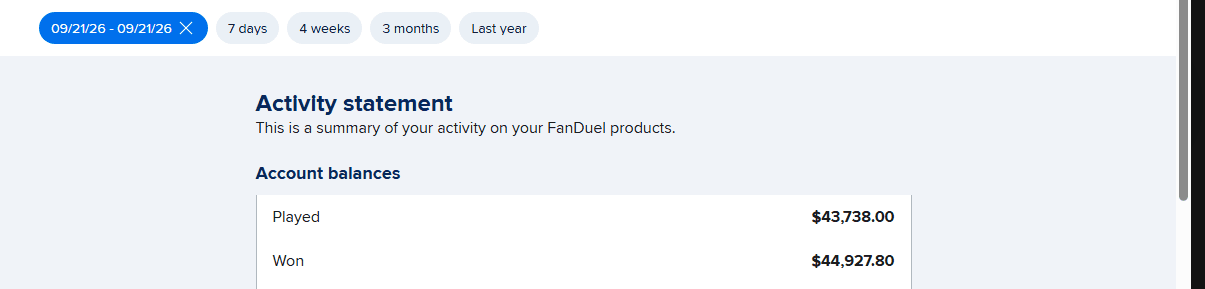
The Best Bet on Sports has documented +$367,520 in verified profit across all sportsbooks over two decades. The documentation is the verified profit record and is available before any subscription decision is made. The two-decade timeframe is meaningful because it spans the pre-mobile, mobile-launch, and post-PASPA-repeal eras of U.S. sports betting — three structurally different market environments — and the profit accumulated across all three. That structural breadth is what separates a verified track record from a marketing claim.
Criterion 2: Delivery Speed
Live betting is the only category of paid pick service where delivery speed is a hard requirement, not a nice-to-have. The reason is that live betting lines move in seconds. A live in-game total over that opens at +105 can move to -110 in 30 seconds and to -125 in 90 seconds. A pick delivered 5 minutes after the analyst spotted the edge arrives at a line that has already absorbed the move, which means the subscriber pays the worse price and captures less of the edge.
The delivery speed requirement makes email-only delivery structurally inadequate for live betting. Discord delivery via direct phone alert and Discord delivery via real-time push notification are the only channels fast enough to capture live betting edge before it disappears. The Best Bet on Sports delivers every live pick simultaneously across email and Discord for exactly this reason — the multi-channel push ensures the subscriber sees the pick on whichever device is in their hand the moment the edge appears.
If a service offers email-only delivery, or if Discord is an "upgrade tier" rather than a base feature, the service is structurally not built for live betting. It is a pregame pick service rebranded with live language, and the actual product experience will reflect that mismatch.
Criterion 3: Sportsbook Coverage and Limited Status
This is the criterion that separates the small number of real live betting services from the large number of recreational ones. The sports betting market structure is that every major U.S. sportsbook limits accounts that win consistently. The limit can be a wager-size cap (max bet $50 instead of $5,000), a market-restriction cap (no live betting available), or an account closure outright. Sportsbook risk teams identify winning accounts via wager pattern analysis, closing-line value, and live betting hit rate, and the limits typically arrive within 30-to-180 days of sustained winning.
A live betting service that has been operating profitably for more than two years and is not limited by the major books is, structurally, not winning. The math is unavoidable — sustained live betting profit at any reasonable wager size produces a profile the sportsbook risk algorithms identify, and the limits follow. The presence of limits across multiple major books is the most reliable third-party verification of live betting profitability that exists.
The Best Bet on Sports is limited on all six major U.S. sportsbooks — FanDuel, DraftKings, Caesars, BetMGM, Fanatics, and ESPN BET. The limits are documented and are the structural reason our service exists in the form it does. Members get the live picks because they can place them at full wager size at sportsbooks the operators can no longer use. That alignment of incentives — operators provide picks they can no longer monetize themselves, members place picks at sportsbooks that have not yet limited them — is the structural fit that makes the subscription model work.
A service operating without that alignment — that is still betting freely at every major book — is either not winning at the levels they claim, or is wagering at levels too small for the sportsbook risk algorithms to flag, which means the picks are not at the volume or sizing the marketing implies.
Criterion 4: Transparent Pricing
The retail pick service market is dense with bait-and-switch pricing — a $25 "trial" that converts to $300 monthly after the trial expires, a $99 "package" that requires upsells to access live picks, a "free" Discord that locks the actual picks behind a separate $500 upgrade. The transparent-pricing criterion is whether the price you see is the price you pay, with no hidden upsells and no auto-renewal traps.
The Best Bet on Sports current pricing is fixed and transparent:
| Package | First Month | Recurring Monthly |
|---|---|---|
| 1-Unit Live Betting | $199 | $299 |
| 2-3 Unit Expert Live | $299 | $500 |
| VIP 5-Unit Live | $500 | $1,000 |
The first-month discount is the only pricing variation. There are no upsell tiers, no separate "live betting" charges on top of a base subscription, no hidden Discord upgrades. The package you select is the package you receive, billed at the listed first-month and recurring prices. The signup page shows the same prices that appear on every blog page, every landing page, and every email follow-up.
The dead-trial pricing some services use ($99 trial, $25 trial, $1 trial) is structurally problematic because the trial price is below the operating cost of delivering the service, which means the trial is a customer-acquisition loss leader that the service has to recoup through aggressive auto-conversion to monthly billing. The Best Bet on Sports operated a $99.95 trial through April 2026 and discontinued it on May 3, 2026 because the structural economics of trial-to-conversion did not produce subscriber experiences that matched the verified track record of the service. The current $199 first-month price is the entry tier and reflects the actual cost of operating a live betting service at the documented profit level.
Criterion 5: Live Betting Infrastructure
The final criterion is whether the service is actually operating as a live betting product or whether it is a pregame pick service marketed with live language. The distinction is operational — a live betting service delivers picks during games in response to in-game state, while a pregame service delivers picks before games based on pregame handicapping. The two are structurally different products that happen to share marketing vocabulary.
The infrastructure markers of a real live betting service:
- In-game pick delivery. Picks arrive during the game, not before. The pick timestamp is meaningful — a pick delivered at 9:47 PM during an NBA third quarter is structurally different from a pick delivered at 6:30 PM before tip-off.
- Live market specificity. Picks reference live betting markets — live total, live spread, live moneyline, live player props — not pregame markets.
- Multi-sportsbook line shopping. Picks include the recommended sportsbook for the specific live market, accounting for which book moves slowest on which market type.
- Entry window guidance. Picks include the entry window — the possession range or game-state window within which the pick remains a live edge.
- Game-state context. Picks reference the specific in-game trigger — foul state, rotation change, pace shift, lineup change — that created the live edge.
The Best Bet on Sports delivers picks with all five infrastructure markers because the service was built specifically around live betting from inception. The picks reference the live triggers, the entry windows, the sportsbook recommendations, and the live market types. The infrastructure is the reason the service has been able to operate profitably across two decades despite the limits the sportsbooks have applied — the infrastructure produces picks at a hit rate the live model lag allows the subscriber to capture.
Questions to Ask Before Subscribing
Before paying for any live betting service, the questions to ask:
1. Can you show me the multi-year verified profit record with sportsbook screenshots? 2. What is the average pick delivery time during games — sub-30 seconds, or longer? 3. Which sportsbooks have you been limited at, and can you show me the limit notifications? 4. Is the subscription price the final price, or are there upsell tiers above what I am paying? 5. What percentage of picks are delivered during games versus before games?
A service that answers all five with verifiable documentation is structurally rare. A service that answers three of five with documentation is the realistic upper-end of the market. A service that deflects on more than two of these questions should be skipped regardless of the marketing or the testimonials.
We go deeper on the related market in whether you can use a live betting service in your state.
Why the Subscription Model Works for Live Betting Specifically
Live betting is the one category of sports betting where a subscription model has a structural fit with the bettor's needs. Pregame handicapping picks can be delivered via blog, podcast, or weekly newsletter because the lines do not move minute-by-minute and the picks are stable across the hours between delivery and bet placement. Live betting picks have to be delivered in real time, which requires infrastructure — a Discord server, an Discord platform, an analyst team in front of multiple games simultaneously — that costs money to operate continuously.
The $199-per-month price point reflects the actual cost of delivering that infrastructure to a member base. A service charging $25 monthly cannot operate that infrastructure profitably, which is why the $25 services either fail to deliver real live picks, fail to maintain the Discord infrastructure, or upsell aggressively to a higher tier that brings the effective price back up to the $200-to-$400 range.
The Best Bet on Sports tested multiple pricing models across two decades and converged on the current $199 first month / $299 recurring structure because it is the price point that aligns the operating cost of the live betting infrastructure with the actual subscriber value created by the picks. The math is transparent and the price is what it is.
Frequently Asked Questions
How much should a live betting service cost?
A live betting service with real infrastructure — multi-channel delivery, sub-30-second pick speed, multi-sportsbook line shopping, in-game pick delivery — has an operating cost that maps to a $200-to-$500 per month price range at sustainable subscriber volume. Services priced below $100 monthly typically lack the infrastructure to deliver true live picks. Services priced above $500 monthly are usually positioned as high-unit "VIP" tiers that include more picks rather than structurally different infrastructure. The Best Bet on Sports' 1-Unit Live Betting package is $199 first month, $299 recurring — the entry price for a service with all five infrastructure markers.
Are live betting subscriptions worth it?
A live betting subscription is worth it when the service's verified profit record is documented, the delivery speed matches the live market's pace, and the price reflects the actual value of the picks. For a bettor wagering $100 units across 30-to-50 live picks per month, a service hitting 56-to-58% on those picks produces a meaningful bankroll gain that exceeds the $199-to-$299 monthly fee. For a bettor wagering $25 units across 5-to-10 picks per month, the math is closer and depends on the specific hit rate. The break-even calculation is straightforward: monthly subscription fee divided by typical wager size equals the units the subscriber needs to net per month to break even on the subscription cost.
How do I know if a live betting service is legitimate?
The most reliable single test of a live betting service's legitimacy is whether the operators are limited by the major U.S. sportsbooks. Sportsbook limits arrive when an account wins consistently, and the limits are the third-party verification that the service's picks have real edge. A service that has been operating for years and is not limited at any major book is, structurally, not winning at the volume their marketing implies. A service limited across multiple books has documented evidence of sustained winning at meaningful volume.
Can I cancel a live betting subscription?
Subscription cancellation policies vary by service. The Best Bet on Sports' subscription cancellation is straightforward — members can cancel through the subscriber portal or by contacting support at any time, and the cancellation takes effect at the end of the current billing cycle. The first-month price is for the first 30 days of access, and recurring billing applies to subsequent months only if the member does not cancel. Members are not locked into long-term contracts.
What does a typical live betting pick look like?
A typical Best Bet on Sports live betting pick includes the live market type (live total, live spread, live moneyline, or live player prop), the specific line and price, the recommended sportsbook for that market, the entry window (typically a possession range or game-state window), the unit size (1-unit, 2-3 unit, or VIP 5-unit based on the subscriber's package), and the in-game trigger that created the live edge. Picks are delivered through Discord, and email simultaneously to ensure the subscriber sees the pick on whichever device is in their hand.
How many live picks do I get per month?
Pick volume varies by sport season and game schedule. During a high-volume period (Sundays full of NFL picks, NBA picks on playoff weekends, MLB peak season), the 1-Unit Live Betting package typically delivers 40-to-80 live picks per month. During a lower-volume period (NFL bye weeks, NBA all-star break, MLB off-season), the volume drops to 15-to-30 live picks per month. The pick volume is calibrated to the actual edge available in the live betting market, not to a fixed monthly quota — a service that promises a fixed pick count regardless of market conditions is structurally not selecting picks for edge.
How do I sign up for The Best Bet on Sports?
The signup process is straightforward. Visit the packages page, select the package that fits your unit size and pick volume needs (1-Unit Live Betting at $199 first month, 2-3 Unit Expert Live at $299 first month, or VIP 5-Unit Live at $500 first month), and complete payment through PayPal. Discord access and Discord enrollment are sent to the email address on file immediately after payment confirms. The first live pick typically arrives within the same sports day as signup, depending on game schedule and live betting opportunity windows.
Choosing a live betting service is a buyer's-guide decision that rewards careful evaluation against the five criteria — verified profit history, delivery speed, sportsbook coverage, transparent pricing, and live betting infrastructure. The retail market is dense with services that fail multiple criteria, which is why most subscribers churn through multiple services before finding one that delivers. The Best Bet on Sports has built the operating model across two decades, and the +$367,520 in verified profit combined with the six-major-book limited status is the third-party evidence that the model works as intended. The first month at $199 is the entry tier for a service that clears all five criteria, and the recurring $299 monthly reflects the actual cost of delivering the live betting infrastructure that produced the verified record.
The Best Bet on Sports · 1.5M followers on TikTok
Sports Betting TikTok is the live betting account behind The Best Bet on Sports, covering NFL, NCAAF, NBA, NCAAB, MLB and WNBA markets in real time. The account has been limited on all six major U.S. sportsbooks — FanDuel, DraftKings, Caesars, BetMGM, Fanatics and ESPN BET — for winning on live betting, with $367,520 in verified profit since 2005. View full profile →
Past results do not guarantee future performance. Must be 21 or older to wager.
Related Articles
What a $199 Live Betting Pick Service Actually Delivers (Honest Breakdown)
$100 to $500: 4-Leg Parlay Strategy That Doesn't Bust Your Bankroll
Middling and Scalping Sports Bets in May 2026: How to Lock Edge When Lines Move
Correlated Parlay Strategy in Sports Betting: How to Stack Game Total, Player Props, and Team Totals for May 2026 Edge
In-Game Hedging vs Letting It Ride in Live Sports Betting in May 2026: When to Lock Profit and When to Hold
Do You Need Betting Experience to Use a Live Betting Service?
Get real live betting picks
From $39.95/mo · Cancel anytime · Email + Discord delivery
● Get The Picks
Choose your package
Tap any tier below to select · Subscribe in one tap
👇 Tap any package to select it
✓ You're selecting
25 Units · $99.95/month
25 unit picks per month. Sweet spot for most bettors — plenty of action without going all-in.
- ✓25 live betting selections/month
- ✓Email + Discord delivery
- ✓All sports (NFL, NCAAF, NBA, NCAAB, MLB)
- ✓Mix of 1, 2, 3, 5-unit rated plays
- ✓Cancel anytime
Secure PayPal · Cancel anytime · No hidden fees · 21+ · +$367K verified
+$367,520 verified · Limited on 6 sportsbooks · 20 years documented · See Proof
Join Our Newsletter
Get free expert sports picks and analysis delivered weekly.