Professional Football Handicapping — How the Number Actually Gets Built
By Sports Betting TikTok
Football handicapping is the process of building an independent projected spread and total for a game, then betting only where that number disagrees with the sportsbook by more than the juice costs. It requires neutral-field power ratings, a home-field constant, key-number awareness, and separating stable metrics from noise. The Best Bet on Sports has run this process for 20 years — and six major sportsbooks have limited our accounts because of it.
Most football content tells you who is going to win. That is a prediction, not a handicap. A handicap is a number — a specific projected margin and a specific projected point total, produced before you ever look at what the sportsbook posted. The bet is the gap between those two numbers, and nothing else. If the gap is smaller than the cost of the vig, there is no play, no matter how confident the analysis feels.
This page is the methodology behind that process at The Best Bet on Sports: how a football spread is constructed from the ground up, why key numbers make football a fundamentally different handicapping problem than basketball or baseball, which statistics actually carry from week to week, and where a completed handicap turns into an actual wager. If you want the weekly card itself, that lives on our football picks page.
Membership
Get the picks
Live betting picks across NFL, NCAAF, NBA, NCAAB, MLB and WNBA — delivered by Email and Discord the moment we spot value.
● Get The Picks
Choose your package
Tap any tier to select · Subscribe in one tap
👇 Tap any package to select it
✓ You're selecting
25 Units · $99.95/month
25 unit picks per month. Sweet spot for most bettors — plenty of action without going all-in.
- ✓25 live betting selections/month
- ✓Email + Discord delivery
- ✓All sports (NFL, NCAAF, NBA, NCAAB, MLB)
- ✓Mix of 1, 2, 3, 5-unit rated plays
- ✓Cancel anytime
Secure PayPal · Cancel anytime · No hidden fees · 21+ · +$367K verified
A Football Spread Is Two Power Ratings and a Home-Field Constant
Every spread on the board reduces to a piece of arithmetic. Each team carries a neutral-field power rating expressed in points. Subtract the visitor's rating from the home team's, add the home-field constant, and the result is your projected spread. If the home team rates 4.5 points better on a neutral field and home field is worth 1.8 points, your number is home team minus 6.3. When the sportsbook posts minus 4.5, you have a 1.8-point disagreement to investigate.
The entire craft lives inside those two inputs. The home-field constant is the easier of the two, and it is one of the places where handicappers using stale assumptions bleed money. Home field in the NFL was worth close to three points for decades. It is not anymore — it has compressed toward the 1.5 to 2 point range as travel, sleep science, officiating standardization, and crowd-noise rules have all moved against the host. A model still crediting three points to every home team is systematically overpricing favorites across the entire slate, every single week.
Rating a Team Means Rating Its Drives, Not Its Box Scores
The power rating itself is built from efficiency, not accumulation. Total yards per game is a pace statistic in disguise — a team running 70 plays will out-gain a team running 55 while being the worse football team. We rate on expected points added per play and success rate on both sides of the ball, adjusted for opponent strength, because those are the measures that describe how well a team actually plays each snap rather than how many snaps it happened to get.
Opponent adjustment is not optional. A defense that has faced three of the league's worst offenses in September will look elite in raw numbers and rate out ordinary once schedule is accounted for. Every September, the market takes several weeks to fully digest this, and the teams with soft early schedules get overpriced. That lag is one of the cleanest structural windows in the football calendar, and it is a recurring source of value in our NFL picks during the season's first month.
Key Numbers Are Why Football Handicapping Is Not Basketball Handicapping
Football scores in threes and sevens. That single fact makes the distribution of NFL final margins violently lumpy rather than smooth, and it changes how every half point should be valued. Roughly one in seven NFL games finishes with a margin of exactly three points. Seven is the next-densest number, then ten, six, and fourteen. A basketball game can end on any margin with roughly equal probability. A football game cannot, and a handicapper who treats a spread move from minus 2.5 to minus 3.5 as equivalent to a move from minus 5.5 to minus 6.5 does not understand the sport's math.
This is why the sportsbooks price half points asymmetrically. Buying off three typically costs 20 to 25 cents of juice, while buying off eleven costs the standard dime — the book knows exactly how much probability mass sits on that number. When our projection lands at 3.2 and the market is sitting at 2.5, that is a materially larger edge than a 0.7-point disagreement anywhere else on the number line, and it gets weighted accordingly on the card.
Crossing Key Numbers Is Worth More Than Being Right
The practical consequence is that timing and line shopping matter more in football than in any other sport. Taking a home underdog at plus 3 on Friday and watching it close at plus 2.5 means every subsequent bettor on your side is playing a meaningfully worse bet than you are. Over an 18-week season, a handful of key-number captures is frequently the entire difference between a profitable year and a break-even one — which is precisely why our releases go out early enough to use them.
Key-number density is also not constant across the two levels of football, which is a distinction most handicappers miss entirely. NFL margins pile onto three and seven because the games are close and decided by field goals. College margins spread out far more — when a spread is minus 24, the difference between a 27-point win and a 31-point win is noise, and the tight clustering that governs NFL pricing simply does not apply. Carrying NFL key-number instincts onto a college board leads to overvaluing half points on numbers where almost no probability mass actually sits. The bet-type implications of all this, including teasers, are covered on our football betting guides.
- Neutral-field power ratings rebuilt weekly on opponent-adjusted efficiency
- Home-field constant recalibrated to current-era values, not legacy assumptions
- Key-number weighting on every spread disagreement (3, 7, 10, 6, 14)
- Wind-speed modeling on totals for every outdoor venue
- Personnel adjustment by position group after final injury designations
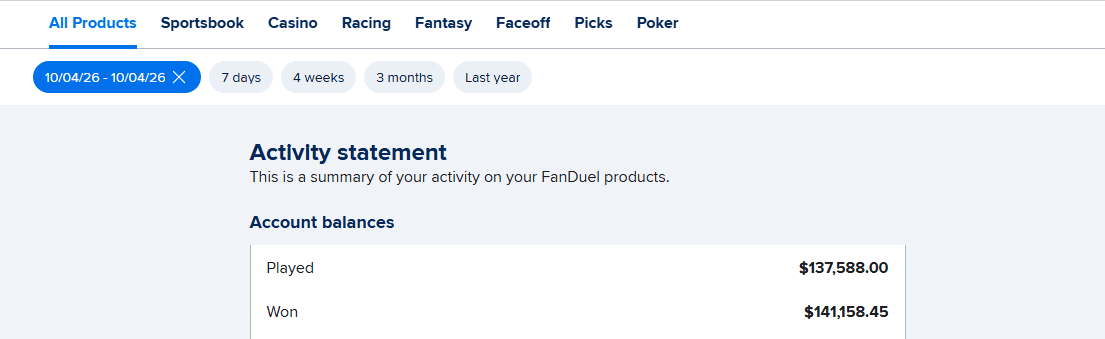
The differentiator behind The Best Bet on Sports football handicapping is not something advertising can produce: account restrictions at every major U.S. sportsbook. FanDuel, DraftKings, Caesars, BetMGM, Fanatics, and ESPN BET have all limited our action because live in-game football wagering was too consistently profitable. That $367,520-plus in verified winnings is a documented result, and the limitations are the receipt.
What Carries Week to Week and What Is Pure Noise
The hardest discipline in football handicapping is refusing to update your rating on evidence that will not repeat. Football gives you a tiny sample — seventeen NFL games, twelve or thirteen in college — and the temptation to treat every result as information is enormous. Most of it is not.
Fumble recovery is the cleanest example. Which team falls on a loose football is close to a coin flip, yet a team that has recovered eight of eleven fumbles will show a gaudy turnover margin, a strong point differential, and an inflated record. The market prices that record. Our ratings deliberately do not, because next week that recovery rate reverts to roughly half and the underlying team quality is exposed. The same logic applies to red zone touchdown conversion rate and to unusually hot or cold field goal kicking — both bounce around heavily on small samples and both drag public perception with them.
Third-down conversion rate deserves particular skepticism. It is one of the most-quoted numbers on a broadcast and one of the least stable. A team converting at a high clip is usually facing shorter third downs rather than executing better on third down specifically, which means the real driver is first and second down efficiency. Rate the down-and-distance the offense is creating, not the conversion rate it is posting, and a lot of apparent late-game magic turns into ordinary football.
What does carry: expected points added per play, success rate, pressure rate generated and allowed, and yards before contact. These stabilize within a handful of games and predict forward performance far better than record or point differential. When a two-win team is posting top-ten efficiency numbers with a negative fumble-luck profile, that team is being sold at a discount for the next month, and buying it is one of the more reliable trades in football.
Get Professional Football Handicapping Picks This Season
Six U.S. sportsbooks have limited our accounts. $367,520-plus in verified profit. NFL and college football coverage from Week 1 through the championship, with the full handicap behind every play.
View Packages & PricingTotals Are Built From Drives, Not From Points Per Game
A football total is a two-part estimate: how many possessions the game will contain, and how many points each possession is worth. Handicappers who work from season points-per-game averages are collapsing those two variables into one and losing most of the information in the process. Two teams averaging 24 points per game can produce wildly different totals depending on whether they get there in nine drives or thirteen.
We project drives first. Offensive tempo, situational pass rate, and how often each offense stays on schedule all feed the possession count — a team that runs the ball on early downs with a lead is actively removing drives from the game. Then points per drive, opponent-adjusted, gets applied to that count. The result frequently diverges from the market number in games where a fast, pass-heavy offense meets a grinding, run-first opponent, because the public reads that matchup as an average of the two styles when the reality is that the slower team controls the possession count.
Wind Is the Only Weather Input That Reliably Moves a Total
Cold weather games get bet under by the public reflexively, and the effect is far weaker than the reputation suggests — offenses in December are not meaningfully worse than the same offenses in October once you control for opponent. Rain is similarly overrated; play-calling adapts and the scoring impact is modest. Wind is the genuine variable. Sustained wind above roughly 15 mph degrades deep passing accuracy and field goal range simultaneously, which removes both the explosive plays and the consolation points from the scoring distribution. That is the forecast condition we model specifically for every outdoor venue, and the one that produces real total value the market has not fully priced.
NFL and College Football Are Two Different Modeling Problems
The two levels share a rulebook and almost nothing else from a handicapping standpoint. The NFL is a closed, 32-team league with a 272-game regular season, compressed talent, and the most intensely priced lines in American sports. Spreads cluster in a narrow band, key numbers dominate, and the work is precision work — you are trying to be right by a half point against a market that is already close to correct.
College football inverts every one of those conditions. The FBS is more than four times the size of the NFL, a Saturday board can carry fifty-plus games, and no trading desk can price them all with equal care. Talent gaps are real and enormous, which pushes spreads into the twenties and thirties where key numbers stop mattering much and blowout variance takes over. The edge in college is rarely a half point on a marquee game — it is a stale number on a Group of Five matchup that nobody at the book had time to sharpen. That difference is why we run entirely separate models, detailed further on our college football handicapping page.
Roster continuity is the other structural split. NFL rosters carry over year to year with predictable turnover, so preseason ratings start from a solid base. College rosters can be rebuilt wholesale through the transfer portal in a single offseason, which makes returning-production metrics far less reliable than they were a decade ago and makes the first three or four weeks of the college season a period where preseason assumptions and on-field reality diverge sharply. That divergence window is the single most profitable stretch of the college calendar.
Where a Completed Handicap Turns Into an Actual Bet
Producing a number is the analysis. Deciding where to express it is a separate skill, and it is where a lot of accurate handicappers leave money on the table. If our projection says a game should be minus 6 and the market has it at minus 6, the side is dead — but the derivative markets built off that same number may not be. First-half lines, team totals, and alternate spreads are all priced off the primary number with less attention and wider margins, and a handicap that identifies a specific mechanism can often be expressed more cleanly there.
The clearest case is a scheme read that applies to part of a game rather than all of it. If the projection is that a heavy pass rush wrecks a compromised offensive line before halftime adjustments arrive, the first-half line captures that thesis far better than the full-game spread does. If the read is that one offense produces points regardless of what the opponent does, a team total isolates that view without needing the game script to cooperate.
The furthest extension of this is live betting, which is where our accounts got restricted. In-game football lines are recalculated by algorithm in seconds, and those algorithms systematically overreact to the most recent drive while underweighting the underlying efficiency picture that produced our pregame number. A team that punts three times to open a game has not become worse; its live price says otherwise. Holding a defensible pregame handicap and knowing precisely how much the live number should have moved is the entire mechanism behind our live betting picks, and it is the reason six sportsbooks decided our action was not worth accepting.
Our Football Handicapping Track Record
Every football play we have released is documented on our results page, broken out by NFL and college, by bet type, and by season. The record includes the losing stretches, because a service that publishes only its good months is not publishing a record at all — it is publishing an advertisement. Football is a short-sample sport and any individual month can run hot or cold regardless of process quality.
The honest way to evaluate a football handicapping service is across full seasons, against the cost of the subscription, with the losing weeks included in the arithmetic. Review the complete record, compare the transparency against anyone else in the industry, and decide whether the math works for your bankroll before you subscribe.
The Best Bet on Sports · 1.5M followers on TikTok
Sports Betting TikTok is the live betting account behind The Best Bet on Sports, covering NFL, NCAAF, NBA, NCAAB, MLB and WNBA markets in real time. The account has been limited on all six major U.S. sportsbooks — FanDuel, DraftKings, Caesars, BetMGM, Fanatics and ESPN BET — for winning on live betting, with $367,520 in verified profit since 2005. View full profile →
Past results do not guarantee future performance. Must be 21 or older to wager.
Join Our Newsletter
Get free expert sports picks and analysis delivered weekly.
Frequently Asked Questions
What does football handicapping actually involve?
Football handicapping is the process of building an independent number for a game and comparing it to the number the sportsbook posted. That means rating both teams on a neutral field, applying a home-field constant, adjusting for personnel and weather, and converting the result into a projected spread and total. A bet only exists when the independent number and the market number disagree by more than the cost of the juice.
How do you handicap NFL games differently from college football?
The NFL is a 32-team league where every roster is professional and the spread distribution is tightly clustered around key numbers, so the work is precision work — a half point matters enormously. College football is a far larger sport with real talent chasms between programs, spreads that run into the thirties, and sportsbook attention spread thin across a huge Saturday board. NFL handicapping is about being right by a half point; college handicapping is about finding the games nobody priced carefully.
How important is weather for football handicapping?
Wind is the only weather variable that consistently moves a football number, and it needs to be sustained above roughly 15 mph before it matters. At that point deep passing efficiency and field goal accuracy both degrade and totals come down. Cold and rain get far more attention from the public than they deserve — teams adjust play-calling and the scoring effect is much smaller than temperature alone suggests. We model wind speed and direction specifically rather than treating all bad weather as one input.
When do you release football handicapping picks?
NFL plays are released after final injury designations are published, typically Friday evening for the Sunday slate and Wednesday for Thursday Night Football. College football plays go out Thursday afternoon for Friday games and Saturday morning for the main slate. The timing is deliberate: it lands after the information that matters is public but before the weekend recreational money pushes numbers through key thresholds.
Do your football picks include totals and moneylines?
Yes. Spreads are the core of the football card because the point spread market is where the most liquid, most repeatedly mispriced numbers live. Totals join the card when pace, drive efficiency, or wind create a projection gap the market has not absorbed. Moneylines appear on underdogs our model gives a materially better outright win probability than the price implies — generally in the +130 to +200 range where the payout justifies the variance.
What is your football handicapping track record?
The football record is published openly on the results page, broken out by NFL and college, by bet type, and by season, including losing stretches. Trust in this business is earned through documented performance across full seasons, not screenshots of winning tickets. Every subscriber is encouraged to audit the record before signing up rather than take a marketing claim at face value.
What makes The Best Bet on Sports different from other football handicapping services?
The credential is one no service can manufacture for itself: FanDuel, DraftKings, Caesars, BetMGM, Fanatics, and ESPN BET have all limited our accounts. Books restrict accounts that beat them, and ours were restricted because live in-game football wagering produced $367,520 in verified profit. Most services can show you a spreadsheet. We can show you six sportsbooks that decided we were a problem.