NFL Week 1 Player Props 2026: How to Attack the Slate
By Sports Betting TikTok
NFL Week 1 player props are the hardest prop slate of the year because there is no current-season data — projections rest on offseason scheme changes, personnel turnover, and camp reports rather than proof. That uncertainty creates value only where a role change is knowable. The Best Bet on Sports, limited on all six major U.S. sportsbooks for winning too much live, attacks the opener in-game via Email and Discord.
NFL Week 1 player props are a market priced almost entirely on projection. There are no current-season snaps to anchor a passing, rushing, or receiving line — the last competitive data is eight months old, and the offseason in between rewrote depth charts, installed new schemes, and moved players into roles they have never played. That is what makes the opener the hardest prop week of the year: the book is guessing, the public is chasing storylines, and the number is a forecast rather than a proven rate. This page covers why Week 1 props are uniquely difficult, where the uncertainty creates value versus a trap, how the market prices the opener without data, and the live in-game edge once Week 1 scripts finally reveal each role — the same workflow that produced $367,520 in verified profit and a limitation on every major U.S. sportsbook.
For the full opening-week card see the NFL picks Week 1 2026 page and the season-long NFL player props pillar. For ongoing weekly coverage see the NFL picks pillar, and for the team's live methodology see the live betting picks page.
How the Team Approaches the NFL Week 1 Player Prop Slate
A Week 1 prop read is not a guess at who scores or who goes over — it is a read on a market that has no current-season data and prices the opener off projections, prior-year baselines, and offseason change. The prop board lists a number for every skill player at once, holds tighter limits than any other week, and rewards finding the roles the market has not repriced for a new scheme or a new depth chart. The sections below walk through why the opener is uniquely hard and where the team concentrates its read. These are general, strategic frameworks — the specific prop reads and live alerts are sent to subscribers via Email and Discord, not posted publicly.
1. Why Week 1 Has No Data to Price Against
Every other week of the season, a prop line is built on current-season usage — snap share, target volume, carry count, and route participation that the book can measure. Week 1 has none of that. The most recent competitive data is eight months old, and the offseason in between is roster turnover, coaching changes, and preseason reps that starters play sparingly and vanilla. The book prices the opener off prior-year baselines and its own projection models, which means the number carries the widest error bars of the year. The team's read starts from that reality: the posted line is a forecast, not a proven rate, and the edge lives in the gap between the projection and how the offense will actually deploy its personnel.
2. Scheme and Coordinator Changes Reshape Every Role
A new head coach or offensive coordinator can move a position's entire usage profile — the offense's pace, its pass rate, how concentrated the target share is, and how it structures early-down work. When the market prices a player off last year's role but the system around him changed, the number is stale before kickoff. This is one of the clearest sources of Week 1 value: an offense that installed a scheme with a known positional tendency, running a player the board still values at his old role. The team's read maps which offenses turned over their play-calling and which positions that specific system historically lifts or suppresses, then looks for the props the market has not adjusted for the change.
3. Personnel Turnover and Where Vacated Volume Lands
Free agency, the draft, trades, and retirements redistribute a fixed pool of targets, carries, and red-zone touches every offseason. That vacated volume is knowable — when a lead receiver, a starting back, or a red-zone target leaves, someone inherits the work — but the market is often slow to fully reprice the beneficiary before the opener. These roster-level shifts are the difference between Week 1 uncertainty that is a value driver and uncertainty that is a trap. A clear beneficiary of vacated volume is a concrete reason a number is stale; a hopeful projection with no roster logic behind it is not. The team commits to the former and treats the latter as a live-market question, not a pregame bet.
4. Role Uncertainty — Value Versus the Trap
Week 1 is defined by role uncertainty, and the entire discipline is telling the knowable from the unknowable. It is a value driver when there is a concrete, roster-level reason the number is wrong — a receiver inheriting vacated targets, a back with a clearer early-down path, an offense whose new system lifts a specific position. It is a trap when the uncertainty is the whole bet: a rookie's debut ceiling, a free agent's first game in a new system, or a snap-share guess dressed up as a read. The team's framework refuses to bet the pure unknowns before kickoff. Those genuine question marks are exactly what the live market is for — the opener itself reveals the usage the projection could only guess at.
5. Reading Camp Reports Without Overtrusting Them
With no game data to work from, camp reports carry outsized attention in Week 1 — and they are useful context, not a standalone thesis. A beat-reporter note on first-team reps, a package a coordinator is installing, or a role a veteran is being groomed for can flag where a prop number may be stale. But starters play limited, vanilla snaps in the preseason, staffs deliberately hide their real game plans, and preseason box scores are compiled largely against backups who will not be on the field in the opener. The team weighs camp signal as one input among prior-year baseline, scheme fit, and depth-chart logic — and lets the opening drives confirm or kill a role before committing anything live.
6. The Live-Betting Edge as Week 1 Scripts Reveal Roles
The pregame read is the map; the live-betting edge is where the repeatable work happens — and Week 1 is the week it matters most. Because the opener is priced without data, the fastest way to know a real role is to watch the game reveal it: who is on the field for early downs, who runs the routes in obvious passing situations, who gets the red-zone looks. The edge is the same one that limited the account on all six major U.S. sportsbooks — reacting to live game script faster than the in-game model reprices the live passing, rushing, and receiving prop menu, the anytime touchdown market, alternate lines, and the live total. On the opener the team keeps pregame exposure light and lets the live market pay, dispatching an alert the moment a role becomes visible and its read diverges from the live number, via Email and Discord.
For related weekly markets see the NFL picks Week 1 2026 page, the season-long NFL player props pillar, and the broader football picks hub. For the full weekly market see the NFL picks pillar.
Six Inputs Behind an NFL Week 1 Player Prop Read
A fair Week 1 prop read weighs far more than last year's box score. The six inputs below are the structural drivers the team weighs when deciding whether an opener prop number carries value — from the limited-data problem that widens every error bar to the live-betting edge once the game reveals each role. None of these are predictions of a specific player's number; they are the framework behind how the team reads the opening slate.
No current-season snaps to anchor a number
Week 1 props are priced without a single competitive rep from the current season. The last real data is eight months old, and everything since is turnover and vanilla preseason reps. That thin foundation is the single biggest reason opener prop lines carry the widest error bars of the year — and the widest gap between projection and reality.
A new system reshapes every role
A new head coach or coordinator can move a position's entire usage profile — pace, pass rate, target concentration, and early-down structure. When the market prices a player off last year's role but the scheme changed, the number is stale before kickoff. The read starts with which offenses installed a system the board has not fully respected.
Vacated volume has to land somewhere
Free agency, the draft, trades, and retirements redistribute targets, carries, and red-zone work. Vacated volume is knowable — someone inherits it — but the market is slow to reprice a clear beneficiary. Those roster-level shifts are where Week 1 uncertainty becomes a value driver rather than a guess.
Knowable shift or hopeful projection
The line between value and trap is whether there is a concrete roster reason the number is stale versus betting a ceiling on faith. A receiver inheriting vacated targets is a read; a rookie's debut ceiling is a dart. The team commits to the knowable and reserves the genuine unknowns for the live market once usage is visible.
Signal, not a standalone thesis
Beat-reporter notes on first-team reps and installed packages flag where a number might be stale, but preseason box scores against backups do not translate to a real projection. Camp signal is one input among prior-year baseline, scheme fit, and depth-chart logic — never the whole bet.
Let Week 1 scripts reveal the roles
The repeatable edge is on the opener itself — keeping pregame exposure light and reacting once the game script reveals who is actually on the field for early downs, the red zone, and obvious passing situations, faster than the in-game model reprices the live prop menu, alternate lines, and live total.
For the rest of the opening card that frames these prop reads see the NFL picks Week 1 2026 page and the live betting picks page. Verified cashed tickets live on the results page.
Membership
Get the picks
Live betting picks across NFL, NCAAF, NBA, NCAAB, MLB and WNBA — delivered by Email and Discord the moment we spot value.
● Get The Picks
Choose your package
Tap any tier to select · Subscribe in one tap
👇 Tap any package to select it
✓ You're selecting
25 Units · $99.95/month
25 unit picks per month. Sweet spot for most bettors — plenty of action without going all-in.
- ✓25 live betting selections/month
- ✓Email + Discord delivery
- ✓All sports (NFL, NCAAF, NBA, NCAAB, MLB)
- ✓Mix of 1, 2, 3, 5-unit rated plays
- ✓Cancel anytime
Secure PayPal · Cancel anytime · No hidden fees · 21+ · +$367K verified
The NFL Track Record That Limited the Account on Six Sportsbooks
NFL is the highest-liquidity U.S. sport at every major operator, and the Week 1 slate carries an enormous volume of player-prop and live-market action as bettors chase opening-day storylines. The lifetime career statements below reflect heavy NFL pre-game and live in-game contribution to the total wagered volume and net profit figures, with the prop-heavy opener among the busiest live-betting days of the year. Limitation on each of these books was driven heavily by NFL live betting performance across multiple seasons.
| Sportsbook | Lifetime Wagered | Net Profit | Account Status |
|---|---|---|---|
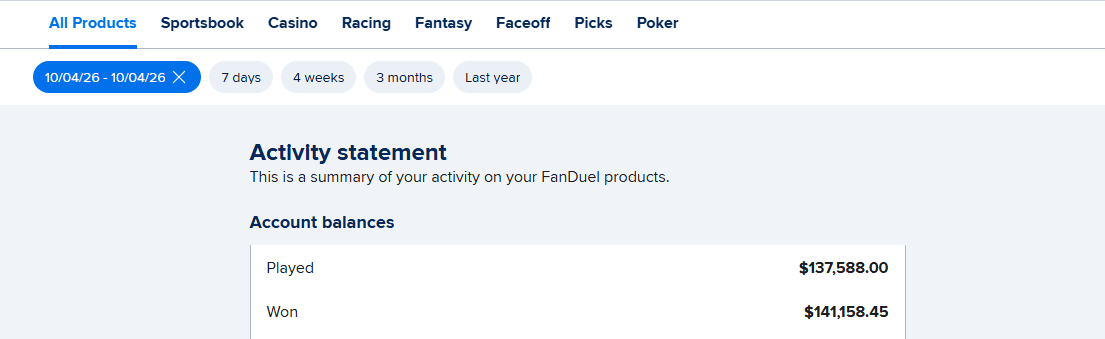
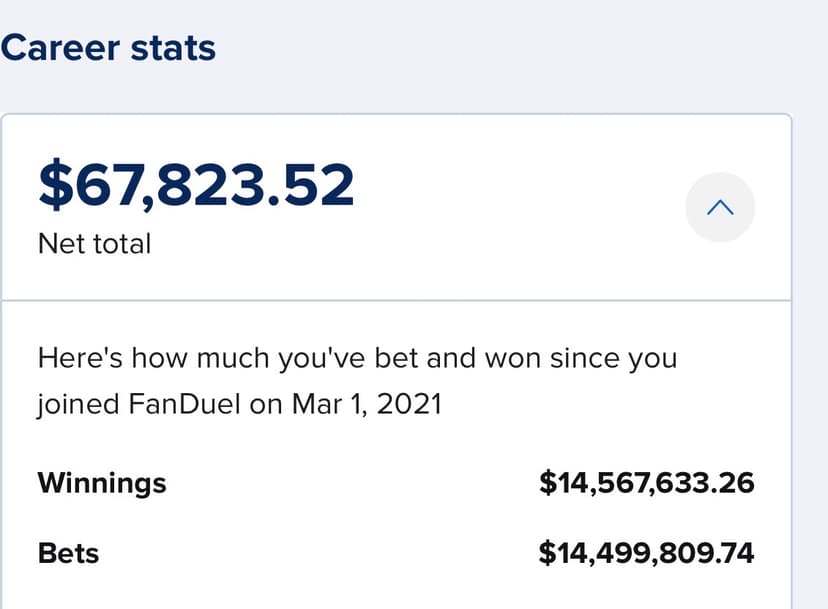
| FanDuel | $14,500,000 | +$67,823 | Limited |
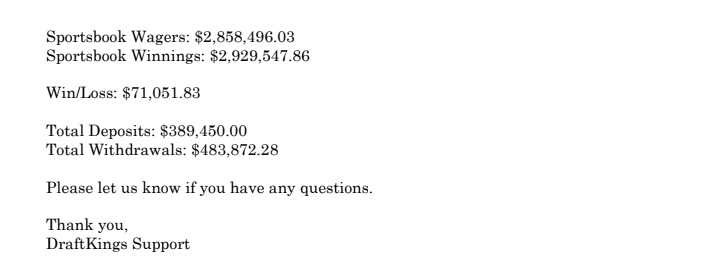
| DraftKings | $2,800,000 | +$71,051 | Limited |
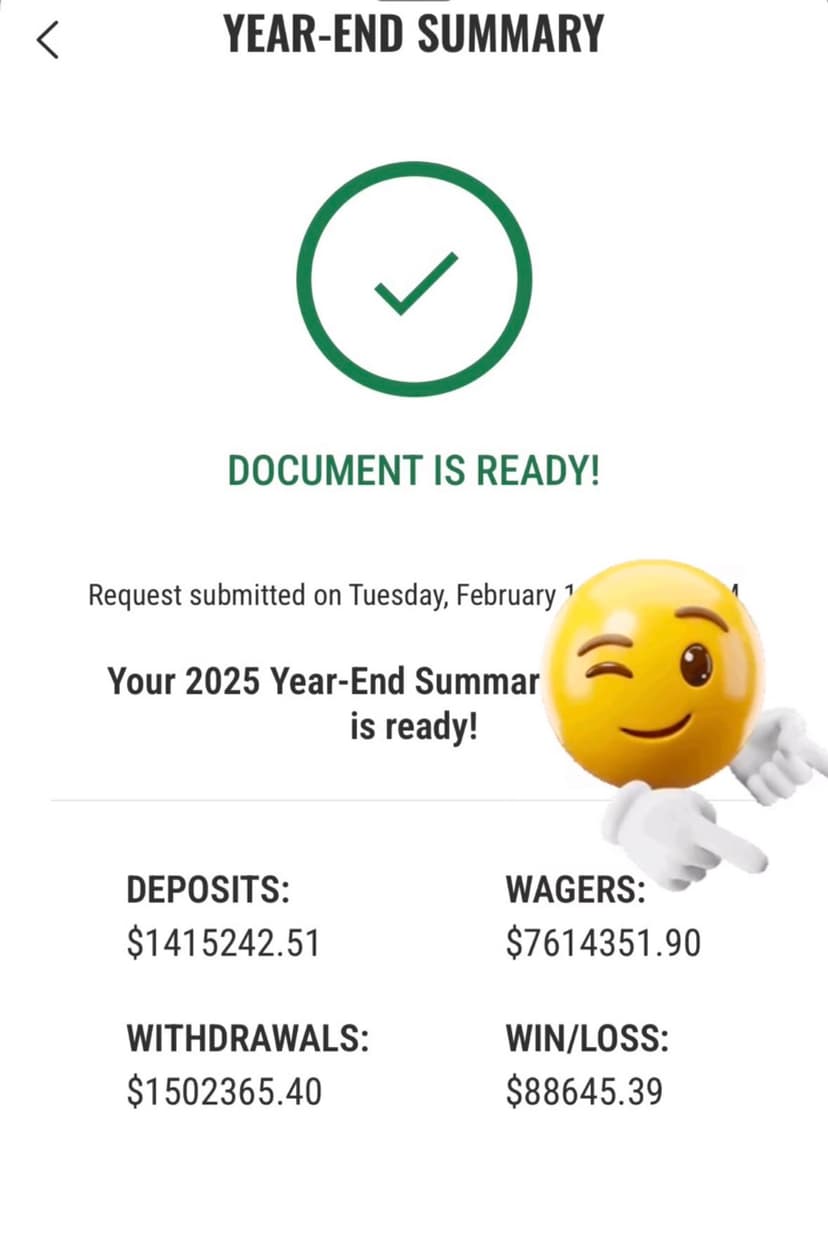
| Caesars | $7,600,000 | +$88,645 | Limited |
| 3-Book Subtotal | $24,900,000 | +$227,519 | All limited |
| All 6 Books Combined | $30M+ wagered | +$367,520 | All 6 limited |
The remaining $140,001 of the $367,520 lifetime figure spans BetMGM, Fanatics, and ESPN BET. Statement screenshots from those three books are archived on the results page.
Verified Live NFL Betting Tickets
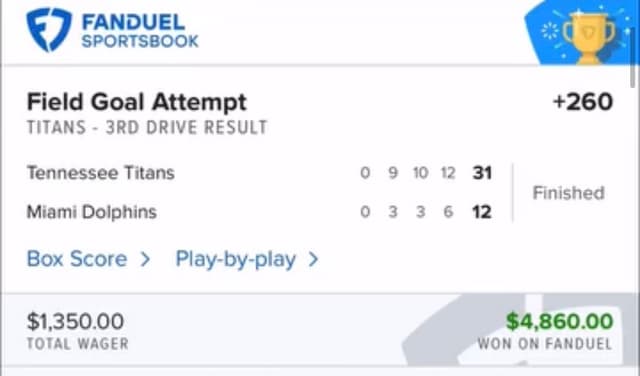
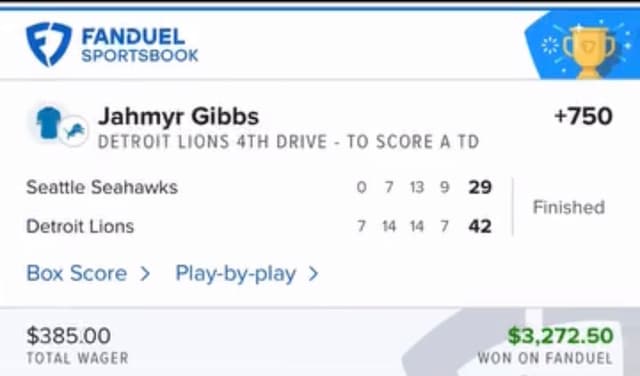
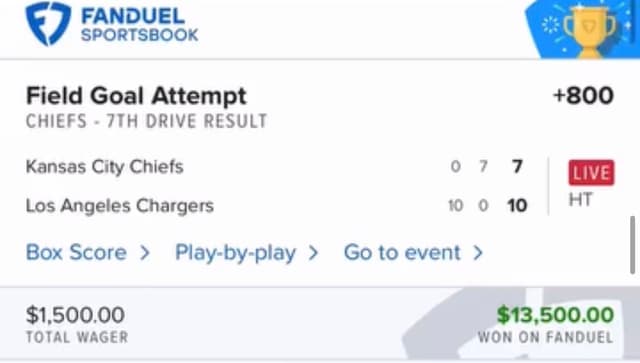
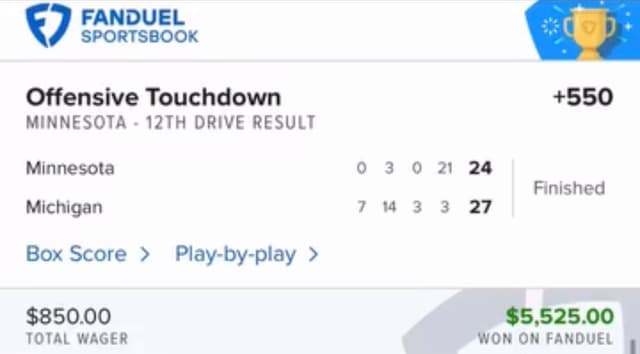
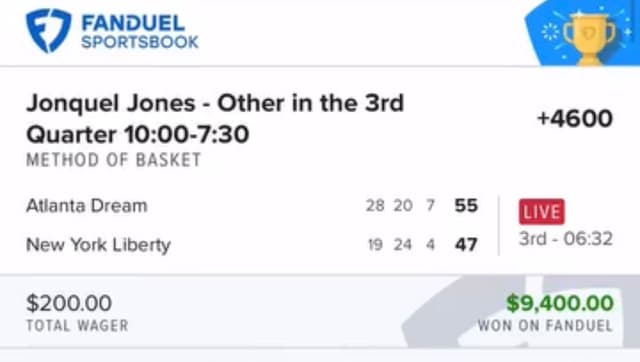
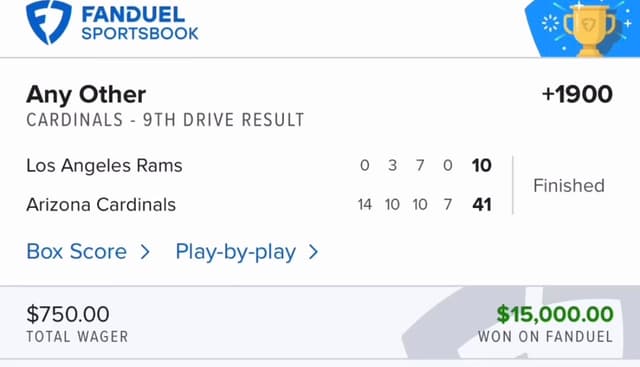
A representative sample of cashed live NFL betting tickets from prior seasons, many from opening-week games where the live prop menu paid once the game script revealed each role. Each ticket was placed during the in-game window after an alert dispatched to subscribers via Email and Discord. Full bet slip archive is on the public results page.
Past results do not guarantee future performance. Must be 21+ to wager.
Why NFL Week 1 Player Props Reward Patience, Not Volume
The phrase "NFL Week 1 player props" describes the most projection-dependent market on the entire calendar, and the most common mistake bettors make is treating the opener like any other week — loading up a stack of prop tickets before a single competitive snap has been played. It is not any other week. There is no current-season data, the roster and scheme have turned over, and the number the book posts is a forecast wearing the confidence of a measured rate. That is why patience beats volume on the opener: the value is narrow and specific, living only in the roles a bettor can point to a concrete roster reason for, not in the dozens of lines that are pure guesswork until kickoff.
The structural cost of a Week 1 prop is compounded by how books defend the opener — tighter limits and a heavier margin on the alternate menu, because the book knows its own error bars are wide. That means chasing the obvious storyline props, the ones every casual bettor is piling into, is usually the worst value on the board. The team's framework separates the knowable from the hopeful: a receiver inheriting vacated targets or an offense whose new coordinator lifts a specific position is a real read; a rookie's debut ceiling or a free agent's first game in a new system is a live-market question, not a pregame bet. None of this is a promise of a particular player's number; prop betting is probabilistic, and the edge is in the pricing and the timing.
Then there is the part that actually pays the bills: the opener itself, live. Because Week 1 is priced without data, the game reveals more about a real role in one half than the entire offseason of projection could — who is on the field for early downs, who runs the routes when the offense has to throw, who gets the red-zone touches. The team's live workflow on those games targets the live passing, rushing, and receiving prop menu, the anytime touchdown market, alternate lines, and the live total, dispatching an alert the moment its read diverges from the live number as usage becomes visible. The pregame read is the reason the team is watching; the live edge is how it profits on the hardest prop slate of the year.
Subscribers receive both halves of this — the narrow set of knowable Week 1 prop reads and the live in-game alerts as the opener reveals each role — through the three live betting packages, with unit sizing scaled to bankroll. For the rest of the opening card see the NFL picks Week 1 2026 page, and for the team's live methodology see the live betting picks page.
Get Live Betting Picks During Games
Every package delivers the team's NFL Week 1 prop reads plus live in-game alerts via Email and Discord the moment the opener reveals a role and the team identifies a mispriced live line. Discounted first month on every plan. No long-term contract.
See Live Betting PackagesPast results do not guarantee future performance. Must be 21 or older to wager.
Frequently Asked Questions
Everything readers ask about NFL Week 1 player props, why the opener is uniquely hard, and the live edge on the games.
Frequently Asked Questions
Why are NFL Week 1 player props harder than the rest of the season?
NFL Week 1 player props are the hardest of the year because there is no current-season data to anchor a projection — the last competitive snaps are eight months old, and everything in between is roster turnover, scheme changes, and preseason reps that rarely resemble the real game plan. A player's role, snap share, target volume, and touch count can all look different from the prior year after a coaching change, a free-agent signing, or a rookie moving up the depth chart. The market prices the opener off projections and prior-year baselines rather than proof, which widens the gap between the number and reality. The Best Bet on Sports treats Week 1 as a live-betting event first — reading how the game script actually reveals each role, then dispatching in-game alerts via Email and Discord.
How does the sportsbook price NFL Week 1 player props without current data?
Books build Week 1 prop lines from prior-season baselines, offseason depth-chart changes, projected game scripts, and their own pace-and-usage models, then shade the number toward the public's favorite storylines. Because no current-season snaps exist, the opener carries wider error bars than any other week, and the book protects itself by holding lower prop limits and a heavier margin on the alternate menu. That combination — thin data plus a defensive book — means the posted line is a projection, not a proven rate, and the mispricing lives in the roles the market has not updated for a new scheme or a new personnel package. The team's read hunts for exactly those stale assumptions rather than betting the obvious names.
Where does Week 1 uncertainty create value instead of a trap?
Week 1 uncertainty is a value driver when the market has under-priced a role change it should already know about — a receiver inheriting vacated targets, a back with a clearer path to early-down work, or an offense with a new coordinator whose system historically lifts a specific position. It becomes a trap when the uncertainty is the whole bet: chasing a rookie's ceiling, a debuting free agent in a new system, or a snap-share guess dressed up as a read. The line between the two is whether there is a concrete, roster-level reason the number is stale versus a hopeful projection. The team separates knowable role shifts from pure guesswork, and reserves the genuine unknowns for the live market once Week 1 shows the actual usage.
Are camp reports and preseason usage reliable for Week 1 props?
Camp reports and preseason usage are useful context but unreliable as a standalone basis for a Week 1 prop, because starters play limited or vanilla snaps in August and coaching staffs deliberately hide their real game plans. A beat-reporter note about first-team reps, a package a coordinator is installing, or a role a veteran is being groomed for can flag where a number may be stale — but preseason box scores against backups do not translate to a real projection. The team weighs camp signal as one input among prior-year baseline, scheme fit, and depth-chart logic, never as the whole thesis, and lets the opening drives confirm or kill a role before committing live. Those live confirmations dispatch via Email and Discord.
What are the most common NFL Week 1 player prop mistakes?
The most common Week 1 prop mistakes are anchoring to last year's final numbers as if the roster and scheme never changed, over-trusting preseason box scores compiled against backups, and betting a rookie or new signing's ceiling on debut before the offense has shown how it will use them. Bettors also overload the pregame slate — placing a stack of prop tickets before a single snap has revealed who is actually on the field for early downs, in the red zone, or on obvious passing situations. The team's discipline is to keep pregame exposure light on the opener and let the live market pay, reacting to the real game script rather than the offseason projection everyone else already bet.
Why is The Best Bet on Sports limited at all six major U.S. sportsbooks?
Sportsbook limitation is enforced by the book itself when an account beats the closing line at a rate the book's risk team views as a threat to its hold. The Best Bet on Sports has been limited on FanDuel, DraftKings, Caesars, BetMGM, Fanatics, and ESPN BET because the team's live in-game wagering produced consistent positive expected value at scale, with $367,520 in verified lifetime profit. Documented statements include FanDuel ($14.5M wagered, $67,823 net profit), DraftKings ($2.8M wagered, $71,051 net profit), and Caesars ($7.6M wagered, $88,645 net profit), with the remaining $140,001 spread across BetMGM, Fanatics, and ESPN BET. NFL live betting — including the prop-heavy Week 1 slate — was the largest single sport contributor.
How do subscribers receive NFL Week 1 player prop reads and live alerts?
Subscribers receive the team's Week 1 prop reads and live in-game alerts through two channels — Email and Discord — dispatched simultaneously. Discord push delivery is typically the fastest and is the recommended primary channel for subscribers who want to act inside a live prop window before the number moves. Discord arrives second, and Email is third because mail clients fetch on intervals rather than push. The 1-Unit Live Betting Package follows one-unit alerts at $199 the first month, $299 per month after. The 2-3 Unit Expert Live Package follows up to three-unit alerts at $299 the first month, $500 per month after. The VIP 5-Unit Live Package follows the full one-to-five unit range at $500 the first month, $1,000 per month after. There is no trial tier.
The Best Bet on Sports · 1.5M followers on TikTok
Sports Betting TikTok is the live betting account behind The Best Bet on Sports, covering NFL, NCAAF, NBA, NCAAB, MLB and WNBA markets in real time. The account has been limited on all six major U.S. sportsbooks — FanDuel, DraftKings, Caesars, BetMGM, Fanatics and ESPN BET — for winning on live betting, with $367,520 in verified profit since 2005. View full profile →
Past results do not guarantee future performance. Must be 21 or older to wager.
Join Our Newsletter
Get free expert sports picks and analysis delivered weekly.