Expert NFL Spread Picks Against the Spread
By Sports Betting TikTok
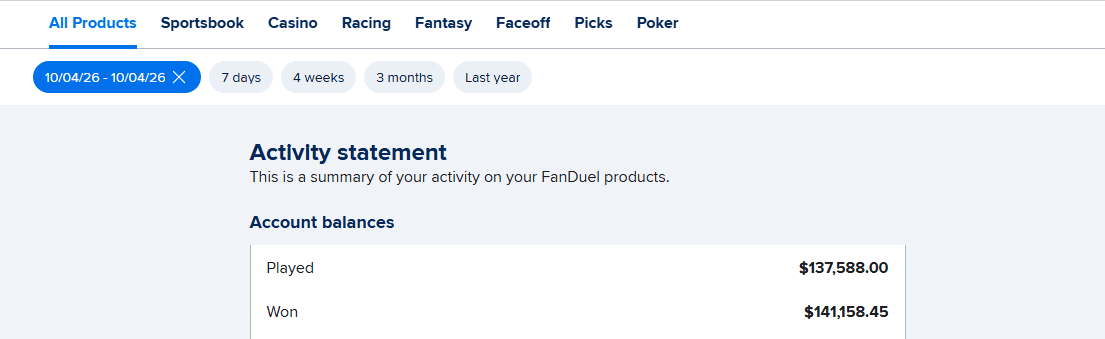
NFL spread picks are expert selections on which team will cover the point spread in a given NFL game. A professional analyst compares a projected margin against the posted number, then attacks the gap. The Best Bet on Sports delivers weekly NFL ATS picks backed by +$367,520 in verified profit and 20 years of documented results — picks arrive via email or Discord before each game window.
The point spread is not a forecast of how a football game will end. It is a price, set to attract money on both sides, and the distance between that price and the game's true expected margin is the only thing a spread bettor is ever actually wagering on. Everything below is how our NFL picks service measures that distance — the shape of NFL scoring, what a half-point is worth in cents, and where the last two minutes of a blowout quietly decide a bet.
Membership
Get the picks
Live betting picks across NFL, NCAAF, NBA, NCAAB, MLB and WNBA — delivered by Email and Discord the moment we spot value.
● Get The Picks
Choose your package
Tap any tier to select · Subscribe in one tap
👇 Tap any package to select it
✓ You're selecting
25 Units · $99.95/month
25 unit picks per month. Sweet spot for most bettors — plenty of action without going all-in.
- ✓25 live betting selections/month
- ✓Email + Discord delivery
- ✓All sports (NFL, NCAAF, NBA, NCAAB, MLB)
- ✓Mix of 1, 2, 3, 5-unit rated plays
- ✓Cancel anytime
Secure PayPal · Cancel anytime · No hidden fees · 21+ · +$367K verified
A Point Spread Is a Price, Not a Prediction
This distinction sounds academic until it costs you money. A sportsbook does not post the number it privately believes is correct. It posts the number that it expects will split the money, then moves that number in response to where the money actually goes. Those two figures — the honest projection and the balancing price — are identical only when a game draws no public attention at all.
On a Bengals–Browns Thursday nighter that nobody outside Ohio is betting, the posted spread is close to the book's true opinion. On a Cowboys home game in prime time, the number carries a tax. Recreational money in this country flows toward favorites, toward overs, and toward a short list of national brands — Dallas, Kansas City, Philadelphia, San Francisco, Green Bay, Buffalo — and the book prices that flow in advance rather than absorbing it. The spread you see is the projection plus a surcharge for popularity.
That surcharge is the single most durable structural edge in ATS betting, and it is why our analysts build an independent projected spread for all 16 games before ever looking at the board. If you look at the market first, the market anchors you, and you will spend the rest of the week rationalizing a number instead of testing it.
Opening Numbers Versus Sunday Numbers
An NFL spread opens early in the week at a small handful of market-setting shops with low limits, gets attacked by professional bettors within minutes, and only then propagates to the retail apps most people use. By Sunday morning that number has absorbed injury designations, weather models, and a full week of public action, which is exactly why it is the hardest number of the week to beat.
The bettor who plays Sunday at 12:45 is competing against the most efficient price the market will ever produce on that game. The bettor holding a number from Friday is competing against a five-day-old opinion. This is not a small distinction, and it is the operational reason our card goes out early rather than at the last responsible minute.
NFL Margins Are Lumpy, and the Lumps Are Worth Money
Football does not score in ones. It scores in threes and sevens, and that scoring grammar propagates all the way up into the distribution of final margins. A field goal is three. A touchdown with the extra point is seven. Two scores is ten or fourteen. The result is that final margins pile up on a few specific integers instead of spreading smoothly, and a three-point win is far and away the most common outcome in the sport — historically appearing in something close to one game in seven. Seven is the next tallest spike. Six, ten, four, and fourteen follow at some distance.
Around those spikes, the whole distribution is wide. The typical NFL game lands somewhere near thirteen points away from the number in either direction on a standard-deviation basis, which is why a team can be genuinely three points better than its opponent and still lose by seventeen without anything strange having happened. Spread bettors chronically underestimate this. A 5-unit play is not a confident forecast of the final score; it is a small tilt applied to an extremely noisy process, repeated hundreds of times.
What a Half-Point Actually Costs
Because the distribution is lumpy, not every half-point costs the same. Moving a spread from -7.5 to -8.5 crosses no meaningful cluster and is cheap. Moving from -3.5 to -2.5 crosses the tallest spike in the entire distribution and is expensive — books routinely charge in the neighborhood of twenty to twenty-five cents of juice to sell that particular half-point, and they charge it because it is worth it. Bettors who buy points indiscriminately at ten cents a pop are overpaying everywhere except at exactly the numbers where the books refuse to sell cheaply.
One current wrinkle matters here. Since the extra point was moved back to a 33-yard attempt, kicks get missed and coaches go for two far more often than they did a decade ago. The seven-point spike has softened at the margins, and margins of five, six, and eight have thickened. Three remains untouched at the top. Any model still running on pre-2015 margin frequencies is mispricing the middle of the board, and any bettor who treats 7 as sacred the way 3 is sacred is a few years behind the market.
Our releases always name the exact number we played, because a pick without a number is not a pick. Backing a road dog at +3 and backing it at +3.5 are genuinely different bets, and over a season of football picks the difference between subscribers who shop and subscribers who do not is measured in whole units. Where to hold accounts is covered on our NFL sportsbook comparison page.
The Last Two Minutes Belong to Nobody
Spread betting has a category of variance that moneyline betting simply does not possess: the outcome can change after the game has been decided. A team leading by eleven with ninety seconds left has won. Whether it wins by eleven, fourteen, or eight is determined by a sequence of decisions that no participant on the field is making with your bet in mind.
Every coach in the league optimizes for win probability, and win probability at that point is already pinned. So the leading defense drops eight, concedes the underneath throw, and trades yards for clock. The trailing offense marches eighty yards against coverage that does not care, scores, and covers a number that was never in doubt as a football matter. Meanwhile the winning team, up eleven with the ball, kneels rather than kicking the field goal that would have covered a -13.5.
Understanding this changes how a spread card should be built. Two teams can look identical on paper and carry very different cover profiles based entirely on late game-script behavior: how aggressively a staff plays a two-score lead, whether a defense sits in prevent or keeps pressuring, whether an offense has the personnel to move quickly against soft coverage. Teams with mobile quarterbacks and quick passing games are structurally better backdoor coverers than teams built to run. That tendency is in our model. It is in almost no recreational bettor's thinking.
It is also the reason the emotional experience of spread betting is worse than the math justifies. A season of ATS results contains a handful of covers that felt stolen and a handful of losses that felt robbed, and they roughly cancel. Judging a service on the ones that hurt is how bettors talk themselves out of a profitable process in November. The complete unedited ledger is on the results page for exactly that reason.
Four Things the ATS Market Gets Wrong Every Season
Angles decay. An edge that prints for three seasons gets priced in by the fourth, and anyone selling you a permanent system is selling you a lagging indicator. These four have survived because each rests on a behavior the market keeps repeating rather than on a statistical artifact.
1. Treating an ATS record as a skill
"They're 8-2 against the spread" is the most-repeated and least-useful sentence in football broadcasting. Covering is not a talent a roster possesses; it is evidence that the roster has been priced too low. The market responds by raising the number, at which point the streak becomes a liability rather than an asset — the team is now being asked to clear a bar set by ten weeks of its own overperformance. Our projections are rebuilt weekly from efficiency and situational inputs, and a team's cover history is not one of them.
2. Pricing an injury by name recognition
The market moves violently on a starting quarterback and barely blinks on a starting left tackle, a slot corner, or a center. That hierarchy roughly matches fame and only loosely matches impact. Losing an interior offensive lineman in a protection-dependent scheme can be worth more than the public thinks, while a skill-position name that draws headlines may cost a team under a point when the replacement absorbs the same routes. We grade injuries by snap share and positional leverage, then compare that figure to how far the number has already traveled — and frequently the answer is that the number traveled too far.
3. Ignoring derivative spreads
First-half spreads, team totals, and alternate lines receive a fraction of the attention the full-game number gets, and many are derived mechanically rather than independently modeled. But halves are not miniature games. Scripted opening drives, halftime adjustments, and staffs that famously start slow or finish strong all mean the first thirty minutes of football can carry a materially different edge than the full sixty. When our full-game projection and the derivative number disagree by more than the derivation should allow, the derivative is usually the softer bet.
4. Misreading which direction the line moved
A spread drifting toward the side the public is not betting is the clearest signal available to a retail bettor: it means money large enough to move a market is arriving on the unpopular side. A spread moving with heavy public action tells you nothing at all — it is a book managing liability. Distinguishing the two requires watching several books at once rather than one app, and it is the step most bettors skip. When that signal agrees with our own projected number, the play gets a higher unit rating. When it contradicts us, we re-examine our work rather than defend it. More on how our analysts read markets is on the NFL handicappers page.
How the Weekly ATS Card Gets Built
The week begins with power ratings for all 32 teams, rebuilt from offensive and defensive efficiency, pressure and protection rates, red zone and third-down performance, special teams value, and a turnover component regressed toward the mean rather than taken at face value. Those ratings generate a projected spread for every game on the board before the market is consulted.
Games where our number and the posted number differ by at least a point and a half advance to a second pass: injury grading by snap share, weather for outdoor venues with attention to wind rather than temperature, rest and travel differentials, coaching tendencies in the specific game script the matchup implies, and a situational database covering post-bye spots, short weeks, divisional rematches, and lookahead games. Whatever survives receives a rating on a 1-to-5 unit scale.
A 1-unit play means the number is wrong. A 5-unit play means the number is wrong and every situational input agrees. Sixteen games typically yield three to five plays. The discipline is refusing to manufacture a sixth, and on a light board we say the board is light rather than inventing action.
Sizing recommendation is unchanged from the first season we published: one to two percent of bankroll per unit, flat, regardless of how the previous week went. Beating -110 requires 52.4 percent, which means a profitable ATS season and a losing one are separated by roughly three games out of a hundred. Nothing survives that margin except consistent sizing.
Get This Week's ATS Card Before the Number Moves
Six U.S. sportsbooks have limited our accounts. +$367,520 in verified profit. Spread picks delivered with the exact number we played.
View Packages & PricingThe ATS Record, Published Whole
The Best Bet on Sports has produced +$367,520 in verified profit across all sports, with the NFL spread market as the core of the operation. The 2024-25 season finished 142-119-8 ATS for +48.2 units and 8.4 percent ROI; the two seasons before it produced +22.8 and +38.4 units. Full season-by-season records live on the results page with losses printed at the same size as wins.
Those numbers matter less than the reason six books stopped taking our action. FanDuel, DraftKings, Caesars, BetMGM, Fanatics, and ESPN BET have all limited our accounts for winning too consistently on live betting markets. A sportsbook never limits a losing customer. It is the only credential in this industry that cannot be manufactured, and it is why our in-game work informs the pre-game card rather than sitting beside it.
Spread picks reach subscribers by email and Discord. Thursday night plays go out Thursday morning; the Sunday and Monday slate is delivered by Friday evening, deliberately early so subscribers can hunt the best available number across books before the weekend money arrives. Adjacent markets are covered on our NFL moneyline picks and parlay picks pages, broader strategy in our NFL betting guides, and a full industry comparison in the best NFL picks service guide.
The Best Bet on Sports · 1.5M followers on TikTok
Sports Betting TikTok is the live betting account behind The Best Bet on Sports, covering NFL, NCAAF, NBA, NCAAB, MLB and WNBA markets in real time. The account has been limited on all six major U.S. sportsbooks — FanDuel, DraftKings, Caesars, BetMGM, Fanatics and ESPN BET — for winning on live betting, with $367,520 in verified profit since 2005. View full profile →
Past results do not guarantee future performance. Must be 21 or older to wager.
Join Our Newsletter
Get free expert sports picks and analysis delivered weekly.
Frequently Asked Questions
What are NFL spread picks and how do they work?
NFL spread picks are expert recommendations on which team will cover the point spread in a given NFL game. The sportsbook sets a spread — for example, the Chiefs -6.5 — meaning Kansas City must win by 7 or more to cover. Our spread picks analyze every relevant factor to identify which side of the spread offers the best value, then deliver that selection with a full written breakdown before kickoff.
How early are your NFL spread picks released each week?
Thursday Night Football spread picks are released Thursday morning. The full Sunday and Monday slate is delivered by Friday evening. Early release is intentional — it gives subscribers a window to lock in the best available number before public money moves the line later in the week. Subscribers receive email and Discord alerts the moment picks go live.
What is your NFL spread record and win rate?
Our full NFL spread record is documented on our Results page with season-by-season win-loss records, units won, and ROI percentages. The 2024-25 NFL season finished at 142-119-8 ATS for +48.2 units. Long-term profitability requires hitting above 52.4 percent to beat -110 juice, and our documented multi-year record exceeds that threshold. Every pick is logged before kickoff and results are never adjusted retroactively.
Do you only provide spread picks or also totals and moneylines?
Point spread picks are the core of our NFL service because ATS markets offer the most consistent edges week to week. We supplement the card with totals plays and select moneyline wagers when the matchup warrants it. Every type of bet is included in a single NFL subscription — you receive spread picks, totals, and moneylines all in one package without paying extra.
How many NFL spread picks do you release per week?
We typically release three to five NFL spread plays per week. Selectivity is the cornerstone of long-term profitability. Forcing action on every game guarantees mediocre results. We only release picks when our handicapping identifies a meaningful edge between our projected spread and the posted line. Quality over volume is non-negotiable.
Can I use your NFL spread picks at any sportsbook?
Yes. Our NFL spread picks are delivered with the recommended spread number and are compatible with any licensed sportsbook. We recommend maintaining accounts at multiple books — DraftKings, FanDuel, BetMGM, Caesars, and others — so you can shop for the best available line on each pick. Getting an extra half-point on a key number like 3 or 7 can be the difference between a push and a win over the course of a season.
Does a team's ATS record tell you anything about future covers?
Almost nothing. A team sitting at 8-2 against the spread has not developed a skill at covering — it has been priced too low ten times in a row, and the market corrects that by raising the number, not by the team changing. ATS records carry very little predictive weight from week to week and essentially none from season to season, which is why our projections are built from efficiency and situational data rather than from a team's cover history.