NFL Playoff Betting Strategy and Picks: How to Win in the Postseason

NFL playoff betting strategy requires fundamental adjustments from regular-season wagering because postseason games feature compressed talent gaps between surviving teams, massive public betting volume that inflates favorite lines, and defensive intensity that pushes games under their regular-season scoring averages. The most profitable playoff betting angles over the past two decades have been backing underdogs with top-10 defenses, targeting unders in Wild Card and Divisional rounds, and fading public favorites in prime-time windows where casual money is heaviest.
NFL playoff betting strategy requires fundamental adjustments from regular-season wagering because postseason games feature compressed talent gaps, massive public betting volume that inflates favorite lines, and defensive intensity that pushes games under their regular-season scoring averages. The most profitable playoff betting angles over the past two decades have been backing underdogs with top-10 defenses, targeting unders in Wild Card and Divisional rounds, and fading public favorites in prime-time windows.
NFL playoff betting is where your entire season of preparation either pays off or falls apart. The postseason operates under a completely different set of dynamics than the regular season, and bettors who fail to adjust their approach leave serious money on the table every January. I have covered NFL playoff betting for over two decades at The Best Bet on Sports, and I have identified consistent patterns that create value in postseason markets year after year. Last January I went 7-3 on my playoff card including hitting the Super Bowl under and backing two divisional round underdogs that covered comfortably. That success was not luck. It was the product of a playoff-specific analytical framework that I have refined over 20 years of postseason handicapping. Here is how to build your own playoff strategy that produces results.
How Is NFL Playoff Betting Fundamentally Different From Regular Season?
The most significant shift in playoff football is the elimination of talent gaps. During the regular season, you routinely see mismatches where a 12-win team hosts a 4-win team. Playoff games pit the league's best against each other, which compresses margins and makes every possession more meaningful. This compression has direct and measurable implications for betting. It also punishes season-long formats that assume mismatches stay available — NFL survivor pool strategy is best understood as a parlay you place one leg at a time, and the easy legs disappear exactly when the field tightens.
Games are tighter. Playoff games since 2000 have been decided by an average of roughly 8 points, compared to about 11 points in the regular season. That three-point compression means underdogs perform significantly better in the postseason, and favorites cover at a lower rate than they do from September through December. The public does not adjust for this. They see a dominant regular-season team and assume that dominance will carry over at the same rate into January. It rarely does.
| Playoff Betting Trends (2000-2025) | Regular Season | Playoffs |
|---|---|---|
| Average margin of victory | 11.2 points | 8.1 points |
| Underdog ATS win rate | 51.2% | 54.1% |
| Games going under total | 49.8% | 53.7% |
| Favorites covering by 7+ | 28.4% | 19.6% |
| One-score games (8 pts or less) | 46.3% | 55.8% |
Coaching matters more in the playoffs because of the extra preparation time, especially in the first round where bye-week teams have additional days to game-plan. Teams with elite coaching staffs consistently outperform their regular-season metrics in the playoffs because the extra preparation allows them to exploit specific weaknesses they have identified on film. Defensive performance stabilizes as well. Playoff teams tend to play tighter defensively, which pushes games under their regular-season scoring averages and has direct implications for totals betting.
What Are the Most Profitable NFL Playoff Betting Strategies?
Based on two decades of postseason analysis, the strategies that consistently produce value in NFL picks during the playoffs revolve around three core principles: lean toward underdogs, target unders in early rounds, and fade public favorites.
Sharp football betting in January rewards bettors who recognize this pattern. Playoff underdogs have historically covered at a rate well above 50% against the spread. The combination of tighter talent gaps and public money inflating favorite lines creates systematic value on the dog. This does not mean betting every underdog blindly. The strongest plays are underdogs with a top-10 defense during the regular season, a quarterback with meaningful playoff experience, a rushing attack that can control time of possession, and a coaching staff with a postseason track record. When three or four of these characteristics overlap, the underdog ATS win rate jumps significantly above the baseline.
Wild Card and Divisional Round games tend to go under at a higher rate than regular-season games. Defensive intensity increases when the stakes are elimination. Offensive play-calling becomes more conservative to avoid turnovers that end seasons. Teams that reach the playoffs typically have strong defensive units, and cold weather in outdoor venues further suppresses scoring in January. By the Conference Championship round and the Super Bowl, this under trend weakens as the remaining teams are typically high-powered offenses that earned byes for a reason.
How Should You Adjust Your Bankroll for Playoff Betting?
Playoff betting volume is concentrated into fewer games over fewer weeks, which changes bankroll dynamics in ways that most bettors do not account for. During the regular season, you have 16 games per Sunday to evaluate and typically bet three to five per week. In the playoffs, you might have only four to six games per round, which means your per-game exposure is inherently higher even if you maintain the same unit size.
Increasing your per-game unit size slightly is reasonable during the playoffs. Bumping your unit size by 25% to 50% keeps your overall weekly exposure similar to regular-season levels when you are betting fewer games. However, this adjustment should be planned in advance as part of your seasonal bankroll strategy, not decided impulsively because you feel confident about a particular game.
Avoid the futures hedging temptation. If you hold a futures ticket on a team that reaches the playoffs, the urge to hedge with game-by-game bets against them is strong. Hedging is a personal risk-management decision, but understand that every hedge bet costs you expected value. If you liked the team at 15-1 in August, riding the ticket through the playoffs maximizes your mathematical edge. The only time hedging makes clear financial sense is when the guaranteed profit from hedging would meaningfully change your life or financial situation. See our NFL futures division winner best bets guide for how to identify futures value before the playoff picture forms and our sports picks packages for expert postseason plays.
Set a firm playoff bankroll that is separate from your regular-season profits. Treat the postseason as its own entity with its own budget. This prevents a bad playoff run from erasing months of regular-season gains and removes the emotional pressure of feeling like your entire season is on the line with every January bet.
What Key Metrics Should You Track for NFL Playoff Picks?
Several data points become more predictive in the postseason than during the regular season because the competitive dynamics amplify their impact.
Turnover margin is the single most predictive factor in playoff outcomes. Teams that protect the football advance. The correlation between turnover margin and playoff wins is significantly stronger than during the regular season because every possession is magnified in tight games. A regular-season game where you turn the ball over three times might still be winnable against a weaker opponent. A playoff game with three turnovers is almost always a loss.
Third-down defense becomes arguably the most important defensive metric in playoff football. The ability to get off the field on third down prevents sustained drives against playoff-caliber offenses, which are skilled enough to convert most first and second-down situations into manageable third downs. Teams that force punts on third down survive and advance. Teams that give up third-and-7 conversions on a regular basis get eliminated.
Red zone efficiency on both sides separates winners from losers in the postseason. With scoring opportunities limited against strong defenses, converting red zone trips into touchdowns rather than field goals is the difference between winning and losing. A team that scores touchdowns on 60% of red zone trips has a massive advantage over one at 45%, and that eight-point-per-game differential compounds across playoff games into the difference between advancing and going home.
Quarterback passer rating under pressure is the final critical metric. Playoff pass rushes are more intense and better game-planned than regular-season rushes because coaching staffs have extra preparation time to design pressure packages. Quarterbacks who maintain efficiency when pressured thrive in January. Those who crumble under pressure get exposed on the biggest stage.
When Should You Place Your NFL Playoff Bets for Best Lines?
Line movement in the playoffs is more dramatic than during the regular season because of the volume of public money that floods the market from casual bettors who do not wager during the regular season. Early-week lines for Saturday and Sunday playoff games often shift significantly by kickoff, sometimes by two or more points on high-profile matchups.
If you are on the public side, bet early before the line moves against you. Public money on popular teams accumulates throughout the week and pushes the spread further away from value. If you are on the contrarian side, wait for line movement to push the number in your favor. This timing discipline can add half a point to a full point of value, which matters enormously in playoff games decided by narrow margins.
The Best Bet on Sports releases playoff picks early in the week specifically to give subscribers the best possible numbers. Visit our NFL picks page for postseason-specific analysis and connect with our expert NFL handicappers for recommendations throughout January. For regular-season context that informs playoff models, see the NFL power rankings betting guide and NFL over/under betting totals guide.
How Does the Super Bowl Differ as a Betting Opportunity?
The Super Bowl is the most heavily bet single sporting event of the year, which means the point spread line is extremely efficient. The combined sharp and public action on the Super Bowl spread leaves very little value for anyone, regardless of their handicapping ability. The line is essentially correct by kickoff in most years.
However, the prop markets and the total tend to offer more exploitable opportunities than the spread. Super Bowl prop markets are massive, with hundreds of individual wagers available, and sportsbooks cannot devote equal modeling resources to every prop. This creates soft lines, particularly on lower-profile player props and game props that receive less betting action. The two-week preparation period before the Super Bowl also makes coaching matchups and game-plan adjustments more impactful than in any other game, which creates opportunities for bettors who study schematic tendencies.
The total in the Super Bowl has historically leaned under because both teams play with maximum defensive intensity and conservative offensive approaches in the biggest game of their careers. The public, conditioned to expect a spectacle between two high-powered offenses, often pushes the total higher than it should be. Fading the public on the Super Bowl total has been one of the more reliable February plays in my career.
What Role Does Home Field Play in NFL Playoff Betting?
Home field advantage in the playoffs carries more weight than during the regular season for several reasons. First, the higher-seeded team earned home field through superior regular-season performance, which means the better team is usually the home team. Second, playoff crowds are louder and more invested than regular-season crowds because the stakes are elimination. Third, the familiarity with the playing surface, the weather conditions, and the routine of playing at home provides a comfort factor that matters in high-pressure situations.
However, the market already prices in home field advantage, so the question is not whether home field matters but whether the market has priced it correctly. In my experience, home field is slightly underpriced in Wild Card round games where the crowd factor is at its peak, and slightly overpriced in Conference Championship games where both remaining teams are elite and the talent gap is minimal. Adjusting your home field assessment by playoff round can add a small but meaningful edge to your postseason handicapping.
We go deeper on the related market in NFL divisional game betting strategy.
How Do You Build a Complete NFL Playoff Betting Framework?
A complete playoff betting framework integrates all of the factors above into a structured decision-making process. Start with your regular-season power ratings and adjust them for playoff-specific factors: defensive intensity increases, coaching quality matters more, turnover protection becomes paramount, and home field carries additional weight.
Next, evaluate the specific matchup through the lens of postseason dynamics. Is this a game where two elite defenses will grind it out, or is one team's offense good enough to break through? Which coaching staff has the preparation advantage? Which quarterback handles pressure better? What are the weather conditions, and do they favor one team's style of play?
Finally, compare your assessment to the market line and identify where the discrepancy exists. If your model says the underdog should be getting 5 points but the spread is 7, the value is on the underdog. If the total should be 42 based on defensive metrics but is posted at 47 because the public sees two offensive powerhouses, the under has value. Track these metrics at our NFL betting page throughout the regular season so you are prepared when the postseason arrives. See how NFL point spread betting fundamentals apply in January when the stakes are highest, and visit our football picks for comprehensive weekly analysis.
Frequently Asked Questions
Do NFL playoff betting systems from the regular season still work?
Regular-season systems need significant adjustment for the postseason. The team quality compression, reduced game volume, and different market dynamics mean that angles which worked from September through December often do not translate. Rebuild your approach around playoff-specific factors like defensive intensity, coaching quality, turnover protection, and the impact of public money on favorite lines.
Is the Super Bowl a good betting opportunity for the spread?
The Super Bowl spread is the most efficient line in all of sports betting because it receives the most money and the most analytical attention. Sharp value on the spread is extremely rare. Prop markets and the total offer more exploitable opportunities for bettors looking for value in the biggest game of the year.
Should I bet NFL playoff futures or individual games?
Both have a place in a diversified playoff betting approach. Futures bets placed before the playoffs begin offer better odds but require your team to win multiple games. Individual game bets allow you to evaluate each matchup on its own merits and adjust your positions as the bracket narrows. A balanced approach uses futures for long-shot value and game-by-game plays for targeted matchup edges.
How important is quarterback experience in NFL playoff betting?
Quarterback playoff experience is a statistically significant factor. First-time playoff quarterbacks cover at a lower rate than experienced playoff quarterbacks, particularly in road games where the crowd noise and pressure are at their highest. However, a first-time playoff quarterback on a team with a dominant defense and strong coaching can still be a value play if the market overweights the experience factor.
What is the best underdog profile for NFL playoff betting?
The ideal playoff underdog has a top-10 defense, a quarterback with at least two playoff starts, a rushing attack that ranks in the top 12 in yards per carry, and a coaching staff with postseason experience. When these four factors overlap and the underdog is getting 4 or more points, the ATS win rate over the past 20 years has been approximately 59%.
How do I manage my emotions during playoff betting?
Playoff games carry higher emotional stakes, which makes discipline harder to maintain. The best approach is to make all of your betting decisions on Tuesday or Wednesday when you can evaluate the games objectively, and then resist the temptation to change your positions based on Thursday through Saturday media narratives. Write down your reasoning for each bet and review it before kickoff to confirm your thesis has not changed.
Is live betting more or less valuable during NFL playoff games?
Live betting in playoff games can be exceptionally valuable because the public overreacts to early scoring events. An early touchdown by the favorite might shift the live spread by three points beyond what the scoring event actually implies about the game's trajectory. If your pre-game analysis supported the underdog, an early deficit creates a live betting opportunity at an even better number than you had pre-game.
The Best Bet on Sports · 1.5M followers on TikTok
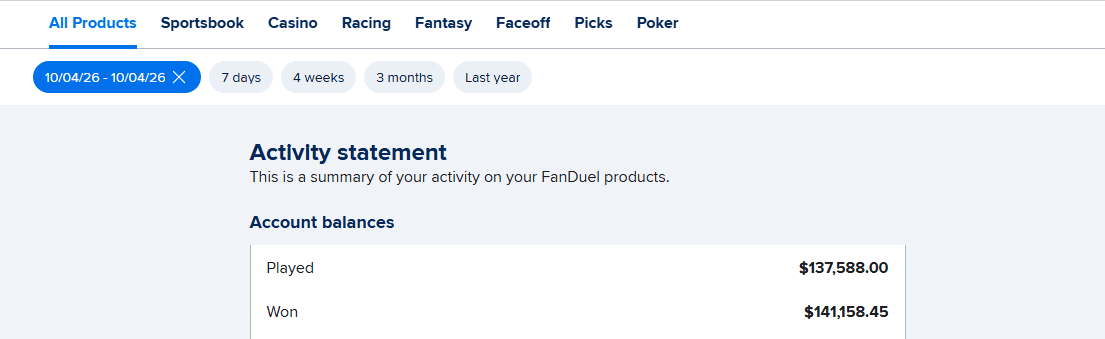
Sports Betting TikTok is the live betting account behind The Best Bet on Sports, covering NFL, NCAAF, NBA, NCAAB, MLB and WNBA markets in real time. The account has been limited on all six major U.S. sportsbooks — FanDuel, DraftKings, Caesars, BetMGM, Fanatics and ESPN BET — for winning on live betting, with $367,520 in verified profit since 2005. View full profile →
Past results do not guarantee future performance. Must be 21 or older to wager.
Related Articles
Bears 59, Panthers 37: Chicago Beat the Game Total By Itself
A Taunting Flag Killed the Over 48.5 in Cowboys-Giants
Vikings 39, Packers 22: The Alternate Line Nobody Was Watching
The NFL's First Australia Game: What a Streaming-Only Kickoff Does to Live Betting
NFL Divisional Game Betting Strategy: Rivalry Edges That Pay
Top NFL Handicappers Review and Rating: What Separates the Best from the Rest
Get real live betting picks
From $39.95/mo · Cancel anytime · Email + Discord delivery
● Get The Picks
Choose your package
Tap any tier below to select · Subscribe in one tap
👇 Tap any package to select it
✓ You're selecting
25 Units · $99.95/month
25 unit picks per month. Sweet spot for most bettors — plenty of action without going all-in.
- ✓25 live betting selections/month
- ✓Email + Discord delivery
- ✓All sports (NFL, NCAAF, NBA, NCAAB, MLB)
- ✓Mix of 1, 2, 3, 5-unit rated plays
- ✓Cancel anytime
Secure PayPal · Cancel anytime · No hidden fees · 21+ · +$367K verified
+$367,520 verified · Limited on 6 sportsbooks · 20 years documented · See Proof
Join Our Newsletter
Get free expert sports picks and analysis delivered weekly.