Expert NFL Over/Under Picks: Live Totals Betting Edges
By Sports Betting TikTok
NFL over/under picks are expert selections on whether the combined score of an NFL game lands above or below the posted total. The Best Bet on Sports builds its edge in live in-game totals, where the number lags pace, weather, early scoring, and game-script shifts faster than the sportsbook's model can reprice. Verified profit: $367,520+, with all six major U.S. sportsbooks having limited the accounts. Live totals alerts arrive via Email and Discord.
The over/under is the most variable market in NFL betting, and that variability is exactly why it is the strongest live wager an analyst can field. A point total has to digest pace of play, possession rate, red-zone efficiency, weather, and game script all at once. Pre-game, the whole betting market sharpens that number until it closes efficiently. Live, the total is repriced by software in seconds — and software lags reality. When a drive stalls, when the wind picks up, when a blowout flips both offenses into clock-killing or comeback mode, the live total carries a brief mispricing the team is built to catch. Every dollar of the documented $367,520 lifetime profit was earned in that live window, which is why all six major U.S. sportsbooks limited the accounts.
This page explains how live NFL totals create edges that pre-game markets do not: how pace and possession move the number, why weather is a live signal and not just a forecast, how early scoring resets a game's scoring trajectory, and how garbage-time game scripts flip unders into overs in the fourth quarter. For the broader card, see our NFL picks service; for the full live workflow, see the live betting pillar.
Why the Over/Under Is the Analyst's Strongest Live Market
Every NFL market reprices live, but they do not all reprice equally well. The live spread and the live moneyline are essentially two views of one number: the in-game win probability. When the score changes, the win-probability engine adjusts both cleanly and quickly, which leaves a narrower window for mispricing. The live total is a different animal. To price a total correctly, the model has to estimate how many more points will be scored in the remaining game time — and that depends on pace, possession rate, red-zone efficiency, weather, and the game script both teams are about to play. That is far more moving parts than a single win-probability read, and more moving parts means more lag.
That structural complexity is why the team's documented live edge concentrates in totals. The sportsbook's automated model is excellent at adjusting the total for the score and the clock. It is materially slower at recognizing that a possession-controlling offense has just changed the entire scoring trajectory of the game, or that a backed-off defense in a blowout is about to surrender easy points. Those are the spots where the live total stays anchored to the prior game state for several drives — long enough for the team to dispatch an alert at a price the book will not be offering a minute later.
The result is a market that rewards live reading over pre-game modeling. A pre-game totals handicapper is fighting the entire betting market for a fraction of a percent. A live totals analyst is fighting one piece of software that has to juggle five variables in real time. The verified $367,520 profit — and the six-book limitations that came with it — is the cumulative product of attacking that gap across twenty seasons of NFL totals.
Live Totals Audit Trail: Sportsbook Career Statements
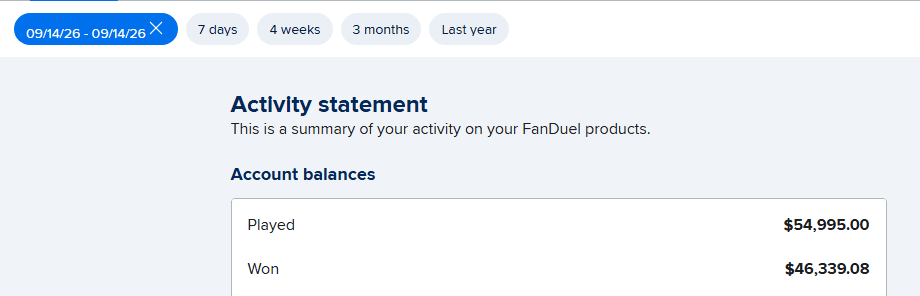
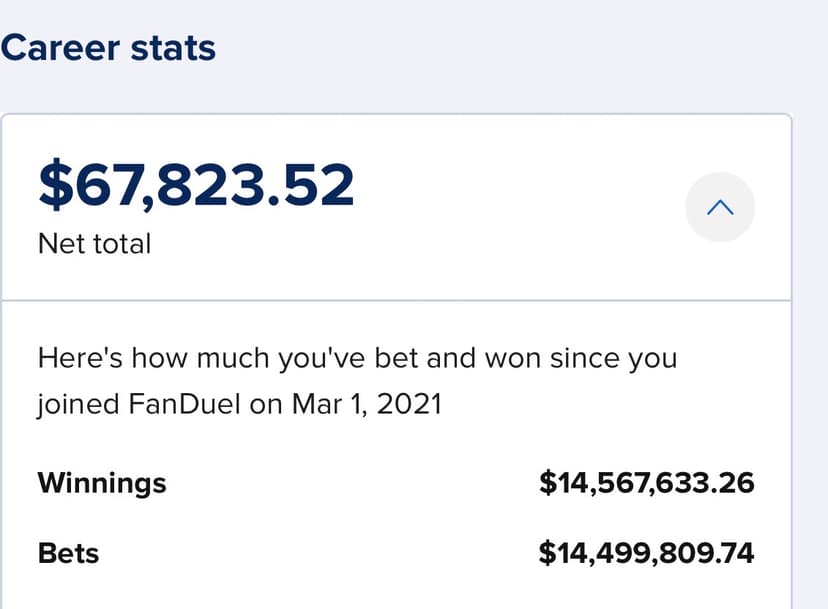
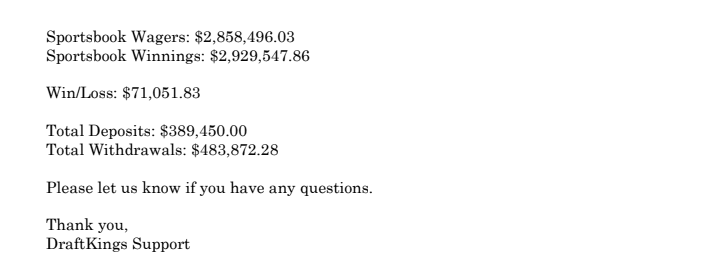
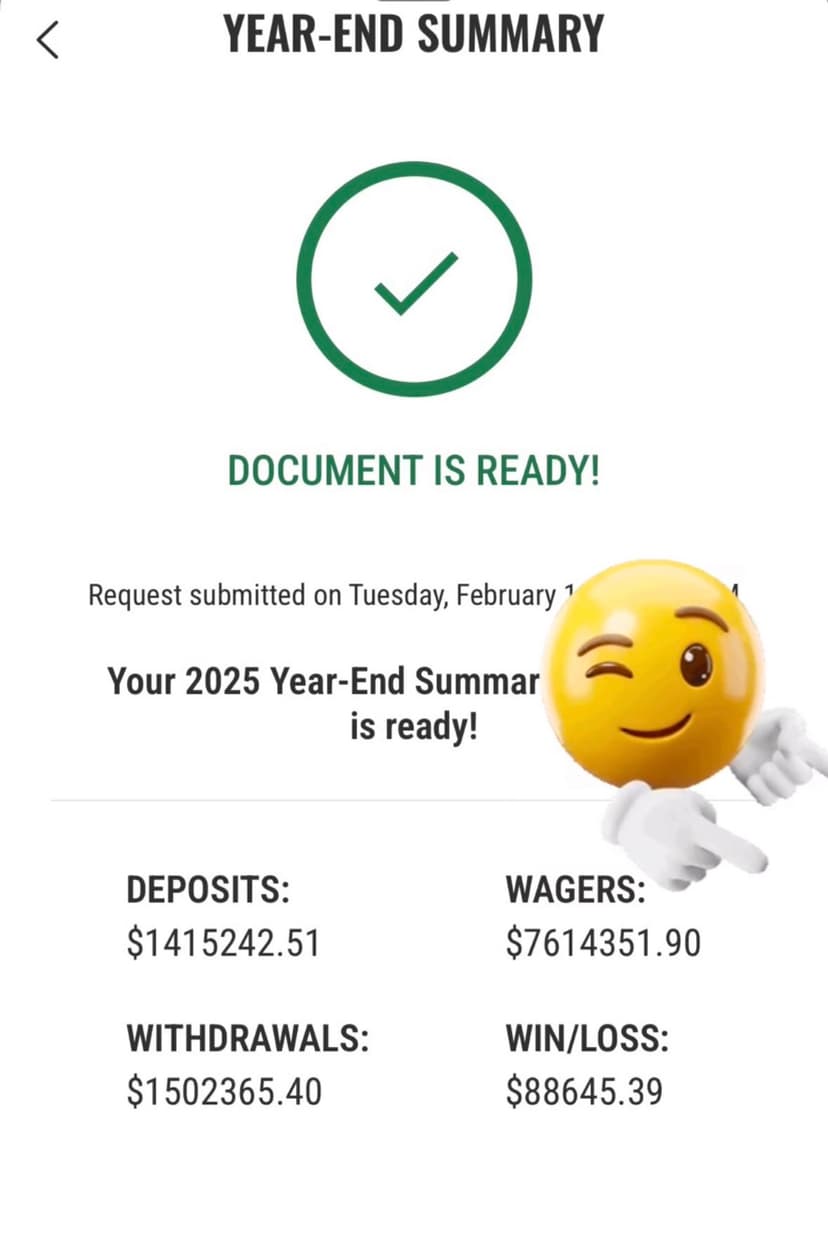
The figures below are the actual lifetime statements from three of the six sportsbooks that have limited The Best Bet on Sports for live betting profitability — much of it earned in NFL totals markets. Display values are reproduced exactly as the sportsbook customer dashboards present them, with no editing, extrapolation, or reconstruction. The remaining three books — BetMGM, Fanatics, and ESPN BET — also issued limitations and are archived on the results page.
| Sportsbook | Lifetime Wagered | Net Profit | Account Status |
|---|---|---|---|
| FanDuel | $14,500,000 | +$67,823 | Limited |
| DraftKings | $2,800,000 | +$71,051 | Limited |
| Caesars | $7,600,000 | +$88,645 | Limited |
| 3-Book Subtotal | $24,900,000 | +$227,519 | All limited |
| All 6 Books Combined | $30M+ wagered | +$367,520 | All 6 limited |
Membership
Get the picks
Live betting picks across NFL, NCAAF, NBA, NCAAB, MLB and WNBA — delivered by Email and Discord the moment we spot value.
● Get The Picks
Choose your package
Tap any tier to select · Subscribe in one tap
👇 Tap any package to select it
✓ You're selecting
25 Units · $99.95/month
25 unit picks per month. Sweet spot for most bettors — plenty of action without going all-in.
- ✓25 live betting selections/month
- ✓Email + Discord delivery
- ✓All sports (NFL, NCAAF, NBA, NCAAB, MLB)
- ✓Mix of 1, 2, 3, 5-unit rated plays
- ✓Cancel anytime
Secure PayPal · Cancel anytime · No hidden fees · 21+ · +$367K verified
How Live In-Game Totals Create Edges Pre-Game Markets Do Not
These are the four live totals dynamics that produce the most repeatable mispricings in the NFL. Each one is a situation where the live number lags the real game, and each one is a pattern the team tracks in real time across every Sunday, Monday, and Thursday slate.
1. Pace and Possession Reset the Scoring Trajectory
The single biggest input into a total is how many possessions remain, and pace controls that. When both offenses settle into long, methodical drives that chew clock, the number of remaining possessions falls and the live total often stays too high for several series before the model catches up. The reverse is true for up-tempo, no-huddle game scripts that manufacture extra possessions and push toward the over. A live total that was set on the early-game rhythm frequently lags a mid-game pace change, and that lag is one of the most reliable live under and live over windows on the board. Time of possession also starves the trailing team of snaps, which compounds the effect when one offense controls the ball.
2. Weather Is a Live Signal, Not Just a Forecast
Pre-game totals bake in a weather forecast, but forecasts are estimates and conditions change during games. Sustained wind above roughly 15 to 20 miles per hour degrades the passing and kicking game and pushes toward the under, yet a live total often holds too high for several drives after gusts pick up in the second half. Rain that begins after kickoff, a field that degrades as the game wears on, or a temperature drop at a cold-weather venue all slow offenses in ways the live model is slow to fully price. The team monitors live conditions at every outdoor stadium and fires live under alerts when the number is still anchored to the pre-game forecast instead of the weather actually on the field.
3. Early Scoring Resets the Game's Expected Total
A fast scoring start can signal a shootout that the pre-game number priced as a defensive battle — or an early scoring burst can be an aberration that regresses hard. Both create live edges. When two offenses trade scores in the first quarter and the underlying efficiency confirms it is real, the live over carries value before the model fully extrapolates the pace. When a high-scoring first quarter was driven by short fields and special-teams scores that will not repeat, the live total can stay inflated while the actual offensive pace points under. Reading which early-scoring pattern is real and which is noise is exactly the kind of judgment a live analyst adds that an automated model struggles to make in the moment.
4. Garbage Time and Game Script Flip Unders Into Overs
Game script is the hidden engine of NFL totals and the clearest live edge of all. Once one team builds a multi-score lead, the leading team runs the ball to drain the clock while the trailing team accelerates, throws deep, and attacks a defense that has backed off into a soft prevent shell. That combination routinely produces garbage-time touchdowns that flip a live under into an over in the fourth quarter. The opposite script — a trailing team that quits — can stall scoring entirely and hand a live under to anyone watching the body language before the scoreboard reflects it. The live model prices the score and the clock well; it is materially slower to price the script transition, and that is where the team dispatches its highest-conviction fourth-quarter totals alerts.
5. Pre-Game Totals Get a Look Too — When the Number Is Wrong
Live is where the edge concentrates, but the team still flags pre-game totals when the posted number is clearly off. A total that has not fully absorbed a backup quarterback, a defense missing its top coverage piece, a pace mismatch between two offenses, or a weather system moving into an outdoor venue can be playable before kickoff. When that pre-game value exists, it is released on the NFL card alongside our NFL spread picks and NFL moneyline picks. But the over/under is the market where waiting for the live window is usually the higher-value play, and the team's workflow reflects that.
Live NFL Totals Trigger Library
The team does not chase every live total that moves. Most live numbers are correctly recalibrated by the sportsbook's engine within the first second after a state change. Live over/under alerts only dispatch when one of the trigger patterns below appears, because those are the patterns the historical data flagged as repeatable across seasons. The library is not exhaustive — full pattern documentation is internal — but it covers the most-fired NFL totals alert types subscribers see week to week.
Pace & Possession Mispricings
- Live total unders when both offenses string together slow, methodical drives and the live number still prices the early-game pace
- Live total overs when an up-tempo offense forces a track-meet rhythm the live model is slow to fully account for
- Live first-half and team-total markets when one offense controls time of possession and starves the opponent of snaps
Weather & Field Conditions
- Live total unders after wind gusts pick up at an outdoor venue and the live number lags the suppressed passing and kicking game
- Live total unders once rain onset or surface degradation begins slowing both offenses mid-game
- Live total adjustments at known park-factor stadiums where conditions shift between the first and second half
Early Scoring & Game Script
- Live total overs when an early scoring burst signals a shootout the pre-game number priced as a defensive battle
- Live total unders after a high-scoring first quarter regresses and the live number still anchors to the early pace
- Live garbage-time overs when a multi-score lead opens the trailing team into deep shots against a backed-off defense
For the complete in-game alert workflow across every sport, see the live betting picks pillar. For the rest of the NFL card, see NFL spread picks and NFL moneyline picks.
Pre-Game Total vs Live Total: The Difference That Defines the Edge
The distinction between a pre-game total and a live total is the entire reason this market is the team's strongest. A pre-game total opens hours before kickoff and is sharpened by every dollar the betting market puts on it until it closes. By game time it is efficient — beating it consistently requires an edge measured in fractions of a percent, and that is hard to sustain in the NFL totals market specifically because the public, the sharps, and the books all study the same scoring and weather data.
| Dimension | Pre-Game Total | Live Total |
|---|---|---|
| Who sets the price | The entire betting market over hours | An automated model, second by second |
| Efficiency | High — beatable by a fraction of a percent | Lower — lags real-game events for seconds |
| Key inputs that move it | Forecast, injuries, season-long pace | Live pace, possession, weather, game script |
| Edge window | Hours, but small | Thirty to sixty seconds, but larger |
| Where the team plays | Selectively, when the number is clearly off | Primary market — source of the verified profit |
The live total is the opposite of the pre-game total in the one way that matters: it is priced by software that has to react in seconds rather than by a market that has had hours to think. That is why the team's over/under workflow waits for the live window on most games. A subscriber who can act on a live totals alert inside the first thirty seconds of dispatch captures a price within a few cents of the team's recommended number, and that is where the documented edge becomes the subscriber's edge. The full in-game delivery mechanics are detailed on the live betting pillar.
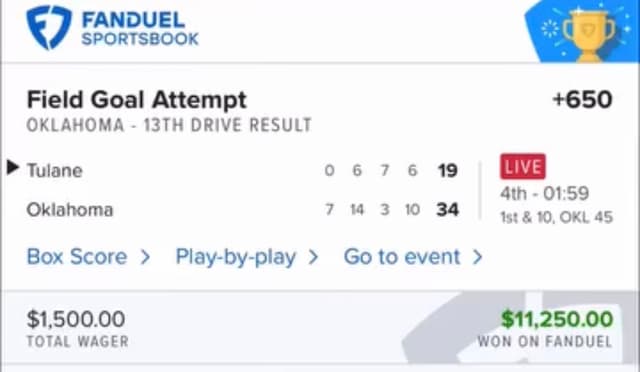
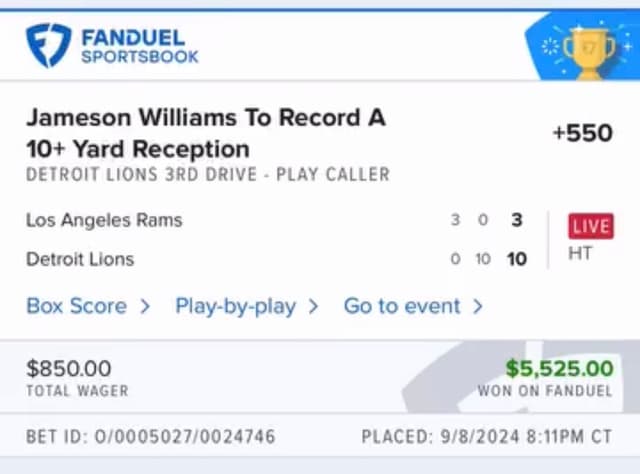
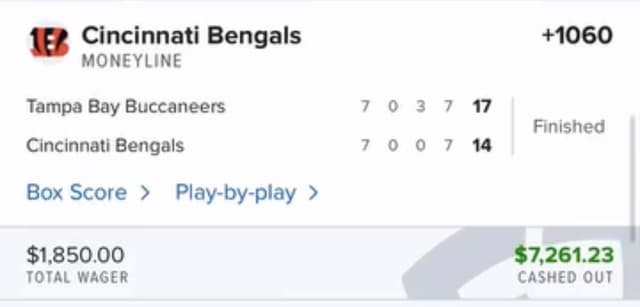
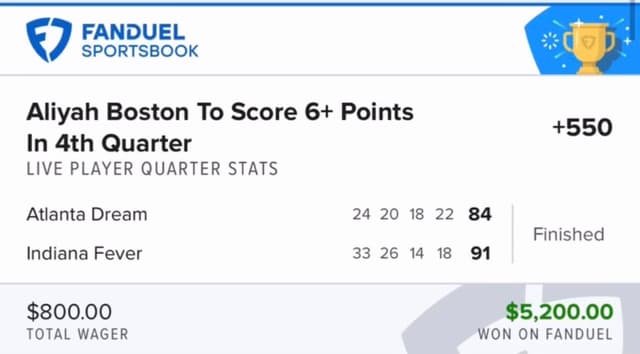
Cashed Live Over/Under Tickets
A representative sample of cashed live totals tickets — live overs and live unders placed during the in-game window after a team alert dispatched to subscribers. Every ticket below was a live wager, not a pre-game pick. The full bet slip archive lives on the results page.
Past results do not guarantee future performance. Must be 21+ to wager.
Building a Disciplined NFL Over/Under Read
Profitable totals betting is not about predicting a final score. It is about identifying the handful of games each week where the posted number — pre-game or live — is meaningfully out of step with how the game is actually being played, and then sizing the wager to the strength of that disagreement. The team's totals process starts with a season-long pace and efficiency baseline for all 32 offenses and defenses: yards per play, seconds per play, red-zone conversion rate, and points allowed per drive. Those baselines produce a projected total for every game, which is the reference point against which both the pre-game and live numbers are measured.
Pre-game, the question is narrow: is the posted total far enough from our projection, after adjusting for injuries and weather, to justify a play before kickoff? Most weeks, for most games, the answer is no — the pre-game market is efficient and the value is not there. That discipline is deliberate. Forcing a totals play on every game is the fastest way to bleed a bankroll, and the team would rather pass twelve games to attack the three where the number is genuinely wrong.
Live, the question changes entirely. Now the team is watching the game state diverge from the live number in real time. Has the pace slowed enough that the remaining possessions no longer support the total? Has the weather turned worse than the forecast the pre-game number assumed? Did the early scoring establish a trajectory the live model has not extrapolated? Is the game script about to flip into garbage time? Each of those is a concrete, observable condition, and each one is a reason the live total might be mispriced for the next several drives. When the condition is clear and the number lags it, the alert dispatches with a unit size scaled to how large the mispricing is.
Bankroll discipline ties the whole approach together. Every totals alert carries a recommended unit size from one to five, and the team recommends risking one to two percent of total bankroll per unit. Closing-line value on totals compounds over a full season only when position sizing stays consistent, so a subscriber who mirrors the unit framework tracks the team's long-run results far more closely than one who bets the same dollar amount on every play regardless of conviction. The complete season-by-season record across totals, spreads, and moneylines is published on the results page, with no retroactive adjustments and no cherry-picked samples.
The reason this entire workflow exists is the same reason all six major U.S. sportsbooks limited the accounts: it works on live markets at scale. No sportsbook restricts a losing bettor. The limitations on FanDuel, DraftKings, Caesars, BetMGM, Fanatics, and ESPN BET are the most credible independent verification a totals analyst can hold, because they are enforced by the books themselves only against accounts that beat the closing number consistently enough to threaten the hold.
Get Live NFL Over/Under Picks During Games
Every package delivers live in-game totals alerts via Email and Discord the moment the team identifies a mispriced live number. Discounted first month on every plan. No long-term contract.
See Live Betting PackagesPast results do not guarantee future performance. Must be 21 or older to wager.
Frequently Asked Questions
Everything readers ask about NFL over/under and live totals picks before subscribing.
Frequently Asked Questions
What are NFL over/under picks and how do totals betting work?
NFL over/under picks are recommendations on whether the combined final score of both teams will land above or below the total the sportsbook posts. If the Chiefs and Bills have a posted total of 48.5, an over pick needs 49 or more combined points and an under needs 48 or fewer. The Best Bet on Sports analyzes pace, situational scoring tendencies, weather, and defensive efficiency to identify mispriced totals — but the largest edge comes from live in-game totals, where the number reprices in seconds as drives stall, weather shifts, or one team builds a lead. All of the team's $367,520 verified profit was built in live markets, and totals are the single most exploitable live NFL market.
Why is the over/under the analyst's strongest live betting market?
The point total reacts to more in-game variables than any other NFL market, which is exactly why the live total is mispriced more often than the live spread or moneyline. Pace of play, red-zone conversion rate, weather changes, injury to a skill-position player, and the shift to garbage-time game scripts all move the true total faster than the sportsbook's automated model can recalibrate. A live spread mostly tracks one number — win probability. A live total has to digest possession rate, time remaining, scoring efficiency, and clock management simultaneously. That added complexity is where the team's documented live edge concentrates, and it is why all six major U.S. sportsbooks limited the accounts on live betting markets.
How are live NFL totals alerts delivered during games?
Every live over/under alert fires simultaneously to two channels: Email and Discord. Each alert specifies the side (live over or live under), the exact total and odds at dispatch, the recommended unit size from one to five units, and a short situational read explaining why the live number is mispriced — for example, a stalled offense with the live total still pricing the first-half scoring pace. Discord is typically the fastest channel, followed by Discord and Email. The two-channel approach exists because live totals move in seconds: a missed notification on one channel does not cost the subscriber the alert, and subscribers act inside the thirty-to-sixty-second window before the live number resets.
What is the difference between pre-game totals and live totals?
A pre-game total opens hours before kickoff and is sharpened by the entire betting market until it closes, which makes it efficient and difficult to beat by more than a fraction of a percent. A live total is repriced second-by-second by the sportsbook's automated model using the current score, time remaining, possession, and pace. Because software reprices live totals rather than the betting market, the live number lags real-game events — a long scoring drive, a sudden weather change, a key injury, or a blowout that flips both offenses into clock-killing mode. The team publishes pre-game totals when value exists, but the documented edge and the resulting six-book limitations come almost entirely from live totals.
How does weather factor into NFL over/under picks?
Weather is one of the most reliable totals signals in the NFL, and it matters even more live than pre-game. Sustained wind above roughly 15 to 20 miles per hour suppresses the passing and kicking game and pushes outcomes toward the under. Rain and field degradation slow offenses as the game progresses. The pre-game total often bakes in a forecast, but live totals frequently lag the actual conditions on the field — when wind gusts pick up in the second half or rain begins after kickoff, the live total can stay too high for several drives before the model adjusts. The team monitors live conditions at every outdoor venue and dispatches live under alerts when the number lags the weather on the field.
How do garbage time and game scripts affect live totals?
Game script is the hidden driver of NFL totals, and it is where live betting separates from pre-game. When one team builds a multi-score lead, the leading team runs the ball to drain the clock while the trailing team accelerates and takes deep shots. That dynamic can push a game over a total that looked safely under, or it can stall scoring entirely if the trailing team gives up. Garbage-time touchdowns against a backed-off defense routinely flip live unders into overs in the fourth quarter. The team tracks these script transitions in real time and dispatches live over or live under alerts when the in-game model is still pricing the prior game state instead of the current one.
Why was the team limited on all six U.S. sportsbooks for live betting?
Sportsbook limitation is enforced by the book itself when an account beats the closing line at a high enough rate to threaten the daily hold percentage. The Best Bet on Sports has been limited on FanDuel, DraftKings, Caesars, BetMGM, Fanatics, and ESPN BET because the team's live in-game wagering — heavily concentrated in totals markets — produced consistent positive expected value at scale, with $367,520 in lifetime verified profit. The verified statements include $14.5M wagered and $67,823 net profit at FanDuel, $2.8M wagered and $71,051 net profit at DraftKings, and $7.6M wagered and $88,645 net profit at Caesars, with the remaining $140,001 spread across the other three books. Six-book limitation is the highest third-party verification a handicapping service can hold, because only sportsbooks themselves enforce it.
The Best Bet on Sports · 1.5M followers on TikTok
Sports Betting TikTok is the live betting account behind The Best Bet on Sports, covering NFL, NCAAF, NBA, NCAAB, MLB and WNBA markets in real time. The account has been limited on all six major U.S. sportsbooks — FanDuel, DraftKings, Caesars, BetMGM, Fanatics and ESPN BET — for winning on live betting, with $367,520 in verified profit since 2005. View full profile →
Past results do not guarantee future performance. Must be 21 or older to wager.
Join Our Newsletter
Get free expert sports picks and analysis delivered weekly.