Football Handicapping Strategies That Actually Work in 2026

Football handicapping strategies that consistently produce profit are built on four pillars: independent power ratings, situational schedule awareness, disciplined line shopping across multiple sportsbooks, and bankroll management that prioritizes survival over aggressive growth. There is no magic formula or hidden system that beats NFL spreads. Winning at football betting requires a structured, repeatable approach, patience through variance, and the willingness to grind out small edges across a full 20-week season that compound into meaningful long-term returns.
Football handicapping strategies that consistently produce profit are built on four pillars: independent power ratings, situational schedule awareness, disciplined line shopping across multiple sportsbooks, and bankroll management that prioritizes survival over growth. There is no magic formula or hidden system. Winning at NFL betting requires a structured approach, patience, and the willingness to grind out small edges that compound over a full 20-week season into meaningful returns.
Updated June 2026.
I have spent over 20 years refining these methods at The Best Bet on Sports, and the fundamentals have not changed even as the betting landscape has evolved dramatically around them. The tools are different. The data is richer. The markets are sharper. But the core strategies that produce profit are the same ones that worked when I started in this industry, and they will be the same ones that work 20 years from now. This guide covers every strategy I have proven profitable through two decades of documented results.
How Do Power Ratings Give You an Edge in Football Handicapping?
Power ratings are the backbone of serious football handicapping and the single most important tool in your analytical arsenal. They represent your own independent assessment of each team's true strength, completely disconnected from what the market says. Without power ratings, you are reacting to lines rather than evaluating them. With power ratings, you are comparing your informed opinion against the market's price.
Building effective power ratings requires breaking teams down by component. Rate each team's offensive efficiency, defensive efficiency, special teams contribution, and home-field advantage separately, then combine them into a composite number. This component approach reveals that a team might be elite on offense but mediocre on defense, which affects how you bet them in different matchup contexts.
The key is updating your ratings weekly based on actual performance weighted by opponent quality. A team that gained 400 yards against the 32nd-ranked defense is not the same as one that gained 400 yards against the 5th-ranked defense. Professional handicappers apply opponent adjustments to every game's results before updating their ratings, which produces a more accurate picture of each team's current quality than raw statistics.
Compare your projected line to the market line every single week. When the discrepancy exceeds 1.5 to 2 points, you have identified potential value. When it exceeds 2.5 points and you understand why the market disagrees with your number, you have identified a strong play. The understanding part matters. If you cannot explain why the market is wrong, the market might be right.
| Power Rating Component | Weight in Composite | Key Metrics Used |
|---|---|---|
| Offensive efficiency | 30% | EPA/play, success rate, explosiveness |
| Defensive efficiency | 30% | EPA/play allowed, havoc rate, red zone defense |
| Special teams | 10% | Field position value, kicking reliability |
| Home-field advantage | 10% | Venue-specific historical margins |
| Situational adjustment | 20% | Rest, travel, motivation, weather |
Why Is Situational Analysis So Critical in the NFL?
The NFL schedule creates unique situational dynamics that do not exist in other sports, and recognizing these situations is one of the most reliable edges available to football handicappers. These are not subjective gut feelings. They are documented patterns backed by decades of data.
Letdown spots occur when teams come off emotional, high-profile wins and face lesser opponents the following week. The performance drop is real and measurable. The public loads up on these teams because they just saw a dominant performance on national television, inflating the line and creating value on the opponent. I have tracked letdown spots for 15 years, and underdogs in these situations cover at roughly 54 percent, which is a significant edge in football betting.
Look-ahead games create similar value. When a team has a marquee divisional matchup the following week, their focus drifts during the current game against a lesser opponent. Players, coaches, and even fans are already thinking about next week. This phenomenon is strongest when the upcoming game has playoff implications and the current game does not.
Short weeks and travel compound fatigue disadvantages. Thursday night games after a Sunday road game create a measurable disadvantage that the market does not always fully price in. Teams traveling coast to coast on a short week face compounded fatigue from reduced recovery time, disrupted practice schedules, and cross-timezone travel.
Divisional familiarity produces closer games than the market expects because teams that play each other twice a year know each other's tendencies intimately. Underdogs in divisional matchups cover at a historically higher rate than in non-divisional games. The familiarity equalizes talent differences and makes game planning more effective for the weaker team.
What Role Does Line Shopping Play in Football Betting Success?
Line shopping is the simplest and most overlooked strategy in football betting. Having accounts at multiple sportsbooks and consistently getting the best available number on every bet is free money that requires zero analytical skill to capture.
The difference between laying 3 and laying 2.5 on an NFL side might seem trivial on a single bet. Over the course of a season with 200 or more wagers, that half point swings multiple outcomes and directly impacts your bottom line. Professional bettors maintain accounts at a minimum of four to five sportsbooks because the cumulative impact of line shopping adds 1 to 2 percentage points of win rate improvement, which translates directly into additional profit.
Getting the best number is especially critical around key numbers in football. The numbers 3, 7, 6, and 10 are where games cluster in terms of final margin, and having the right side of those numbers is transformative. If your handicapper releases a pick at minus 3 and one sportsbook has minus 2.5 while others have minus 3, taking the 2.5 saves you from a push on roughly 10 percent of NFL games that land exactly on 3. That single half point difference can be worth several units per season.
Every serious bettor involved in NFL betting should maintain accounts at a minimum of three to four sportsbooks. The five minutes spent comparing lines before placing each bet is the highest-return activity in all of sports betting.
How Should You Manage Your Bankroll Throughout Football Season?
Bankroll management is where good handicappers become profitable handicappers. Without a disciplined staking plan, even sharp analysis produces inconsistent results because one oversized losing bet can erase three weeks of disciplined winning.
Use a flat unit system as your foundation. Assign a fixed dollar amount as one unit, typically 1 to 2 percent of your total bankroll. Every standard play gets one unit. Resist the urge to chase losses with bigger bets or overload on a game you feel especially confident about. Confidence tiers are acceptable for experienced bettors, with 2 to 3 unit plays for above-average edges and rare 5-unit plays for maximum conviction spots. But these tiers require honest self-assessment of your edge, and most bettors overestimate their conviction accuracy.
Limit your plays. More bets does not mean more profit. The best football handicappers are selective, typically playing 5 to 8 games per week at most. Every additional play beyond your strongest edges dilutes the quality of your card and increases your exposure to variance.
Separate your bankroll from your personal finances completely. Your betting bankroll should be money you can afford to lose without affecting your lifestyle. Emotional betting with money you need leads to terrible decisions because every loss feels like a personal financial crisis rather than a normal part of the process.
Track everything. Log every bet including the line, the odds, the stake, and the result. Without detailed records, you cannot identify strengths, weaknesses, or leaks in your approach. The bettor who does not track their results does not know whether they are winning or losing until their bank account tells them, and by then the damage may be significant.
What Football Handicapping Strategies Should You Avoid?
Knowing what does not work is just as valuable as knowing what does. These strategies cost bettors money every season despite their persistent popularity.
Parlays as a primary betting strategy is the most common money-losing approach in football betting. Parlays are entertaining, and the potential payoffs are exciting, but the compounding juice on each leg gives the sportsbook an enormous mathematical edge. A 2-team parlay at standard minus 110 odds pays 2.6 to 1, but the true fair odds should be 3 to 1. That gap compounds with every additional leg. Use parlays sparingly for entertainment, never as a profit center.
Chasing steam moves based on social media alerts is another losing strategy. By the time you see a line move posted on Twitter, the value is gone. The sharp bettors who caused the move have already placed their bets at the better number. Reacting to line movement without understanding the reason behind it leads to consistently bad numbers and negative expected value.
Betting every game on the NFL slate is perhaps the most common amateur strategy. The NFL offers 16 games on a typical Sunday. You do not need an opinion on all of them. The best handicappers pass on more games than they play. Discipline in game selection is a strategy in itself, and it is the strategy most bettors refuse to employ because passing on games does not feel productive. But passing on marginal games is the most productive thing you can do for your bankroll.
Tailing social media personalities without verifiable track records costs bettors billions of dollars annually. Anyone can post a winning bet slip. The question is what their complete record looks like, including every loss they did not post. If a handicapper does not publish a complete, date-stamped record of every play, they are not worth following. Our sports handicappers publish a fully documented record — see the free vs. paid sports picks guide for how to evaluate any service before spending money.
How Do You Evaluate Whether a Strategy Is Actually Working?
Evaluating strategy effectiveness requires patience, data, and statistical literacy. Most bettors declare a strategy works or does not work based on a sample size that is far too small to draw meaningful conclusions.
A minimum of 100 bets is required before making any preliminary judgments about a strategy's effectiveness. At 10 bets per week, that takes 10 weeks. During those 10 weeks, normal variance can make a winning strategy look like a loser or a losing strategy look like a winner. Discipline means committing to the full evaluation period before making changes.
Track your closing line value as the primary indicator of skill. If you consistently bet at numbers better than the closing line, your handicapping process is adding value regardless of short-term results. A bettor who gets better numbers than the close on 60 percent of their bets is demonstrating genuine skill even if their win rate in any given month is below 50 percent due to variance.
Compare your results by bet type, conference, and situation to identify where your edge is strongest. You might discover that your totals plays crush at 58 percent while your sides barely break even at 52 percent. That information should shift your bet allocation toward totals without abandoning sides entirely.
How Do You Adapt Your Strategies as the Season Progresses?
Football handicapping strategies need seasonal adjustments to maintain their edge. The NFL season has distinct phases, and the strategies that work in September are not always the same ones that work in December.
Early season favors handicappers with strong preseason evaluation processes. The market has the least information in Weeks 1 through 4, which means well-prepared handicappers have the largest information edge. As the season progresses and the market absorbs game data, the edges from preseason preparation shrink.
Mid-season is where power rating updates become critical. Teams evolve through injuries, scheme adjustments, and player development. Handicappers who update their ratings rigorously outperform those who anchor to early-season assessments. This is also when coaching adjustments reveal themselves, and teams that started slowly often improve as their systems take hold.
Late season and playoffs introduce motivation analysis that earlier weeks do not require. Teams eliminated from playoff contention play differently than teams fighting for seeding. Star players on eliminated teams may be rested or play through reduced effort. The market adjusts for some of this, but not all of it, and the edges from motivation analysis are most valuable in Weeks 15 through 18.
Frequently Asked Questions
What is the most important football handicapping strategy for beginners?
Start with bankroll management and line shopping. These two strategies require no analytical skill and immediately improve your results. Once your financial discipline is solid, begin developing your own power ratings and incorporating situational analysis. Building the foundation of discipline before the advanced work ensures you survive long enough to benefit from improved handicapping.
How many NFL games should I bet per week?
Most successful handicappers play between 3 and 8 games per week. The exact number depends on how many genuine edges you identify. If you only find 2 strong plays, bet 2. Forcing action on games where you do not have a clear edge is one of the fastest ways to erode your bankroll. Quality always beats quantity in football handicapping.
Do football handicapping strategies work for college football too?
Many of the same principles apply, but college football has unique dynamics including larger roster disparities, less efficient markets, and more games per week. Situational analysis and power ratings are even more valuable in college football because the market is less sharp. Explore our football handicapping resources for strategies tailored to both NFL and college.
How long does it take to develop profitable power ratings?
Building a functional power rating system takes one full season of weekly updates and tracking. Your first-year ratings will be rough, but the process of updating them weekly against actual results teaches you what factors matter most. By your second season, your ratings will be significantly more refined, and by your third season they should be a reliable handicapping tool.
Is it possible to be profitable betting only totals?
Yes. Some of the most profitable bettors specialize exclusively in totals. Totals markets are driven by pace-of-play data, weather conditions, and defensive matchups that are more predictable than picking game winners. Specializing in totals removes the need to evaluate which team will win and focuses entirely on the scoring environment, which some bettors find easier to handicap.
How important is watching actual games versus relying on statistics?
Both are important, but they serve different purposes. Statistics provide objective, large-sample insights that eliminate the biases inherent in watching games. Film study reveals contextual details that statistics miss, like a quarterback's mechanics breaking down under pressure or an offensive line struggling with a specific blitz package. The best handicappers use both, starting with statistical analysis and supplementing with targeted film study on their strongest plays.
Should I adjust my strategy based on whether I am winning or losing?
Never adjust your strategy based on short-term results. Variance dominates short samples, and changing your approach during a cold streak is as likely to make things worse as better. Evaluate your strategy only at predetermined intervals, such as every 100 bets, and only make changes when the data clearly shows a persistent leak rather than normal fluctuation. For complementary reading, see the football handicapping system explained guide and the NFL power rankings betting value overview. Visit our football picks page and results page to see how a consistent process performs across full seasons.
The Best Bet on Sports · 1.5M followers on TikTok
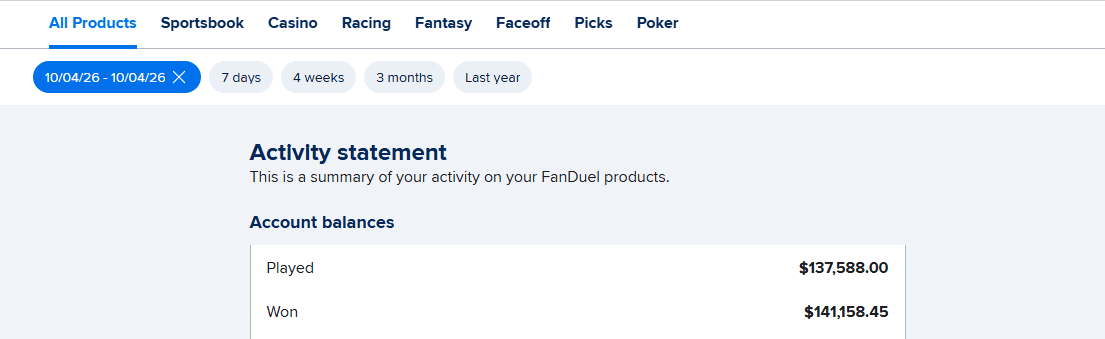
Sports Betting TikTok is the live betting account behind The Best Bet on Sports, covering NFL, NCAAF, NBA, NCAAB, MLB and WNBA markets in real time. The account has been limited on all six major U.S. sportsbooks — FanDuel, DraftKings, Caesars, BetMGM, Fanatics and ESPN BET — for winning on live betting, with $367,520 in verified profit since 2005. View full profile →
Past results do not guarantee future performance. Must be 21 or older to wager.
Related Articles
Football Handicapping System Explained: How the Pros Pick Winners
Best NFL Handicapper with a Proven Record: How to Find One That Actually Wins
NFL Sunday Best Bets: How to Approach the Week's Biggest Slate
NFL Thursday Night Football Picks: How to Bet TNF and Win
Best Football Prediction Sites 2026: What to Look For
Football Betting Secrets From the Best Sports Handicappers
Get real live betting picks
From $39.95/mo · Cancel anytime · Email + Discord delivery
● Get The Picks
Choose your package
Tap any tier below to select · Subscribe in one tap
👇 Tap any package to select it
✓ You're selecting
25 Units · $99.95/month
25 unit picks per month. Sweet spot for most bettors — plenty of action without going all-in.
- ✓25 live betting selections/month
- ✓Email + Discord delivery
- ✓All sports (NFL, NCAAF, NBA, NCAAB, MLB)
- ✓Mix of 1, 2, 3, 5-unit rated plays
- ✓Cancel anytime
Secure PayPal · Cancel anytime · No hidden fees · 21+ · +$367K verified
+$367,520 verified · Limited on 6 sportsbooks · 20 years documented · See Proof
Join Our Newsletter
Get free expert sports picks and analysis delivered weekly.