Hedging Futures Bets in Sports Betting: When to Lock Profits April 2026

Hedging futures bets in sports betting means placing offsetting bets to lock in guaranteed profit or limit downside risk before a futures ticket resolves. Smart hedging protects long-running futures positions when championship odds shorten, but over-hedging silently destroys long-term expected value. The math determines when hedging is correct and when letting the ticket ride is the better play.
Hedging futures bets in sports betting means placing offsetting bets to lock in guaranteed profit or limit downside risk before a futures ticket resolves. Smart hedging protects long-running futures positions when championship odds shorten, but over-hedging silently destroys long-term expected value. The math determines when hedging is correct and when letting the ticket ride is the better play. Our verified +$367,520 historical profit across all sportsbooks reflects two decades of running this exact math on hundreds of futures positions.
Hedging is one of the most misunderstood concepts in sports betting. Casual bettors hedge too often, treating any large potential payout as something to "lock in" the moment hedging becomes possible. Professional bettors hedge selectively, only when the math justifies it — and they're willing to let large tickets ride to the end when hedging would destroy expected value.
This guide breaks down exactly when hedging is correct, how to calculate the optimal hedge size, and how to recognize the emotional traps that make bettors hedge tickets they shouldn't. The same framework applies to NFL futures, NBA futures, MLB futures, and any long-running futures position.
What Hedging Actually Means
A hedge is an offsetting bet placed on the opposite side of a position you already hold. The most common hedging scenario in sports betting involves a futures ticket — for example, a +1500 bet on a team to win a championship — that becomes more valuable as the team advances through the playoffs.
When the team reaches the championship game, the bettor faces a choice. They can let the original futures ticket ride and accept the binary outcome (win the full payout or win nothing). Or they can place a hedge bet on the opposing team, guaranteeing some profit regardless of which team wins.
Example hedge scenario:
You bet $100 on Team A to win the championship at +1500. Team A reaches the championship game. The championship game line is Team A +180 (underdog) vs. Team B -220 (favorite).
Your futures ticket pays $1,500 plus your $100 stake = $1,600 total return if Team A wins. You can hedge by betting Team B in the championship game.
To hedge for equal outcome regardless of result: - If Team A wins: $1,600 from futures - hedge stake = profit - If Team B wins: hedge winnings - $100 original stake = profit
To equalize, you'd bet approximately $500 on Team B at -220. If Team B wins, you collect about $727 ($500 + $227 winnings) minus the $100 lost on the futures = $627 profit. If Team A wins, you collect $1,600 from the futures minus the $500 hedge = $1,100 profit.
Most bettors immediately see the appeal: guaranteed profit between $627 and $1,100 instead of an all-or-nothing $1,600 vs $0. But that "guaranteed profit" comes at a real cost — and the cost is often higher than the bettor realizes.
The Hidden Cost of Hedging: Expected Value Math
The cost of hedging is the expected value you give up by removing variance from the position. To run that math, you have to compare the expected value of the unhedged position against the expected value of the hedged position.
Using the example above, assume the championship game line is "fair" — Team B is the true 69% favorite (the implied probability of -220).
Unhedged expected value: - Probability of winning: 31% (Team A's true win probability) - Payout: $1,500 profit - Expected value: 0.31 × $1,500 + 0.69 × (-$100) = $465 - $69 = +$396
Hedged expected value (using $500 hedge): - If Team A wins (31%): +$1,100 - If Team B wins (69%): +$627 - Expected value: 0.31 × $1,100 + 0.69 × $627 = $341 + $433 = +$774
Wait — the hedge looks better on expected value? It's not. The hedged expected value calculation includes the hedge stake as winnings, but the hedge stake is new money you're putting at risk, not house money from the original ticket.
The proper EV comparison treats the original $100 ticket as a sunk decision and looks only at the new hedging decision:
Hedge bet expected value: - Stake: $500 on Team B at -220 (true 69% probability) - Expected return: 0.69 × $727 + 0.31 × $0 = $501.63 - Expected profit on hedge bet: $501.63 - $500 = +$1.63
The hedge is approximately break-even on its own (slightly positive only because we assumed the line is exactly fair, which it never is — sportsbooks build in juice). In reality, championship game lines have 4-5% juice baked in, meaning the hedge bet has a negative expected value of approximately -$15 to -$25 in this scenario.
The hedge costs you $15-25 in expected value to remove $1,600 of variance from your position. Whether that's worth it depends on your bankroll size and your risk tolerance — not on whether the unhedged position "feels scary."
When Hedging Is Mathematically Correct
Hedging is correct in three specific scenarios.
Scenario 1: The hedge bet itself has positive expected value.
If the championship game line is mispriced — for example, if Team B is actually a 75% favorite but the line implies only 69% — then betting Team B is +EV regardless of your existing futures position. In that case, the hedge isn't a "cost" to remove variance; it's a profitable bet on its own merit. Place it whether or not you have the original futures ticket.
Scenario 2: The futures ticket size is large enough to threaten your bankroll.
If a $100 futures ticket grows to a $1,600 potential payout, that's a meaningful chunk of money but probably not bankroll-threatening for most bettors. If a $1,000 ticket grew to a $16,000 potential payout, suddenly the variance matters more. The size at which hedging becomes correct depends on your bankroll — but the rule is consistent: hedge when the position size has grown beyond your standard unit sizing, not when the absolute dollar amount feels exciting.
Scenario 3: You believe the futures line was originally mispriced and you've already captured most of the value.
If you bet a team at +1500 and you thought their true championship probability was 12% (fair price +733), your edge was meaningful at the time of the bet. As the team progresses to the championship game and the price compresses, much of your original edge has already been realized. Hedging at that point captures the realized value of the edge that already exists in your position.
In all three scenarios, the math drives the decision — not the emotional pull of "locking in profit." Bettors who hedge because they're afraid to lose almost always lose more long-term value than bettors who hedge only when the math says to.
When Hedging Is Mathematically Wrong
Hedging is wrong in several common scenarios that bettors fall into anyway.
Wrong Scenario 1: Hedging because the dollar amount "feels big."
A $1,600 potential payout is exciting. Hedging it down to a guaranteed $700 feels safe. But "feels big" is not a financial framework. If your bankroll is large enough to comfortably absorb a $100 losing ticket, the dollar size of the potential payout is irrelevant to the hedging decision.
Wrong Scenario 2: Hedging every futures ticket that reaches the championship.
Some bettors have a rule: "I always hedge in the championship round." That rule is mathematically equivalent to "I'm willing to give up 4-5% of my long-term EV in exchange for reduced variance on a small percentage of my bets." If you wouldn't take that trade explicitly, you shouldn't take it implicitly through a blanket hedging rule.
Wrong Scenario 3: Hedging at unfavorable juice.
Championship game lines often have wider juice than regular-season lines (sportsbooks know hedge action will pour in). A "-220" hedge price might actually reflect an implied probability of 71% when the true probability is 67%. Hedging at that price compounds your expected value loss compared to a standard regular-season line.
Wrong Scenario 4: Hedging when you originally had no edge.
If you bet a team to win the championship as a "fun" futures bet without any analytical edge, the hedge math is even worse. You don't have any prior expected value to "lock in" — you have variance you took on for entertainment, and hedging just adds more cost on top of an already-negative-EV decision.
The bettors who profit long-term from futures markets — the kind of work our sports handicappers team has been doing since 2005 — generally hedge less than the public, not more. They take on the variance because they believe their original edge is large enough to justify it.
How to Calculate the Optimal Hedge Size
If you've decided hedging is correct, the next question is how much to hedge. The three most common hedging strategies are equal-outcome hedging, full-cover hedging, and partial hedging.
Equal-outcome hedge:
This is the most common hedging strategy. You calculate the hedge stake that produces the same profit regardless of which team wins. The math is straightforward: hedge stake = (futures payout) ÷ (hedge odds + 1).
Using the earlier example: $1,600 futures payout ÷ (1 + 0.4545) = $1,100. Hmm, the math gets a bit messier with American odds — you have to convert to decimal odds first. At -220 (decimal 1.4545), the equal-outcome hedge from a $1,600 futures payout would be $1,600 ÷ 2.4545 = $652. (Slightly higher than my earlier rough estimate.)
Equal-outcome hedging guarantees the same profit on both outcomes, but it costs the most in expected value because you're maximizing the hedge stake.
Full-cover hedge:
You bet enough on the opposite side to fully cover the cost of the original ticket. In our example, you'd bet $222 on Team B (which would return $323, covering the original $100 ticket and producing $223 if Team B wins). If Team A wins, you collect $1,600 minus the $222 hedge = $1,378.
Full-cover hedging eliminates downside without giving up much upside. It's typically the better choice when you want to reduce variance without significantly capping your potential return.
Partial hedge:
You bet some smaller amount on the opposite side — typically 25-50% of the equal-outcome hedge stake. This reduces variance but preserves more of the original ticket's upside. Partial hedging is often the most appropriate strategy when you want to take some risk off the table without giving up the full upside.
The right choice between these strategies depends on your specific situation. Bankroll size, risk tolerance, and your assessment of the championship game line all matter. There's no one-size-fits-all answer — and the bettors who default to "always equal-outcome hedge" leave the most expected value on the table over time.
Hedging in Different Sports: NFL, NBA, MLB
The hedging framework applies across all sports, but the specifics vary.
NFL futures hedging:
Super Bowl futures are the most commonly hedged sports betting position in the U.S. The 14-day gap between the conference championships and the Super Bowl gives bettors plenty of time to think about hedging — which usually leads to over-hedging. The Super Bowl line itself typically has standard NFL juice (around 4.5%), so the EV cost of hedging is similar to regular-season NFL bets. Our NFL picks team rarely hedges Super Bowl futures unless one of the three correct scenarios above applies.
NBA futures hedging:
NBA Finals futures are usually held for shorter periods than NFL Super Bowl tickets, but the conference finals series stretches the hedging window across multiple games. Bettors often have opportunities to hedge after Game 1 or Game 2 if their futures team falls behind. The same math applies — only hedge when the math justifies it. Our NBA picks page covers playoff strategy in more depth.
MLB futures hedging:
World Series futures are unusual because the championship round is best-of-seven and stretches over two weeks. Bettors can hedge at multiple points in the series, which creates more decision points and more opportunities to over-hedge. The series price market itself becomes a hedging vehicle — you can hedge with the series price rather than individual game lines. Our MLB picks team uses series prices selectively when the math favors them over single-game hedges.
How Sportsbook Limits Affect Hedging
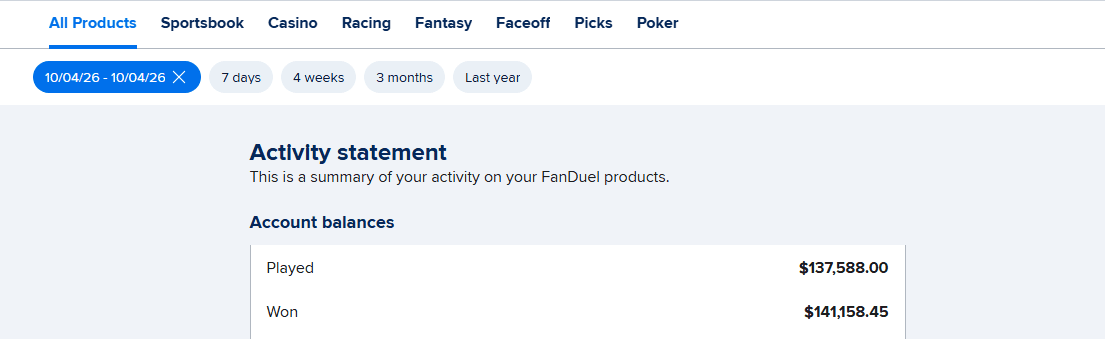
This is an underappreciated reality of long-term sports betting. Bettors who consistently win futures bets often find that their accounts get limited well before they have the chance to hedge. The Best Bet on Sports is currently limited on all six major U.S. sportsbooks (FanDuel, DraftKings, Caesars, BetMGM, Fanatics, ESPN BET) — including on hedging-relevant markets like Super Bowl point spreads and NBA Finals series prices.
That creates a practical problem: your $500 hedge bet can become a $50 max bet at a flagship book once the account is limited. Bettors who plan to hedge large futures positions need to maintain accounts at multiple books to ensure they can place hedges at the size they need.
Our results page documents the verified +$367,520 historical profit that drove those limits, and our buy page covers subscription options for bettors who want access to picks they can place on accounts that aren't limited.
Common Hedging Mistakes Bettors Make
After two decades of working with sports bettors, the same hedging mistakes show up over and over.
Mistake 1: Hedging the day before instead of the day of.
Sportsbooks typically tighten lines and increase juice as game time approaches — but they also increase juice when hedging volume picks up days before the game. The optimal hedging window is usually the morning of the game, after most public hedging volume has cleared.
Mistake 2: Using the wrong type of hedge.
A bettor who wants to fully cover their original stake but uses an equal-outcome hedge ends up giving up far more upside than necessary. Choose the hedge type that matches the actual goal.
Mistake 3: Hedging tiny tickets.
A $20 futures ticket that grew to $400 potential payout doesn't need to be hedged. The expected value cost of hedging exceeds the variance reduction for any bettor with a meaningful bankroll. Save hedging for positions large enough to genuinely matter.
Mistake 4: Forgetting about taxes.
In the U.S., gambling winnings are taxable. The dollar amounts in hedge calculations should account for tax implications, especially for large hedges that push a bettor into a higher tax bracket. This is genuinely important for sized hedges in the $5,000+ range.
Mistake 5: Letting emotion drive the decision.
The emotional pull to "lock in profit" is the single most expensive force in futures hedging. Bettors who hedge because they can't sleep at night with a big ticket open are paying a real expected value cost for emotional comfort. Sometimes that cost is worth it. But it should be a conscious choice, not a default reflex.
Readers working through this should also see our companion piece on World Cup knockout stage title odds.
We go deeper on the related market in the Open Championship betting recap.
Related Strategy Reading
For deeper context on the angles covered above, our analysis of nfl prop bet picks guide and round robin parlay betting strategy pairs well with this guide; our sports picks reflect these same principles applied to live games.
Frequently Asked Questions
What does it mean to hedge a futures bet?
Hedging a futures bet means placing an offsetting bet on the opposite side of your original position to lock in guaranteed profit or limit downside risk. The most common hedging scenario involves a championship futures ticket where the team has reached the championship game — you place a bet on the opposing team to ensure you profit regardless of the outcome.
Should I always hedge a futures bet that reaches the championship game?
No. Hedging always costs expected value because it requires placing a new bet that includes sportsbook juice. Hedge only when (1) the hedge bet itself has positive expected value due to a mispriced line, (2) the futures position is large enough to threaten your bankroll, or (3) you've already realized most of the value from your original edge. Default hedging on every championship ticket destroys long-term EV.
How do I calculate the right hedge size?
The most common method is equal-outcome hedging: divide your potential futures payout by the decimal odds of the hedge bet to get the stake that produces equal profit on both outcomes. Other approaches include full-cover hedging (cover only the original ticket cost) and partial hedging (smaller stakes that preserve more upside). The right size depends on your goals — there's no universal "correct" hedge size.
Does hedging cost me money in the long run?
Yes, almost always. Hedging requires placing a bet at sportsbook juice, which has a built-in negative expected value. Over many futures positions, bettors who hedge by default give up 3-5% of their long-term EV compared to bettors who let tickets ride. The trade-off is reduced variance — which is sometimes worth the cost, but not always.
When does hedging actually make sense?
Hedging makes sense when the hedge bet is mispriced in your favor (positive EV on its own merits), when the futures ticket size is large enough to meaningfully impact your bankroll, or when you've already captured most of the value from your original analytical edge. In all three cases, the math justifies the hedge — not the emotional pull of "locking in" the win.
Can sportsbooks restrict me from hedging?
Sportsbooks can and do limit accounts that consistently profit on futures and hedging strategies. Limited accounts may face reduced max bets that make sized hedges difficult to place. Bettors who plan to hedge large futures positions should maintain accounts at multiple sportsbooks to preserve their ability to bet the size they need when hedging becomes necessary.
Do professional sports bettors hedge futures bets?
Most professional bettors hedge less than the public, not more. Professionals are willing to take on variance because they trust their analytical edge. They hedge only when the specific math of the situation justifies it — typically when the hedge bet itself has positive expected value or when the position has grown large enough to require risk management. Default hedging is a public habit, not a professional one. The Best Bet on Sports has been delivering picks since 2005 with a verified +$367,520 profit, and our team's approach to futures has always emphasized letting analytical edges run rather than reflexively hedging them away.
The Best Bet on Sports · 1.5M followers on TikTok
Sports Betting TikTok is the live betting account behind The Best Bet on Sports, covering NFL, NCAAF, NBA, NCAAB, MLB and WNBA markets in real time. The account has been limited on all six major U.S. sportsbooks — FanDuel, DraftKings, Caesars, BetMGM, Fanatics and ESPN BET — for winning on live betting, with $367,520 in verified profit since 2005. View full profile →
Past results do not guarantee future performance. Must be 21 or older to wager.
Related Articles
Parlay vs. Straight Bets: Which Actually Wins More Money?
Bankroll Management for $100 to $500 Bettors: Unit Sizing, Drawdown Math, and When a $199 Pick Service Pays for Itself
Middling Sports Bets Explained: How to Catch a Middle April 2026
Sports Betting Unit Sizing: Kelly Criterion, Flat Betting, and What Actually Works
Fade the Public Sports Betting Strategy: How Contrarian Betting Creates Edge
Kelly Criterion for Sports Betting: The Math Behind Optimal Bet Sizing
Get real live betting picks
From $39.95/mo · Cancel anytime · Email + Discord delivery
● Get The Picks
Choose your package
Tap any tier below to select · Subscribe in one tap
👇 Tap any package to select it
✓ You're selecting
25 Units · $99.95/month
25 unit picks per month. Sweet spot for most bettors — plenty of action without going all-in.
- ✓25 live betting selections/month
- ✓Email + Discord delivery
- ✓All sports (NFL, NCAAF, NBA, NCAAB, MLB)
- ✓Mix of 1, 2, 3, 5-unit rated plays
- ✓Cancel anytime
Secure PayPal · Cancel anytime · No hidden fees · 21+ · +$367K verified
+$367,520 verified · Limited on 6 sportsbooks · 20 years documented · See Proof
Join Our Newsletter
Get free expert sports picks and analysis delivered weekly.