Sports Betting Unit Sizing: Kelly Criterion, Flat Betting, and What Actually Works

Sports betting unit sizing determines long-term profitability more than pick accuracy. The Kelly Criterion maximizes bankroll growth mathematically but requires disciplined edge estimation. Flat betting at 1–3% of bankroll per unit controls variance for most bettors — and position sizing is the single most overlooked variable in sports betting success.
Sports betting unit sizing is the most important variable in long-term profitability — more important than pick accuracy, more important than which sports you bet, and more important than which sportsbooks you use. A bettor who hits 56% on NFL spreads with poor unit sizing will go broke. A bettor who hits 53% with disciplined position sizing will build a sustainable bankroll. The Best Bet on Sports has generated +$367,520 in verified profit over years of operation, and professional-level unit management is foundational to every dollar of that documented edge. The math is unambiguous: discipline in sizing is what separates long-term winners from everyone else.
The sports betting market is full of services, analysts, and services offering "guaranteed winners" and "lock of the week" language that implies some picks matter more than others. This framing is not only misleading — it is mathematically destructive. The single biggest mistake recreational sports bettors make is wagering inconsistent amounts based on perceived confidence, then suffering catastrophic losses when high-confidence plays fail.
Understanding unit sizing, the Kelly Criterion, and the practical realities of bankroll management will do more for your long-term results than any single pick or system. This is the foundational analytical work that professional bettors learn before they place a single dollar at risk.
What Is a Betting Unit?
A betting unit is a fixed percentage of your total bankroll that you designate as your standard wager. Professional bettors and serious sports betting operations designate 1% to 3% of total bankroll as one unit. This number is not arbitrary — it is derived from the mathematics of variance management over a long betting sample.
If your sports betting bankroll is $5,000, one unit is $50 to $150. If you build that bankroll to $7,500 through winning, your unit size adjusts upward accordingly. If you face a losing stretch that draws your bankroll down to $4,000, your unit size adjusts downward. This dynamic sizing is what allows professional bettors to survive variance and still compound winnings over time.
The most important characteristic of the unit system is its uniformity. Every single bet is either 1 unit, 2 units, or 3 units — never 10 units because you "feel really good" about a game. Never 0.1 units because you want a small hedge. The system works because it removes emotion and impulse from the position-sizing decision.
Flat Betting: The Foundation of Sustainable Betting
Flat betting — wagering the same amount (1 unit) on every selection regardless of perceived confidence — is the safest and most sustainable unit sizing method for the vast majority of sports bettors. It is also, counterintuitively, the method that produces the cleanest measure of your actual edge.
When every bet is the same size, your win rate translates directly into profit or loss. If you hit 54% on -110 spreads (the standard American vig), you are a winning bettor. If you hit 51%, you are breaking even. If you hit 48%, you are losing. These numbers are clean and measurable — and they tell you the objective truth about your handicapping ability.
The alternative — varying bet sizes based on confidence — introduces a confounding variable that makes it impossible to accurately measure your edge. A bettor who wins their 1-unit bets at 52% but wins their 5-unit "locks" at 48% is actively destroying value while believing they are being clever. The higher the confidence, the higher the bet size — but high-confidence picks do not win at higher rates than average picks in any documented, long-term sports betting dataset.
For ongoing football picks and sports analysis with clearly documented unit recommendations, The Best Bet on Sports provides transparent recommendations with standardized sizing.
The Kelly Criterion: Mathematically Optimal Sizing
The Kelly Criterion is the mathematically derived formula for optimal bet sizing when you have a genuine edge. Developed by Bell Labs scientist John L. Kelly Jr. in 1956, the formula calculates the exact percentage of your bankroll to wager in order to maximize long-term growth without risking ruin.
The formula is:
Kelly % = (Edge / Odds) = (bp - q) / b
Where: - b = the decimal odds minus 1 (net odds received per unit wagered) - p = your estimated probability of winning - q = your estimated probability of losing (1 - p)
Example: If you estimate a 55% probability of winning a bet priced at -110 (decimal odds 1.909):
Kelly % = (0.909 × 0.55 - 0.45) / 0.909 = (0.500 - 0.45) / 0.909 = 0.055 / 0.909 = 6.05%
The full Kelly Criterion tells you to bet 6.05% of your bankroll on this play. For a $5,000 bankroll, that is $302.50.
Why Fractional Kelly Is the Professional Standard
Full Kelly betting produces extreme volatility. Even with a genuine edge, running full Kelly creates 50% bankroll drawdowns at a non-trivial frequency during the normal variance cycles of sports betting. Most professional sports bettors — and every institutional sports betting operation — uses fractional Kelly, typically one-quarter to one-half Kelly.
At half-Kelly, the example above becomes a 3% bet — $150 on a $5,000 bankroll. At quarter-Kelly, it becomes 1.5%, or $75. These are sustainable numbers that compound over time without creating bankroll-threatening drawdowns.
The critical variable in Kelly sizing is the accuracy of your edge estimate. If you estimate 55% probability but your actual win rate is 52%, you are over-betting — your Kelly calculation was wrong. This is why many professional bettors default to flat betting or quarter-Kelly: it protects against the systematic overconfidence that inflates edge estimates.
For deeper coverage of the formula and worked examples, our Kelly Criterion sports betting bankroll management guide and the Kelly Criterion bet sizing guide walk through the per-bet math step by step.
| Method | Bet Size (55% edge, -110 line) | Variance Level | Ruin Risk |
|---|---|---|---|
| Full Kelly | 6.05% of bankroll | Extreme | Moderate |
| Half Kelly | 3.03% of bankroll | High | Low |
| Quarter Kelly | 1.51% of bankroll | Moderate | Very Low |
| Flat betting (2%) | 2% of bankroll | Moderate | Very Low |
| Flat betting (1%) | 1% of bankroll | Low | Negligible |
Unit Tiering: 1-Unit, 2-Unit, and 3-Unit Plays
Most professional sports betting services use a tiered unit system — not to signal higher confidence, but to signal higher perceived edge. The distinction matters. A 3-unit play does not mean "I am 90% confident in this game." It means "My edge estimate on this bet is approximately triple my average edge estimate."
The trigger for escalating unit size should be structural, not emotional. Structural edge multipliers include:
- A line that has not moved despite heavy sharp action (indicating intentional book hold)
- A weather or injury variable that emerged after the line was set and has not been fully priced in
- A rest advantage combined with a pace or pace-specific matchup advantage
- A closing line value gap of more than 1.5 points from the opening line
These are analytical triggers. "I have watched this team all season and I know they will cover" is not a structural trigger. It is a bias trigger — and it is the most common driver of inappropriate unit escalation among recreational bettors.
For sports handicapper analysis with clearly communicated unit tiers and documented historical performance, The Best Bet on Sports provides transparent breakdowns on every recommendation.
Bankroll Recovery Mathematics
Understanding what happens during a losing streak is as important as understanding how to grow a bankroll. Losing streaks are not signs of bad handicapping — they are mathematical certainties in any probabilistic endeavor. Even a bettor with a genuine 57% win rate will experience 8-game losing streaks multiple times per season. The math is unavoidable.
The most damaging response to a losing streak is to increase bet size to "get back to even faster." This is the most reliable bankroll-destruction pattern in sports betting, and it is documented in every serious study of retail sports bettor behavior. Increasing bet size during a drawdown does the opposite of its intended effect — it accelerates the path to bankruptcy while the inevitable reversion to the mean is still pending.
The professional response to a losing streak is to maintain flat sizing, review bet selection for systematic errors (not individual game errors), and continue applying the same process. If your edge is real, variance will revert. If your edge is not real, increasing bet size will not create it. Our sports betting losing streak and bankroll recovery guide covers the recovery framework in detail, and the sports betting unit sizing and bankroll management guide for April 2026 extends the position-sizing logic with current-season examples.
The Best Bet on Sports is limited on all six major U.S. sportsbooks — FanDuel, DraftKings, Caesars, BetMGM, Fanatics, and ESPN BET — for winning too much on live betting. The books limit winning bettors precisely because consistent bettors with genuine edges eventually become unprofitable for the book to hold. Maintaining multiple active accounts across all major sportsbooks is the professional response to account restrictions.
Line Shopping and Its Unit-Equivalent Value
Line shopping — finding the best available price across multiple sportsbooks before placing any bet — is the unit-equivalent of flat-betting discipline. Getting -105 instead of -110 on a standard spread bet is worth roughly 0.3% per bet in long-term expected value. Over hundreds of bets per season, that difference compounds into meaningful profit.
The half-point on a total — getting 47.5 instead of 48 at the same price — has an even larger equivalent value when that key number is frequently hit. These marginal pricing advantages are not glamorous, but they are the difference between a 52% bettor who wins and a 52% bettor who loses after vig.
For complete NFL picks, NBA picks, MLB picks, and college football picks with transparent unit recommendations and documented results, visit The Best Bet on Sports at /results and /buy.
Frequently Asked Questions
What percentage of my bankroll should I bet per game?
Professional sports bettors wager 1% to 3% of their total bankroll per game as a standard unit. This range minimizes ruin risk while allowing meaningful bankroll growth over a winning season. Bets should never exceed 3 to 5% of your total bankroll on any single game, regardless of confidence level.
What is the Kelly Criterion and should I use it?
The Kelly Criterion is a mathematical formula that calculates the optimal bet size to maximize long-term bankroll growth given a specific edge estimate. Most professionals use fractional Kelly (25% to 50% of the full formula output) to reduce variance. The formula is only as accurate as your edge estimate — overconfident bettors who inflate their edge estimates will overbetaccordingly.
Is flat betting or Kelly betting better for sports bettors?
Flat betting is safer and produces a cleaner measure of your actual edge. Kelly betting maximizes long-term growth but requires accurate edge estimation and tolerance for higher variance. Most professional sports bettors use flat betting or quarter-Kelly; very few use full Kelly because the drawdowns are severe.
What is a 2-unit or 3-unit play and how should I interpret it?
A 2 or 3-unit play signals that the analyst estimates a higher edge than average on the selection — not that the outcome is more certain. Unit escalation should be driven by structural analytical factors (sharp line movement, unpriced injury, clear rest advantage) rather than subjective confidence. Interpret tiered units as edge signals, not certainty signals.
How should I handle a losing streak with my bankroll?
Maintain your flat unit sizing during losing streaks. Do not increase bet size to recover losses faster — this is the most reliable path to bankroll destruction in sports betting. If you have a genuine edge, variance will revert over a large enough sample. Review your bet selection methodology for systematic errors, but do not change your sizing strategy mid-streak.
How many units does a professional bankroll hold?
Professional sports bettors maintain bankrolls of 50 to 100 units. At 100 units, even a 10-unit losing streak represents only a 10% drawdown — survivable and statistically expected. At 20 units, a 10-unit streak is catastrophic. The larger your bankroll in unit terms, the more variance you can absorb while your edge plays out.
Where can I access picks with clear unit recommendations and documented results?
The Best Bet on Sports provides transparent unit recommendations on every NFL pick, NBA pick, and MLB pick. Documented outcomes with verified profit figures are available at /results. Service tiers and pricing are at /buy.
The Best Bet on Sports · 1.5M followers on TikTok
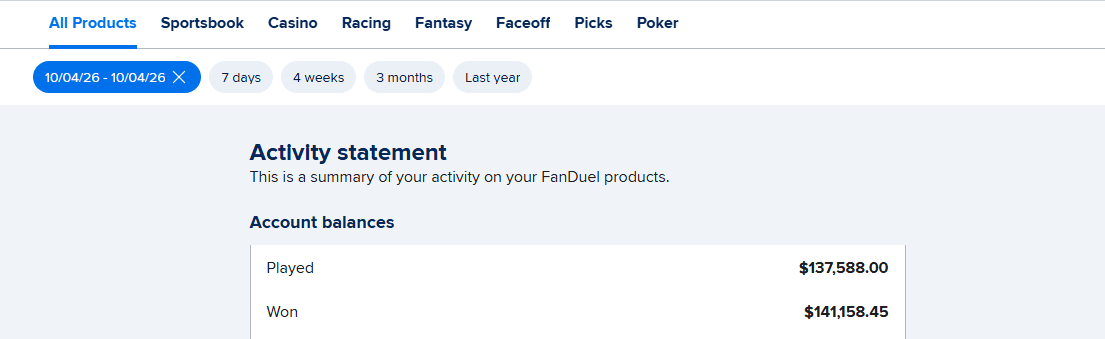
Sports Betting TikTok is the live betting account behind The Best Bet on Sports, covering NFL, NCAAF, NBA, NCAAB, MLB and WNBA markets in real time. The account has been limited on all six major U.S. sportsbooks — FanDuel, DraftKings, Caesars, BetMGM, Fanatics and ESPN BET — for winning on live betting, with $367,520 in verified profit since 2005. View full profile →
Past results do not guarantee future performance. Must be 21 or older to wager.
Related Articles
Kelly Criterion for Sports Betting: The Math Behind Optimal Bet Sizing
Kelly Criterion for Sports Betting: Optimal Bet Sizing Explained
Bankroll Management for $100 to $500 Bettors: Unit Sizing, Drawdown Math, and When a $199 Pick Service Pays for Itself
Sports Betting Unit Sizing and Bankroll Management: The Complete Guide
What Bankroll Do You Need for a Live Betting Service?
Power Ratings in Sports Betting Explained: How Teams Are Numerically Rated
Get real live betting picks
From $39.95/mo · Cancel anytime · Email + Discord delivery
● Get The Picks
Choose your package
Tap any tier below to select · Subscribe in one tap
👇 Tap any package to select it
✓ You're selecting
25 Units · $99.95/month
25 unit picks per month. Sweet spot for most bettors — plenty of action without going all-in.
- ✓25 live betting selections/month
- ✓Email + Discord delivery
- ✓All sports (NFL, NCAAF, NBA, NCAAB, MLB)
- ✓Mix of 1, 2, 3, 5-unit rated plays
- ✓Cancel anytime
Secure PayPal · Cancel anytime · No hidden fees · 21+ · +$367K verified
+$367,520 verified · Limited on 6 sportsbooks · 20 years documented · See Proof
Join Our Newsletter
Get free expert sports picks and analysis delivered weekly.