Sports Betting Unit Sizing and Bankroll Management: The Complete Guide

Sports betting bankroll management using proper unit sizing is the single biggest factor separating long-term profitable bettors from those who go broke despite picking winners. A disciplined bankroll system — betting 1-3% of your total bankroll per unit — survives variance, compresses losing streaks, and maximizes growth during winning runs. Here is the complete professional framework for managing your sports betting capital.
Sports betting bankroll management using proper unit sizing is the single biggest factor separating long-term profitable bettors from those who go broke despite picking winners. A disciplined bankroll system — betting 1-3% of your total bankroll per unit — survives variance, compresses losing streaks, and maximizes growth during winning runs. Without bankroll discipline, even a 57% win rate can produce a net loss. The mathematical principles of unit sizing are non-negotiable for sustainable profitability.
Every serious bettor eventually confronts the same uncomfortable truth: you can be right more than you are wrong and still lose money. The mechanism is poor bankroll management. A bettor who wins 55% of their plays but bets inconsistent sizes — going large on "locks," chasing losses with inflated units, and abandoning their system during cold streaks — will underperform a 52% bettor who maintains rigid unit discipline.
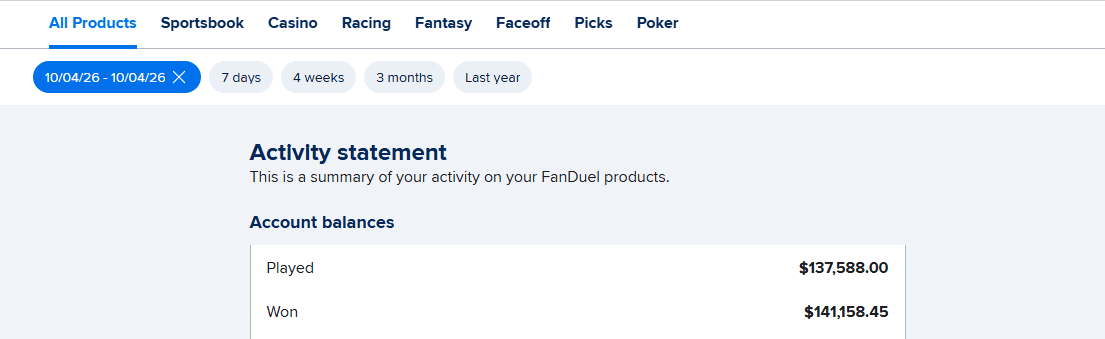
At The Best Bet on Sports, we have been operating since 2005 with a verified track record of +$367,520 in documented sportsbook profits. None of that would be possible without a bankroll management framework that treats capital preservation as the primary objective and profit maximization as the secondary one. Here is the framework, in full.
The Foundation: What Is a Unit?
A unit is the base denomination of your betting activity. It represents a fixed percentage of your total betting bankroll, not a fixed dollar amount. This distinction is critical.
Wrong approach: "I bet $100 per unit."
Right approach: "I bet 1% of my bankroll per unit."
If your starting bankroll is $10,000, one unit equals $100. If your bankroll grows to $15,000 through winning, your unit grows to $150. If a losing stretch drops your bankroll to $7,500, your unit drops to $75. The unit adjusts with your bankroll in both directions, which is the mechanism that prevents catastrophic loss sequences and allows compounding growth during winning runs.
The standard professional recommendation is to set one unit at 1-2% of your total bankroll. For bettors with verified edges and high confidence in their analytical process, some professionals extend to 3% for highest-confidence plays — but never beyond that, regardless of confidence level.
This connects directly to accessing professional analysis. Visit the buy page to see how The Best Bet on Sports structures our unit recommendations for subscribers: each pick comes with a specific unit designation (1 unit, 2-3 units, or 5 units) so you always know exactly how to size relative to your bankroll.
The Kelly Criterion: Theory vs. Practical Application
The Kelly Criterion is the mathematically optimal bet sizing formula derived from information theory. The formula is: `f = (bp - q) / b`, where `f` is the fraction of bankroll to bet, `b` is the net odds received, `p` is the estimated win probability, and `q` is the estimated loss probability (1 - p).
For a bet at -110 odds where you estimate a 55% win probability: - b = 0.909 (net odds at -110) - p = 0.55 - q = 0.45 - f = (0.909 × 0.55 - 0.45) / 0.909 = (0.500 - 0.45) / 0.909 = 0.055 / 0.909 ≈ 6%
Full Kelly says bet 6% of your bankroll. In practice, most professional bettors use "fractional Kelly" — typically half Kelly or quarter Kelly — because the formula requires perfect accuracy in win probability estimation, which is never actually achievable.
At quarter Kelly, the same bet would be sized at 1.5% of bankroll. This aligns closely with the practical 1-2% unit sizing recommendation and is the theoretical underpinning for why that range is optimal.
Understanding the Kelly framework helps explain why chasing losses with larger bets is always mathematically destructive: it inverts the formula by increasing bet size precisely when your estimated edge is most uncertain (after a losing sequence when confidence is low).
Unit Tiers: Standard, Confidence, and Maximum Plays
A functional bankroll system uses unit tiers rather than flat betting everything at the same size. The Best Bet on Sports uses three tiers:
1-unit plays — Standard confidence. The analytical process has identified value, but variance is expected and the play is not among your highest-conviction positions.
2-3 unit plays — High confidence. Multiple independent analytical factors align, the line has meaningful value, and the historical base rate for this type of bet is strong.
5-unit plays (maximum) — Highest conviction. Reserved for situations where the edge is substantial, information quality is high, and multiple confirmation factors are present. These plays are rare — occurring perhaps 2-4 times per month at most.
Notice that the maximum recommended play size is 5 units, not 10 or 20. Even in the highest-confidence situations, professional bankroll management requires a ceiling. The reason is simple: the perception that a play is "a lock" or "a sure thing" is itself a red flag. Sports betting has no sure things, and the cognitive state of certainty is a known precursor to poor bankroll decisions.
The results page on our site tracks our historical unit-tiered performance, showing long-term profitability across all three categories.
Building Your Bankroll: Realistic Growth Expectations
Public perception of sports betting profitability is distorted by outlier success stories. The realistic picture for a disciplined, skilled bettor looks like this:
A 54% ATS win rate at -110 odds produces a Return on Investment (ROI) of approximately 3.5%. On a $10,000 bankroll betting 200 plays per year at 1-2% per unit, that represents $700-$1,400 in annual profit.
That sounds modest compared to get-rich-quick narratives. But consider what it means compounded over time with proper bankroll management:
| Year | Bankroll (at 5% annual growth) |
|---|---|
| Start | $10,000 |
| Year 1 | $10,500 |
| Year 2 | $11,025 |
| Year 3 | $11,576 |
| Year 4 | $12,155 |
| Year 5 | $12,763 |
With unit sizes tied to bankroll percentage, the dollar return also grows. By year 5, a 1-unit play is $127 instead of $100, and the compounding accelerates. This is sustainable, verifiable profitability — not gambling.
The Losing Streak Protocol
Every bettor, no matter how skilled, experiences losing streaks. The question is not whether they happen — it is whether your system survives them. Proper bankroll management is specifically designed to ensure the answer is yes.
The mechanics work as follows: if your unit is 1% of your bankroll and you experience a 10-game losing streak, your bankroll is reduced by approximately 10%. Your unit size automatically decreases by 10% as well. The losing streak has cost you real capital, but it has not compromised your ability to continue betting at the same structural rate of return.
Compare this to a flat-dollar bettor who loses 10 consecutive $200 bets: they are down $2,000 with no structural protection against continuing to lose at the same dollar amount. A bad streak at fixed dollar sizes can wipe a bankroll in weeks. Percentage-based sizing makes the same streak survivable.
The psychological component is equally important. When you know your system will survive a losing streak — because the math guarantees it — you are less vulnerable to emotional decision-making: chasing losses, doubling up to "get even," or abandoning your analytical framework because it feels like it is not working.
Review the full library of betting strategy content on the blog for more on loss management and the psychological discipline required for long-term success.
Chasing Losses: The Single Biggest Bankroll Killer
Chasing losses is the most common and most destructive behavior pattern in sports betting. It is so universal that every book on betting strategy addresses it, yet bettors at every level continue to fall into the trap under emotional pressure.
The mechanism is simple: you lose two or three bets in a row and feel an urge to bet larger to "get it back." This seems rational — a bigger bet will recover the losses faster. But it inverts the entire logic of bankroll management. You are increasing your risk exposure precisely when your information and analytical confidence should be lowest, because recent results suggest either bad variance or an error in your framework.
The correct response to a losing streak is not to increase bet size. It is to:
1. Review recent losses for analytical errors (did you miss something, or was it pure variance?) 2. Confirm your framework is sound (your analysis process, not just your results) 3. Continue betting at standard unit size with the confidence that positive expected value plays win over time
Professional bettors who have been at this for years will tell you: the losing streak protocol is where bankroll management pays its biggest dividends. Anyone can maintain discipline when winning. The test is maintaining it when the results are painful.
The Importance of a Dedicated Betting Bankroll
Bankroll management only functions correctly when your betting capital is genuinely isolated from personal finances. A dedicated betting bankroll means:
- Money you can afford to lose without affecting your life
- A separate account or tracking system from your personal bank accounts
- No "topping up" from personal funds to recover losses
This separation serves both mathematical and psychological functions. Mathematically, it ensures your unit sizes are accurately calculated against your actual betting capital. Psychologically, it removes the emotional overlay of real-life financial pressure from betting decisions. When you are betting with money tied to your rent or groceries, the decisions become distorted.
The sports handicappers at The Best Bet on Sports emphasize this point to every subscriber: set your bankroll before the season, commit to the unit percentage, and treat it as investment capital that operates by its own rules.
Tracking and Analytics: You Cannot Manage What You Do Not Measure
Professional bankroll management requires comprehensive tracking. At minimum, track:
- Date of every bet
- Sport, league, and game
- Side or total
- Odds at time of placement
- Unit size
- Result (win/loss/push)
- Running bankroll total
This data serves several purposes. First, it provides an honest P&L record that prevents the common psychological distortion of remembering wins more clearly than losses. Second, it enables ROI analysis by sport, bet type, and line range — revealing which areas of your betting are profitable and which are not. Third, it creates accountability to your system.
Many serious bettors also track their opening line vs. closing line performance to measure their ability to beat closing line value (CLV), which is the most reliable indicator of long-term edge in the market.
Compare your tracking approach to The Best Bet on Sports' fully public results record. Transparency in results reporting is the only standard that matters when evaluating any sports betting service.
Related Strategy Reading
For deeper context on the angles covered above, our analysis of sports betting variance sample size edge math and kelly criterion sports betting bankroll management pairs well with this guide; our sports picks reflect these same principles applied to live games.
Frequently Asked Questions
What is a betting unit and how do I calculate mine?
A betting unit is a fixed percentage of your total sports betting bankroll — typically 1-2%. If your bankroll is $5,000, one unit equals $50-$100. Units should never be a fixed dollar amount, because they must scale with your bankroll in both directions: increasing when you are winning and decreasing when your bankroll declines. This percentage-based approach is the foundation of every professional bankroll management system and is what prevents losing streaks from becoming bankroll-ending events.
How many units should I bet on each play?
Standard plays should be 1 unit, high-confidence plays 2-3 units, and maximum confidence plays 5 units. Never exceed 5 units on a single bet regardless of perceived certainty. The unit tier system reflects your analytical confidence while maintaining mathematical protection against variance. The biggest bankroll management mistake is sizing up beyond 5 units on "lock" bets, which exist only in perception — no sports bet is a certainty.
What win rate do I need to be profitable at -110 odds?
At standard -110 odds (the vig on most point spread bets), you need a minimum 52.4% win rate to break even. A 54-55% win rate produces a meaningful positive ROI over time. Anything above 56% consistently is excellent and represents a genuine edge over the market. Most recreational bettors win 48-50% of their bets and lose money steadily due to the vig, even when they feel like they are picking correctly.
How long should my sports betting bankroll last?
A properly managed sports betting bankroll with 1-2% unit sizing should survive virtually indefinitely through normal variance. Even a sustained 10-game losing streak only reduces a percentage-based bankroll by approximately 10%. The bankroll is fully protected against catastrophic loss as long as unit sizes remain tied to percentage rather than fixed dollar amounts. The only way to exhaust a properly managed bankroll is to consistently bet negative expected value plays for an extended period.
Should I increase my bet size after a losing streak?
Never increase your bet size after a losing streak. Chasing losses with larger bets inverts the logic of bankroll management and exposes you to catastrophic loss during a period when your edge and confidence should both be at their lowest. The correct response is to maintain standard unit sizing, review recent losses for analytical errors, and continue applying your framework with the mathematical confidence that positive expected value plays are profitable over the long term.
What is closing line value and why does it matter?
Closing line value (CLV) measures whether you consistently beat the final odds on a game versus the odds you got when you placed your bet. Research consistently shows that bettors who beat the closing line long-term are profitable, because the closing line represents the most accurate available probability assessment after all sharp action has been incorporated. Tracking your CLV performance is more predictive of long-term success than win/loss record alone.
How do I build a betting bankroll from scratch?
Start with a dedicated bankroll of only what you can afford to lose. Set your initial unit at 1% of that total. Maintain complete records of every bet from day one. Do not increase unit size until your bankroll has grown by 20% or more from its starting point, at which point you may recalibrate your unit to 1% of the new total. Follow this compounding approach strictly and resist the temptation to accelerate growth by increasing unit size prematurely. Consistency compounds over time.
The Best Bet on Sports · 1.5M followers on TikTok
Sports Betting TikTok is the live betting account behind The Best Bet on Sports, covering NFL, NCAAF, NBA, NCAAB, MLB and WNBA markets in real time. The account has been limited on all six major U.S. sportsbooks — FanDuel, DraftKings, Caesars, BetMGM, Fanatics and ESPN BET — for winning on live betting, with $367,520 in verified profit since 2005. View full profile →
Past results do not guarantee future performance. Must be 21 or older to wager.
Related Articles
Kelly Criterion for Sports Betting: The Math Behind Optimal Bet Sizing
Kelly Criterion for Sports Betting: Optimal Bet Sizing Explained
Football Bankroll Management Guide - How to Protect and Grow Your Betting Account
Bankroll Management for $100 to $500 Bettors: Unit Sizing, Drawdown Math, and When a $199 Pick Service Pays for Itself
Sports Betting Unit Sizing: Kelly Criterion, Flat Betting, and What Actually Works
What If a Live Pick Is on the Other Side of Your Bet?
Get real live betting picks
From $39.95/mo · Cancel anytime · Email + Discord delivery
● Get The Picks
Choose your package
Tap any tier below to select · Subscribe in one tap
👇 Tap any package to select it
✓ You're selecting
25 Units · $99.95/month
25 unit picks per month. Sweet spot for most bettors — plenty of action without going all-in.
- ✓25 live betting selections/month
- ✓Email + Discord delivery
- ✓All sports (NFL, NCAAF, NBA, NCAAB, MLB)
- ✓Mix of 1, 2, 3, 5-unit rated plays
- ✓Cancel anytime
Secure PayPal · Cancel anytime · No hidden fees · 21+ · +$367K verified
+$367,520 verified · Limited on 6 sportsbooks · 20 years documented · See Proof
Join Our Newsletter
Get free expert sports picks and analysis delivered weekly.