Kelly Criterion for Sports Betting: The Math Behind Optimal Bet Sizing

Kelly Criterion for sports betting is the mathematically optimal formula for sizing bets based on your edge and bankroll. Understanding Kelly prevents the most common bankroll destruction errors — overbetting on low-edge plays and underbetting on high-edge opportunities — while maximizing long-term growth.
Kelly Criterion for sports betting is the mathematically optimal formula for determining how much of your bankroll to wager on a given bet based on your true edge and the odds offered. Applying Kelly — even in a simplified fractional form — prevents the most common bankroll destruction errors: overbetting modest-edge plays and underbetting high-edge opportunities. It is the foundation of every professional bankroll management system.
Most sports bettors lose not because they can't identify winning plays, but because they size their bets incorrectly. A bettor who correctly identifies 55% winners but bets inconsistently — going heavy on hunches, light on high-edge plays — will underperform their true win rate dramatically. The Kelly Criterion solves this problem with mathematics rather than gut feeling.
The formula is deceptively simple. But applying it properly — and understanding when to modify it — requires a clear-eyed understanding of what Kelly is actually measuring, where it breaks down, and how professional bettors adapt it to real-world sports betting conditions.
What Is the Kelly Criterion?
The Kelly Criterion was developed by John L. Kelly Jr. in 1956 while working at Bell Labs. Kelly was solving a problem in information theory — how to maximize the long-term growth rate of capital when making decisions with uncertain outcomes. The formula he derived has since been applied in investing, gambling, and professional sports betting.
The basic Kelly formula is:
f = (bp - q) / b
Where: - f = the fraction of your bankroll to wager - b = the net odds received on the wager (expressed as decimal odds minus 1) - p = your estimated probability of winning - q = your estimated probability of losing (1 - p)
For sports bettors working in American odds, the conversion to Kelly is straightforward:
- If the odds are negative (e.g., -150): b = 100/150 = 0.667
- If the odds are positive (e.g., +130): b = 130/100 = 1.30
Then plug your estimated win probability into the formula.
Example: You believe a team has a 58% chance of winning. The moneyline is -120, which means b = 100/120 = 0.833. p = 0.58, q = 0.42.
f = (0.833 × 0.58 - 0.42) / 0.833 = (0.483 - 0.42) / 0.833 = 0.063 / 0.833 = 7.56%
Kelly says bet 7.56% of your bankroll on this play.
Why Full Kelly Is Too Aggressive for Sports Betting
The theoretical Kelly formula assumes two things that don't hold perfectly in sports betting: first, that you know your true edge with precision; second, that you have infinite betting opportunities to let the mathematical expectation play out.
In practice, sports bettors are estimating their edge. Win probabilities are estimates, not certainties. If you believe a team has a 58% chance of winning and they actually have a 54% chance, Kelly says bet 7.56% of your bankroll — but the true Kelly bet based on your actual edge is much smaller. Betting the overcalculated Kelly amount exposes you to a "overbetting" scenario that mathematically guarantees worse performance than flat betting.
This is why professional bettors almost universally use fractional Kelly — typically between one-quarter and one-half of the full Kelly output. Using half-Kelly in the example above means betting 3.78% of your bankroll instead of 7.56%. You sacrifice some growth rate, but you dramatically reduce variance and protect against edge estimation errors.
| Kelly Fraction | Max Edge Scenario | Conservative Scenario | Recommendation |
|---|---|---|---|
| Full Kelly (100%) | Highest growth rate | Severe overbetting if edge is misjudged | Not recommended |
| Half Kelly (50%) | 75% of full Kelly growth | Robust against edge estimation errors | Recommended starting point |
| Quarter Kelly (25%) | ~56% of full Kelly growth | Very conservative, appropriate for beginners | Suitable for bettors starting out |
The math shows that half-Kelly captures about 75% of the long-term growth rate of full Kelly while being far more resilient to real-world edge uncertainty. For most sports bettors, half-Kelly is the optimal operating point. Our bankroll management guide covers additional frameworks for sizing bets.
The Unit System vs. Kelly: Understanding the Relationship
Most sports bettors who have been around the industry for a while use a unit system — designating a standard unit size (typically 1-3% of bankroll per play) and scaling plays by confidence level (1-unit, 2-unit, 3-unit, etc.). This is a simplified Kelly-adjacent system.
The relationship between Kelly and the unit system becomes clear when you map them together:
- A 1-unit play (1% of bankroll) corresponds to a Kelly bet on a play with a thin edge at a marginal price
- A 2-unit play (2% of bankroll) corresponds to Kelly on a moderate edge at a good price
- A 3-unit play (3% of bankroll) corresponds to Kelly on a strong edge at an attractive price
- A 5-unit play (5% of bankroll) should be reserved for situations where Kelly says 8-10% — high confidence, high edge, great price
The danger of the unit system without Kelly discipline is arbitrary sizing. When bettors say "I feel good about this one — going 5 units" without calculating the actual edge implied by Kelly, they're guessing. A 5-unit bet is only appropriate when the math supports it. Our football picks page labels each play with recommended unit sizing based on our internal edge calculations.
Calculating Your True Edge
Kelly is only as good as your edge estimate. If you can't accurately estimate your win probability on a given bet, Kelly becomes worse than useless — it becomes a mechanism for mathematical self-destruction.
Here's how professional bettors estimate true edge:
Step 1 — Build a baseline probability model: Use a model that incorporates team strength, recent form, matchup factors, and situational variables to generate a win probability for each team. Advanced models use regression-adjusted metrics (expected goals, EPA, DVOA, FIP, etc.) rather than surface stats.
Step 2 — Adjust for known situational factors: Rest advantages, injury reports, weather, home/away dynamics, and schedule spots all affect true probability beyond the baseline model. Add or subtract probability points based on these factors using historical data.
Step 3 — Convert the market price to implied probability: A moneyline of -150 implies a 60% win probability (150/250). Compare the book's implied probability to your estimated true probability.
Step 4 — Calculate edge: True probability minus book implied probability equals your estimated edge. If you estimate 63% and the book implies 60%, your edge is approximately 3%.
Step 5 — Apply fractional Kelly: Plug your edge into the Kelly formula using the current odds. Bet the resulting fraction, but apply your chosen Kelly fraction (typically 50%).
This process requires discipline. Bettors who skip steps 1 through 4 and jump straight to sizing by feel are not using Kelly — they're using wishful thinking.
Bankroll Growth Projections: What Kelly Actually Delivers
One of the most valuable aspects of understanding Kelly is setting realistic expectations for bankroll growth. Bettors frequently overestimate how much they should grow their bankroll in a season, which leads to frustration and discipline failure.
Here's what half-Kelly delivers at different edge and volume levels, modeled over a 500-game season:
| Edge % | Plays/Month | Avg Bet Size (Half-Kelly) | Expected Annual ROI |
|---|---|---|---|
| 3% edge | 30/month | ~1.5% of bankroll | ~18-22% annual |
| 5% edge | 30/month | ~2.5% of bankroll | ~32-40% annual |
| 7% edge | 20/month | ~3.5% of bankroll | ~28-36% annual |
| 10% edge | 15/month | ~5% of bankroll | ~40-50% annual |
These projections assume accurate edge estimation. In practice, edge is estimated imperfectly, so real-world ROI is somewhat lower. But the framework makes a critical point: even a 3% edge, applied consistently with proper Kelly sizing, produces meaningful returns. The professional bettors who sustain 25-40% annual bankroll growth are not finding massive edges — they're finding small, consistent edges and sizing them correctly.
Common Kelly Errors and How to Avoid Them
Several systematic errors undermine Kelly application in sports betting:
Error 1 — Counting expected return as edge: A -110 bet on a coin flip has no edge. Some bettors calculate Kelly on bets where they haven't established an actual win probability advantage. Kelly applied without edge produces negative bets (Kelly says don't bet) — which is the correct answer.
Error 2 — Ignoring correlation between bets: Kelly assumes each bet is independent. When you bet multiple games on the same day, outcomes often correlate — bad weather affects multiple games, a referee tendency influences multiple spreads. In these cases, reduce your overall exposure rather than summing individual Kelly recommendations.
Error 3 — Not accounting for account limits: The Best Bet on Sports has been limited on all six major U.S. sportsbooks — FanDuel, DraftKings, Caesars, BetMGM, Fanatics, and ESPN BET. When accounts are limited, the practical maximum bet size at a given book becomes the binding constraint, not Kelly. In these situations, spread action across multiple books to maintain optimal sizing.
Error 4 — Recalculating Kelly based on last-bet bankroll: If you win three bets in a row, your bankroll has grown — recalculate Kelly from the new bankroll figure. Similarly, after losses, scale down to the current bankroll. Kelly is a dynamic formula, not a static one. View our buy page to understand how we structure pick recommendations around practical bankroll management.
Applying Kelly to Parlays and Teaser Bets
Many bettors wonder how Kelly applies to parlays. The answer requires understanding what a parlay does to your edge (and why it often eliminates it).
For a two-team parlay to have positive Kelly bet size, each leg must carry enough individual edge that the combined edge — accounting for the parlay multiplier — exceeds the vig. At standard parlay payouts (-110/-110 parlay pays +260), the implied win rate required for a parlay to be positive EV is approximately 28.6% (each leg winning at 53.5% independently). If both legs only win at 52%, the parlay is a negative-EV bet regardless of what Kelly says.
The correct Kelly application to parlays is to only parlay games where each individual leg has a positive Kelly recommendation on its own. When that condition is met, the parlay can be sized using the combined edge formula. When it's not met — when you're parlaying arbitrary games for a larger payout — Kelly returns a negative bet recommendation: don't bet. Our parlay betting guide explains which parlay structures pass a Kelly-based value filter.
The Psychological Case for Kelly Discipline
Beyond the mathematics, Kelly betting has a powerful psychological benefit: it removes the emotional sizing decision from every bet. When the formula tells you to bet 2.3% of your bankroll, you bet 2.3%. You don't chase losses by upping to 5%. You don't press winning streaks by going to 10%. The discipline of systematic sizing is what separates professionals from recreational bettors over time.
This psychological stabilization has compounding value. Bettors who don't chase losses or press winners maintain their analytical clarity — they evaluate each bet on its own merits rather than through the distorting lens of recent results. Discipline in sizing is inseparable from discipline in game selection. Our sports handicappers page explains how we build analytical discipline into every element of our process.
Related Strategy Reading
For deeper context on the angles covered above, our analysis of football bankroll management guide and sports betting unit sizing bankroll management pairs well with this guide; our sports picks reflect these same principles applied to live games.
Frequently Asked Questions
What is the Kelly Criterion in simple terms?
Kelly Criterion is a mathematical formula that tells you what percentage of your bankroll to bet based on your estimated edge and the odds offered. It maximizes long-term bankroll growth while avoiding the overbetting that destroys most bettors. The simple version: the bigger your edge and the better the odds, the larger your recommended bet as a percentage of your total bankroll.
Why should I use fractional Kelly instead of full Kelly?
Full Kelly assumes you know your exact edge with perfect precision. In sports betting, edge estimates are approximations. If your true edge is lower than you calculated, full Kelly causes you to overbet significantly — and overbetting by even 20% dramatically reduces your long-term growth rate compared to correct-size betting. Half-Kelly provides about 75% of the full Kelly growth rate while being far more resilient to edge estimation errors.
How do I calculate my win probability for a bet?
Win probability estimation requires a model that accounts for team quality (using schedule-adjusted metrics), situational factors (rest, injuries, weather, home/away), and historical performance in similar contexts. The more variables you incorporate and test against historical data, the more accurate your probability estimates become. Start with public advanced metrics and adjust for factors the market may not have priced.
What bankroll percentage should a recreational bettor use per play?
Recreational bettors without a formal edge-estimation process should use flat betting at 1-2% of bankroll per play. This protects against the inevitable edge-estimation errors that come with informal analysis. As your win rate data accumulates over hundreds of bets, you can refine your edge estimates and apply Kelly more precisely. Never bet more than 5% of your bankroll on any single play regardless of confidence.
Does Kelly apply to live betting?
Yes, but with important modifications. Live betting odds change in seconds, so you can't pause to run Kelly calculations in real time. The practical approach is to pre-calculate Kelly ranges for likely live bet scenarios before the game starts. For example, calculate what a half-point spread shift would mean for your edge, and have a sizing decision ready. The Best Bet on Sports has developed live betting systems that incorporate these pre-game Kelly calculations — it's partly why we've been limited on all six major sportsbooks for live betting.
How does Kelly change when I'm on a losing streak?
Kelly automatically adjusts for losing streaks because it's calculated as a percentage of your current bankroll, not your original bankroll. If your bankroll drops 20% due to a losing streak, your Kelly bet size drops proportionally. This natural scaling is one of Kelly's most valuable features — it prevents a losing streak from destroying your bankroll because each successive bet is sized from the reduced current bankroll.
Where can I learn more about applied bankroll management for sports betting?
Our blog publishes ongoing bankroll management content, including unit sizing frameworks and applied Kelly examples from real betting scenarios. Our results page documents our complete performance history, which provides context for how disciplined sizing compounds over time. For active picks with recommended unit sizes, visit our buy page to join our service.
The Best Bet on Sports · 1.5M followers on TikTok
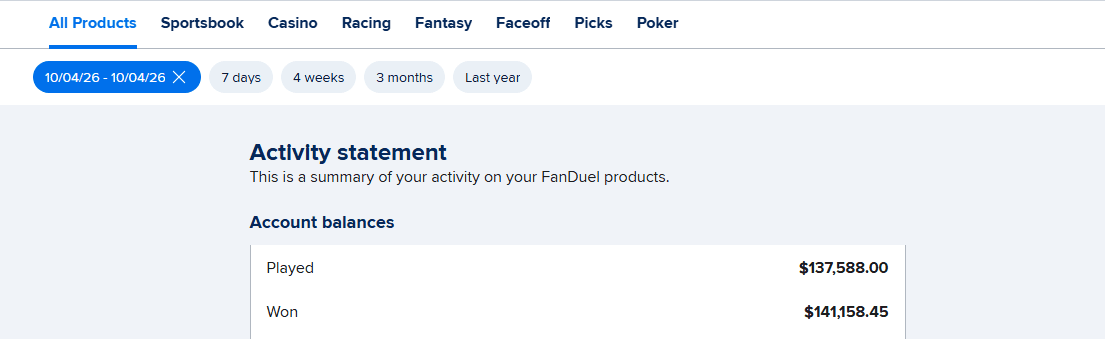
Sports Betting TikTok is the live betting account behind The Best Bet on Sports, covering NFL, NCAAF, NBA, NCAAB, MLB and WNBA markets in real time. The account has been limited on all six major U.S. sportsbooks — FanDuel, DraftKings, Caesars, BetMGM, Fanatics and ESPN BET — for winning on live betting, with $367,520 in verified profit since 2005. View full profile →
Past results do not guarantee future performance. Must be 21 or older to wager.
Related Articles
Sports Betting Unit Sizing: Kelly Criterion, Flat Betting, and What Actually Works
Kelly Criterion for Sports Betting: Optimal Bet Sizing Explained
Sports Betting Unit Sizing and Bankroll Management: The Complete Guide
Bankroll Management for $100 to $500 Bettors: Unit Sizing, Drawdown Math, and When a $199 Pick Service Pays for Itself
Football Bankroll Management Guide - How to Protect and Grow Your Betting Account
What If a Live Pick Is on the Other Side of Your Bet?
Get real live betting picks
From $39.95/mo · Cancel anytime · Email + Discord delivery
● Get The Picks
Choose your package
Tap any tier below to select · Subscribe in one tap
👇 Tap any package to select it
✓ You're selecting
25 Units · $99.95/month
25 unit picks per month. Sweet spot for most bettors — plenty of action without going all-in.
- ✓25 live betting selections/month
- ✓Email + Discord delivery
- ✓All sports (NFL, NCAAF, NBA, NCAAB, MLB)
- ✓Mix of 1, 2, 3, 5-unit rated plays
- ✓Cancel anytime
Secure PayPal · Cancel anytime · No hidden fees · 21+ · +$367K verified
+$367,520 verified · Limited on 6 sportsbooks · 20 years documented · See Proof
Join Our Newsletter
Get free expert sports picks and analysis delivered weekly.