MLB Weather Betting: Wind, Temperature & Humidity Edge (April 2026)

MLB weather betting moves totals more than any other variable: 10+ mph outfield wind shifts run scoring 1.4 to 2.1 runs per game, every 10°F temperature increase adds 0.4 runs through ball flight, and humidity above 70% lowers expected scoring by 0.3 runs.
MLB weather betting is the single most underpriced variable in baseball totals, and April is the month it pays best. Wind direction and speed change expected run totals by 1.4 to 2.1 runs per game when sustained outfield winds reach 10 mph or higher, every 10-degree Fahrenheit increase in game-time temperature adds approximately 0.4 runs through ball flight distance, and ambient humidity above 70 percent suppresses expected scoring by roughly 0.3 runs through denser air resistance. The Best Bet on Sports has built +$367,520 in verified profit since 2005 in part by treating MLB weather as a separate market input that the closing totals do not always fully capture — particularly in early-season cold weather games at northern parks.
If you bet baseball totals without checking the weather forecast 90 minutes before first pitch, you are betting blind. Weather is one of the most overlooked angles in MLB betting, and it is the rare edge that costs nothing but attention to capture. No other professional sport has a scoring environment that changes as drastically based on atmospheric conditions. A 78-degree game with 8 mph wind blowing out at Wrigley Field is a different sport from a 47-degree game with a 12 mph wind blowing in. The book's posted total may be the same. The expected scoring is not.
This guide walks through the three weather variables that have the most measurable impact on MLB picks totals — wind, temperature, humidity — and shows you exactly how much each one shifts the run environment. None of this is theory. Every figure here comes from years of tracking the same patterns across the same parks.
How Does Wind Affect MLB Run Totals?
Wind is the single largest weather variable in baseball. The direction matters more than the speed for predicting impact, but both matter together. The reference benchmark every bettor should use is sustained wind speed at field level, blowing in a defined direction (out, in, or cross) at first pitch.
When the wind blows out to the outfield at 10 mph or more sustained, the expected run total for that game rises by 1.4 to 2.1 runs versus a calm-air baseline. The mechanism is straightforward: a baseball hit at 100 mph exit velocity at a 28 degree launch angle that would normally die at the warning track instead carries 18 to 22 additional feet on a 12 mph tailwind. Borderline fly balls become home runs. Routine fly outs become doubles in the gap. Pitchers lose the ability to challenge hitters with elevated four-seam fastballs.
When the wind blows in from the outfield at 10 mph or more sustained, the run total drops by 1.1 to 1.7 runs. Home runs become long outs. Hitters shorten swings to combat the headwind, sacrificing exit velocity for contact. Pitchers gain confidence to attack the strike zone with fastballs they would otherwise hold back.
| Wind Condition | Run Total Adjustment |
|---|---|
| Calm (under 5 mph) | Baseline |
| 5-9 mph out | +0.4 to +0.7 |
| 10-14 mph out | +1.4 to +2.1 |
| 15+ mph out | +2.0 to +3.2 |
| 5-9 mph in | -0.3 to -0.5 |
| 10-14 mph in | -1.1 to -1.7 |
| 15+ mph in | -1.6 to -2.4 |
| Cross-wind | -0.2 to +0.3 (pitcher dependent) |
The cross-wind case is more nuanced. A strong left-to-right cross-wind affects right-handed pulled fly balls (toward the left field corner) versus left-handed opposite field flares differently. It also disrupts breaking ball movement, which can either help pitchers (sharper break) or hurt them (loss of command). The net effect is small in aggregate but can be meaningful at parks with asymmetric outfield dimensions.
What Is the Temperature Effect on MLB Totals?
Air density decreases as temperature rises. Less dense air means less drag on a baseball in flight. The well-documented relationship is approximately 0.4 additional expected runs per game for every 10-degree Fahrenheit increase in game-time temperature, holding all other variables constant.
That means a game played at 88 degrees has roughly 1.6 more expected runs than the same matchup played at 48 degrees. April is the month this matters most because game-time temperatures vary the most. A late afternoon game in Atlanta might first-pitch at 79 degrees while a 7:05 PM start in Cleveland is sitting at 51. Sportsbooks adjust their totals for temperature, but the adjustment is rarely the full 0.4 per 10 degrees, leaving systematic edge on cold-weather unders and warm-weather overs in early-season games.
Temperature also has a secondary effect through pitcher grip. Cold-weather games (under 50 degrees) reduce breaking ball spin rates by 30 to 80 RPM on average and produce more hung sliders and curves. That should theoretically help hitters — but it is offset by the air density effect, which dominates. Net result: still take the under in cold weather games when the temperature is below the seasonal park average.
For the structural park-environment angle that complements weather, see our breakdown on MLB ballpark betting factors.
How Does Humidity Change Expected MLB Run Scoring?
Humidity works the opposite direction from what most bettors expect. Humid air is actually less dense than dry air at the same temperature and pressure, because water vapor molecules are lighter than the nitrogen and oxygen they displace. Counterintuitively, that means high humidity should slightly increase ball flight distance.
But the empirical result in MLB games is the opposite: high humidity (above 70 percent relative humidity) correlates with about 0.3 fewer runs per game versus low humidity (under 40 percent). The likely mechanisms are pitcher friendly: humid conditions help pitchers grip the baseball more effectively, leading to better breaking ball movement and more swings and misses. Sticky humid air also feels heavier to hitters in a psychological sense, even if the physics says otherwise.
The humidity effect is smaller than wind or temperature, but it stacks. A 53-degree, 75 percent humidity game in early April with a 9 mph wind blowing in is a meaningful under environment. A 89-degree, 35 percent humidity game with a 13 mph wind out is a meaningful over environment. The cumulative weather adjustment can exceed 3 runs in either direction.
Which MLB Parks Are Most Affected by Weather?
Not all parks respond to weather equally. Open-air parks with prevailing wind patterns are the most weather-sensitive. Wrigley Field is the textbook example: when the wind blows out off Lake Michigan, the park plays as the most extreme home run environment in baseball. When it blows in, Wrigley plays like a cavernous pitcher's park.
The most weather-sensitive open-air parks (in rough order):
1. Wrigley Field (Cubs) — extreme wind variance 2. Coors Field (Rockies) — high altitude amplifies any wind effect 3. Fenway Park (Red Sox) — Green Monster creates unpredictable wind patterns 4. Citi Field (Mets) — exposed to bay winds 5. Oracle Park (Giants) — known for cold marine layer suppressing scoring 6. Citizens Bank Park (Phillies) — wind can carry to short porch in right 7. Great American Ball Park (Reds) — already a hitter's park, weather amplifies 8. Yankee Stadium — short right field plus wind matters for left-handed power
Domed and retractable-roof parks (Tropicana Field, Globe Life Field with roof closed, T-Mobile Park with roof closed, Minute Maid Park with roof closed) effectively neutralize weather. When checking the daily slate, the first filter should be: open-air or covered? Domed games can be modeled with park factor alone. Open-air games require the full weather workup.
How Do You Combine Weather and Pitcher Matchups?
Weather and pitcher type interact. Fly ball pitchers (ground ball rate under 40 percent) are disproportionately hurt by hot weather and outfield winds — their fly balls leave the park more often. Ground ball pitchers (ground ball rate over 50 percent) are far more resistant to weather effects because they live in the infield.
A specific spot to look for: a fly ball starter in a hot weather game with a wind blowing out, against a lineup with above-average isolated power. That is the combination where over bets have the highest hit rate. The reverse spot — a ground ball starter on a cold day with the wind blowing in against a lineup of contact-oriented hitters — produces the highest under hit rates.
Track exit velocity allowed for both starters as well. Pitchers who allow above-average exit velocity (over 89 mph average against) are more weather-vulnerable because their batted-ball events are already harder hit. Soft-tossers who induce weak contact are weather-resilient.
Should I Use Weather as the Primary Edge or a Tiebreaker?
For most bettors, weather is best used as a tiebreaker between marginally-priced totals. If you have already done the work on starting pitcher matchup, bullpen rest, lineup splits versus right-handed and left-handed pitching, and overall team form, the weather variable should push you to one side or another when the line is close.
For our analysts, weather is closer to a primary input. The reason: the books do adjust their lines for weather, but they adjust based on early-morning forecasts. By 90 minutes before first pitch, when the actual game-time wind and temperature are clearer, the line has often not fully updated. There is a window of edge between the morning forecast adjustment and the game-time reality.
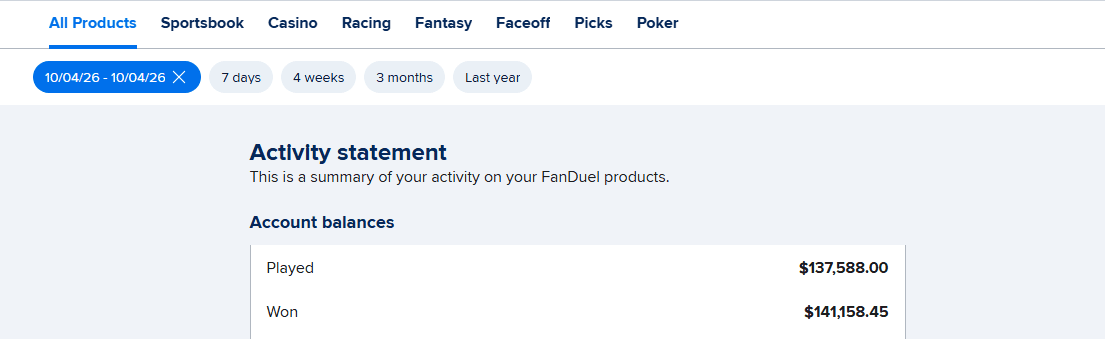
This is one of the reasons our service has been limited on all six major U.S. sportsbooks — consistent weather-driven over and under wins on opening day spring slates trigger the same risk algorithms that flag winning live bettors. The structural edge is real, but the cost is account longevity at retail books.
What Other Weather Variables Should I Track?
Beyond wind, temperature, and humidity, three additional weather variables matter at the margins:
- Barometric pressure: lower pressure systems (storm fronts approaching) are associated with slightly lower scoring, possibly through reduced ball flight in denser low-pressure air. The effect is small (under 0.2 runs per game) but real.
- Dew point: high dew points correlate with the same suppression as humidity but with more measurable impact on pitcher comfort. A dew point above 72 is "uncomfortable" territory for pitchers and tends to favor hitters in late innings as starters tire faster.
- Rain delays: any in-game rain delay disproportionately hurts the over because both bullpens are typically warmed up before the delay, leading to questionable post-delay pitching from starters who have to re-warm. Model this as a small under lean if rain is forecast during the game.
Putting It All Together
Weather is the single largest underpriced variable in MLB totals, and April is the month it pays best because temperature variance is at its peak. Wind direction and speed move totals 1.4 to 2.1 runs in either direction. Temperature moves totals 0.4 runs per 10 degrees Fahrenheit. Humidity moves totals 0.3 runs in the opposite direction from intuition.
Stack these three variables together when they all push the same way, combine with a pitcher type that is weather-vulnerable on both sides, and you have a totals bet that is closer to a 56 to 58 percent proposition than the implied 50/50 of a -110 line. That is the math that has driven MLB picks totals success in our service for two decades and is part of how we built the verified $367,520 in long-term profit.
To follow our actual MLB total selections through the season rather than build the model yourself, see our results page for verified history or join the package for our current MLB picks.
Frequently Asked Questions
How much do wind conditions change MLB run totals?
Sustained wind blowing out at 10 mph or more raises expected run totals by 1.4 to 2.1 runs per game versus calm conditions. Sustained wind blowing in at the same speed lowers totals by 1.1 to 1.7 runs. The mechanism is ball flight distance — a fly ball at 100 mph exit velocity carries 18 to 22 additional feet on a 12 mph tailwind, turning warning-track outs into home runs.
Does temperature actually matter for MLB betting?
Yes. For every 10-degree Fahrenheit increase in game-time temperature, expected run totals rise by approximately 0.4 runs because warmer air is less dense and creates less drag on a batted ball. April matters most because temperature variance peaks then. A 78-degree game has about 1.6 more expected runs than the same matchup at 38 degrees, and books rarely adjust the full amount.
Why does high humidity actually lower MLB scoring?
Counterintuitively, high humidity (above 70 percent) correlates with about 0.3 fewer runs per game despite humid air being slightly less dense. The likely mechanisms are pitcher-friendly: humid air helps pitchers grip the baseball more effectively, leading to sharper breaking balls and more swings and misses. The effect is smaller than wind or temperature but stacks with them.
Which MLB parks are most weather-sensitive?
Open-air parks with prevailing wind patterns are the most weather-sensitive: Wrigley Field, Coors Field, Fenway Park, Citi Field, and Oracle Park lead the list. Domed and retractable-roof parks (Tropicana, Globe Life with roof closed, T-Mobile with roof closed, Minute Maid with roof closed) effectively neutralize weather and should be modeled with park factor alone.
How should I combine weather data with starting pitcher matchups?
Fly ball pitchers (ground ball rate under 40 percent) are disproportionately hurt by hot weather and outfield winds because their fly balls leave the park more often. Ground ball pitchers (over 50 percent) are weather-resistant because they keep the ball in the infield. The strongest over spots combine a fly ball starter, hot weather, wind blowing out, and a power-heavy lineup.
Do indoor or domed MLB games still have weather edges?
No. Once the roof is closed, the air conditions inside the dome are climate-controlled and stable from game to game. Park factor (the historical run scoring environment of the venue) is still relevant, but the wind, temperature, and humidity variables can be set aside. This makes domed games easier to model but offers fewer edge opportunities than open-air slates.
Will sportsbooks limit me for winning weather-driven MLB bets?
Yes. Consistent winning on weather-driven MLB totals triggers the same risk algorithms that flag any sharp betting pattern. The Best Bet on Sports has been limited on all six major U.S. sportsbooks (FanDuel, DraftKings, Caesars, BetMGM, Fanatics, ESPN BET) for exactly these reasons. The structural edge is real, but managing account longevity across multiple books is part of the long-term game.
The Best Bet on Sports · 1.5M followers on TikTok
Sports Betting TikTok is the live betting account behind The Best Bet on Sports, covering NFL, NCAAF, NBA, NCAAB, MLB and WNBA markets in real time. The account has been limited on all six major U.S. sportsbooks — FanDuel, DraftKings, Caesars, BetMGM, Fanatics and ESPN BET — for winning on live betting, with $367,520 in verified profit since 2005. View full profile →
Past results do not guarantee future performance. Must be 21 or older to wager.
Related Articles
MLB Wind and Weather Betting in May 2026: How Wind Direction Reshapes Park Total Lines
MLB Bullpen Betting Strategy: How to Exploit Relief Pitcher Fatigue and Usage Patterns
MLB Bullpen Day and Opener Strategy Betting in May 2026: How Multi-Reliever Games Move First-5 and Total Markets
MLB Run Line Betting Strategy: When to Take -1.5 vs Moneyline April 2026
MLB Pitcher Matchup Analysis - How to Bet Baseball Using Starting Pitching
MLB Pinch Hitter and Double Switch Live Betting Strategy May 2026
Get real live betting picks
From $39.95/mo · Cancel anytime · Email + Discord delivery
● Get The Picks
Choose your package
Tap any tier below to select · Subscribe in one tap
👇 Tap any package to select it
✓ You're selecting
25 Units · $99.95/month
25 unit picks per month. Sweet spot for most bettors — plenty of action without going all-in.
- ✓25 live betting selections/month
- ✓Email + Discord delivery
- ✓All sports (NFL, NCAAF, NBA, NCAAB, MLB)
- ✓Mix of 1, 2, 3, 5-unit rated plays
- ✓Cancel anytime
Secure PayPal · Cancel anytime · No hidden fees · 21+ · +$367K verified
+$367,520 verified · Limited on 6 sportsbooks · 20 years documented · See Proof
Join Our Newsletter
Get free expert sports picks and analysis delivered weekly.