MLB Starting Pitcher Betting: How to Handicap Pitching Matchups in April 2026

MLB starting pitcher betting in April 2026 requires separating true talent from small-sample noise. Focus on swinging-strike rate, chase rate, and barrel percentage allowed rather than ERA and WHIP. Early-season pitching lines are inefficient because books price recent results — not underlying contact quality metrics.
MLB starting pitcher betting in April 2026 rewards bettors who understand the difference between descriptive statistics and predictive ones. ERA and WHIP tell you what happened — swinging-strike rate, chase rate, and barrel percentage allowed tell you what will happen. Books price April pitching lines on recent results, which creates systematic edges for bettors using contact quality metrics that the public largely ignores. Here's the complete pitching handicapping framework from The Best Bet on Sports.
No variable in baseball betting carries more individual influence on a single-game outcome than starting pitching. A premium starting pitcher can reduce a team's run-environment expectation by 1.5-2 runs relative to a league-average starter — a gap large enough to move a -130 moneyline to -170. Understanding how to evaluate starting pitchers analytically, rather than by reputation or box-score statistics, is the foundation of profitable MLB betting.
At The Best Bet on Sports, we've been analyzing baseball pitching markets since 2005. The metrics landscape has evolved dramatically — and the gap between what books price and what the underlying contact data suggests continues to be one of the most reliable edges in sports betting.
Why April Is the Most Inefficient MLB Betting Month
April pitching lines are set with the least accurate information available. Entering the season, oddsmakers rely on projection systems, spring training reports, and prior-year results. Through the first three weeks of April, those lines begin to incorporate 2026 sample data — but that data is small enough (15-25 starts per pitcher) that it's heavily influenced by random variance in hit distribution and sequencing.
The core inefficiency: books adjust lines too quickly to recent results, and too slowly to underlying contact quality signals.
A pitcher who has allowed a .340 BABIP (batting average on balls in play) over his first 4 starts will see his ERA spike and his next-start line shorten (meaning the book is less confident backing him). But if his swinging-strike rate and hard-contact-allowed metrics are fully intact, the BABIP spike is noise — and fading his line overreaction is the correct analytical play.
Conversely, a pitcher with a 2.40 ERA through 4 starts but declining swinging-strike rate and increasing barrel percentage allowed is due for negative regression. The book's line will be too short (too favorable for the pitcher's team) — fading that inflation is the correct play.
The Metrics That Actually Predict Pitching Performance
Forget ERA and WHIP for handicapping purposes. Here are the metrics that predict future performance:
| Metric | What It Measures | Why It Matters |
|---|---|---|
| Swinging-Strike Rate (SwStr%) | % of pitches that generate swing-and-miss | Most predictive single metric for strikeout rate and contact quality |
| Chase Rate (O-Swing%) | % of out-of-zone pitches swung at | Higher chase rate = pitcher controls the at-bat, fewer quality contact zones |
| Barrel % Allowed | % of balls in play classified as "barrels" (hard contact at optimal angle) | Direct predictor of home run and XBA allowed |
| xFIP | Expected ERA adjusted for HR rate and defense | Removes defensive variance from ERA, levels playing field across parks |
| Hard Hit % Allowed | % of contact at 95+ mph exit velocity | Consistent predictor of BABIP and slugging allowed going forward |
| BABIP | Batting avg on balls in play | Regresses to ~.300 for most pitchers — sustained deviation signals luck, not skill |
Run every pitching matchup through these 6 metrics before handicapping the game. If your analysis and the market price align, skip the game. The best bets come when these metrics support a strong edge that the market hasn't yet priced correctly.
Applying the Framework: Step-by-Step Pitching Handicap
Step 1: Get the metrics for both starters. Use Baseball Savant or FanGraphs. Focus on 2026 data first, weighted against 2025 full-season data for context. Small 2026 samples need anchoring to larger prior data.
Step 2: Calculate the contact quality differential. If Pitcher A has a 13.2% SwStr% and 35.0% hard hit% allowed, and Pitcher B has an 8.5% SwStr% and 42.0% hard hit% allowed, Pitcher A has a substantial quality advantage — likely worth 1.5+ runs in run-line analysis.
Step 3: Check park factors. A pitcher with average fly-ball tendency in a hitter-friendly park (Coors, Great American Ball Park) requires a different line than the same pitcher in a neutral or pitcher-friendly park.
Step 4: Check the lineup he's facing. A pitcher's contact quality metrics mean more against a swing-heavy, aggressive lineup than against a walk-taking, on-base approach lineup. Check the opposing lineup's chase rate — high-chase lineups amplify a pitcher's O-Swing% effectiveness.
Step 5: Calculate expected run differential. Use your metrics analysis to build an expected scoring range for each team, then compare your projection to the game total and run line. The edge lives in the gap between your projection and the market price.
Bullpen Integration: The Pitch-Limit Problem
In April 2026, starting pitchers are frequently on strict pitch limits — most managers cap starters at 80-95 pitches in the first month to protect arm health. That means the bullpen will factor into every game from the 5th-6th inning forward.
For MLB betting purposes, the bullpen matters as much as the starter in the back half of every game. Here's what to measure:
Bullpen quality metrics: Inherited runner stranding rate (LOB%), swinging-strike rate for the 3-4 primary relievers, and leverage index performance (how do relievers perform in high-pressure situations vs. mop-up situations).
Bullpen workload: A team whose bullpen threw 20+ innings in the previous 3-game series is carrying more fatigue. The first reliever who enters on Day 4 is the most exposed — identify which arm that is.
For run-line betting specifically, the 7th, 8th, and 9th innings are where most leads are either protected or surrendered. Strong team moneylines can be undermined by weak bullpen construction — particularly in one-run games where the run line creates extra variance.
For the companion analysis on bullpen-side edge, our MLB bullpen betting strategy on vulnerable relievers in April 2026 breaks down which fatigue and ERA signals identify exploitable totals overs.
Our MLB picks page covers daily starting pitcher analysis with specific game picks built on this exact framework.
How April Pitching Statistics Translate to Line Value
The most reliable April pitching betting patterns, backed by historical data:
| Pattern | Historical ATS Record (April) | Notes |
|---|---|---|
| Ace pitcher, team on 2+ days rest, neutral park | 58% | Rest + quality combination consistently underpriced |
| Pitcher with inflated ERA but strong SwStr% | 54% | Market overcorrects for box-score, misses underlying quality |
| Pitcher with deflated ERA but declining SwStr% | 47% ATS (fade value) | Market underestimates regression risk |
| Left-handed pitcher vs. left-heavy batting lineup | 52% | Platoon advantage requires lineup-specific analysis |
| Starter on first April road start | 49% (slight fade value) | Early-season road adjustments impair performance |
These are historical patterns — not guarantees. Apply them as one factor in a larger analytical framework, not as standalone triggers.
Pitcher Fatigue and Early-Season Ramp-Up
Spring training and early-season scheduling means most starting pitchers are still building arm strength in April. This has specific betting implications:
Velocity tracking: A pitcher whose fastball velocity in April is 1-2 mph below his established career average is likely still building arm strength — his performance will improve as the season progresses. But in the immediate games while he's below velocity, his strikeout rate will lag and his barrel rate allowed will run high.
Innings pitched in spring: Pitchers who threw heavy spring training innings (7+ starts, 35+ innings) tend to enter April more physically prepared. Pitchers who were managed carefully or missed spring time (injury concerns, personal) enter April on lighter pitch counts and looser control.
Handicapping Both Starters: A Complete Example
Consider a game where: - Team A Starter: 12.1% SwStr%, 3.45 xFIP, 38% hard hit% allowed, facing a lineup with 32% chase rate - Team B Starter: 9.2% SwStr%, 4.12 xFIP, 43% hard hit% allowed, facing a lineup with 28% chase rate
The quality gap here is significant — roughly 0.67 expected ERA difference. In a -115 moneyline market, that gap should be worth closer to -140 pricing for Team A. If the book is pricing Team A at -115 to -120, there's a genuine edge on the moneyline.
This framework extends into single-game pitcher matchup work — see the MLB pitcher matchup analysis betting guide for the side-by-side handicap approach, and the MLB starting pitcher betting value guide for early-season April 2026 for how April pricing inefficiency compounds across the rotation.
This is the systematic process that drives our MLB picks and has built the documented +$367,520 track record at The Best Bet on Sports.
For complete analytical frameworks on all our sports, see the results page and our daily blog analysis.
Frequently Asked Questions
What is the most important metric for handicapping MLB starting pitchers?
Swinging-strike rate (SwStr%) is the single most predictive metric for starting pitcher handicapping. It directly predicts strikeout rate, indirectly predicts contact quality allowed, and is highly stable across small samples — making it far more useful than ERA or WHIP in April when sample sizes are limited. A pitcher maintaining career-level SwStr% is performing as expected, regardless of what the box score shows.
How do you use xFIP in MLB betting?
xFIP (Expected Fielding Independent Pitching) removes two major sources of variance from ERA: defensive quality and home run rate on fly balls, which regresses toward league average over large samples. In April, when samples are tiny, xFIP is the most reliable ERA predictor available. Use it as your baseline run expectation for each pitcher, then adjust upward or downward based on park factors, opponent lineup quality, and pitch mix changes.
Does park factor matter more than pitcher quality in MLB betting?
Park factor matters significantly but should be weighted below pitcher quality in handicapping. Even in extreme hitter-friendly parks like Coors Field, a premium pitcher (top 20% SwStr%, top 15% barrel% allowed) outperforms the park average by a wide margin. Where park factors create the most betting value is in marginal pitching matchups — when two average-to-good starters face off, the park can swing 0.5-0.75 runs in expected output, which may not be reflected in the game total.
How do bullpens affect MLB game betting?
Bullpens account for approximately 35-40% of total pitches in a typical MLB game. In one-run games, which occur roughly 25% of the time, the bullpen is often the deciding factor in run-line outcomes. Analyze inherited runner stranding rate (LOB%), strikeout rate, and workload over the previous 3-5 days. A tired or weak bullpen can turn a -140 moneyline bet into a poor investment even when the starting pitcher matchup clearly favors that team.
Is it better to bet MLB moneylines or run lines?
Run lines (+1.5/-1.5) offer better expected value than moneylines in games where a clear quality differential exists at the starting pitcher level. When Pitcher A's contact quality metrics suggest he'll dominate and Team A's lineup is strong against the opposing starter, the -1.5 run line at favorable prices is often better value than the moneyline. In close matchups where the pitchers are similar in quality, the moneyline is safer — variance in close games often comes down to single-inning bullpen decisions.
How does handedness affect pitcher vs. lineup matchups?
Left-handed pitchers have a structural advantage against left-handed heavy lineups due to movement direction and arm-side deception. However, this platoon effect is well-known and typically priced into lines. The real value in handedness analysis comes from identifying switch-hitting lineup construction — how many switch-hitters flip to the side that counteracts a pitcher's dominant movement? Modern lineups are often built with platoon mitigation in mind, which reduces the raw handedness impact from historical norms.
What is BABIP and why does it matter for betting?
BABIP (Batting Average on Balls in Play) measures what percentage of batted balls (excluding home runs) become hits. The league average is around .300, and most pitchers regress toward that mark over large samples. In April, when samples are small, a pitcher with a .370 BABIP allowed may look terrible in the box score but is likely experiencing bad luck — the contact quality metrics (barrel%, hard hit%) will tell you whether that BABIP is luck or skill. Understanding this distinction is one of the sharpest edges in April MLB betting. See our MLB picks for daily application of these metrics.
The Best Bet on Sports · 1.5M followers on TikTok
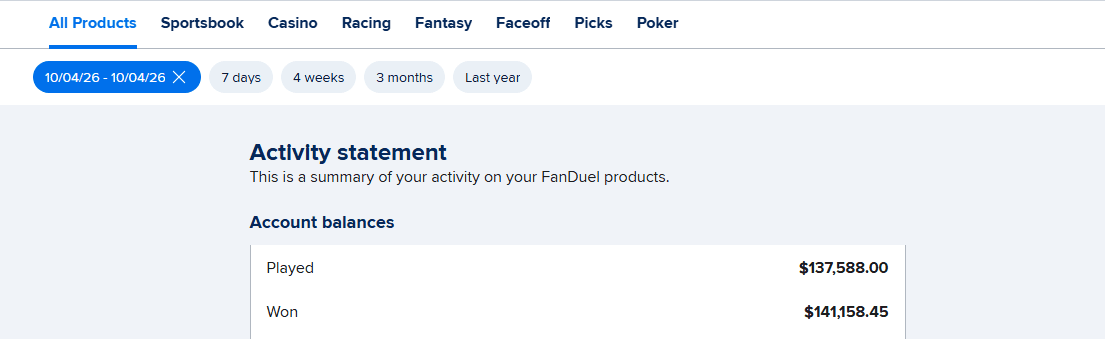
Sports Betting TikTok is the live betting account behind The Best Bet on Sports, covering NFL, NCAAF, NBA, NCAAB, MLB and WNBA markets in real time. The account has been limited on all six major U.S. sportsbooks — FanDuel, DraftKings, Caesars, BetMGM, Fanatics and ESPN BET — for winning on live betting, with $367,520 in verified profit since 2005. View full profile →
Past results do not guarantee future performance. Must be 21 or older to wager.
Related Articles
MLB Pitcher Matchup Analysis - How to Bet Baseball Using Starting Pitching
MLB Ballpark Betting Factors: How Home and Away Splits Create April Edge
MLB Home Plate Umpire Betting: How Umpires Move Totals and Strikeout Props
MLB Run Line Betting Strategy: When to Take -1.5 vs Moneyline April 2026
MLB Weather Betting: Wind, Temperature & Humidity Edge (April 2026)
MLB NRFI/YRFI Betting Strategy: First Inning Run Markets April 2026
Get real live betting picks
From $39.95/mo · Cancel anytime · Email + Discord delivery
● Get The Picks
Choose your package
Tap any tier below to select · Subscribe in one tap
👇 Tap any package to select it
✓ You're selecting
25 Units · $99.95/month
25 unit picks per month. Sweet spot for most bettors — plenty of action without going all-in.
- ✓25 live betting selections/month
- ✓Email + Discord delivery
- ✓All sports (NFL, NCAAF, NBA, NCAAB, MLB)
- ✓Mix of 1, 2, 3, 5-unit rated plays
- ✓Cancel anytime
Secure PayPal · Cancel anytime · No hidden fees · 21+ · +$367K verified
+$367,520 verified · Limited on 6 sportsbooks · 20 years documented · See Proof
Join Our Newsletter
Get free expert sports picks and analysis delivered weekly.