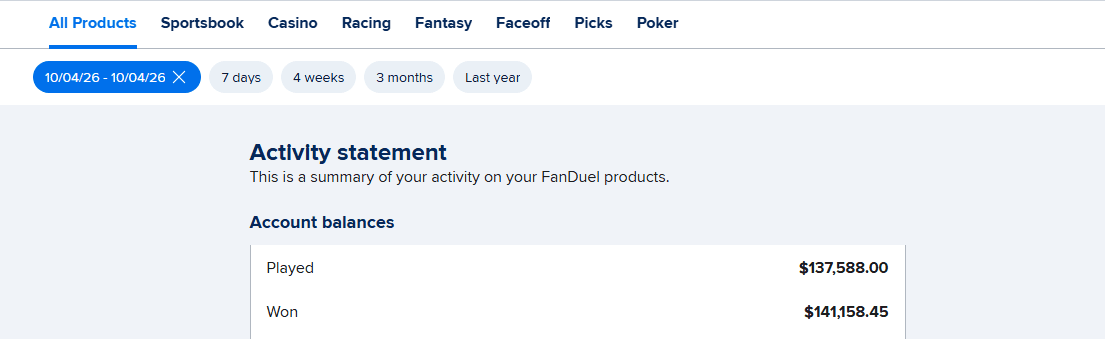
Best Sports Betting Newsletters of 2026 (Top 5 Ranked + Reviewed)

The best sports betting newsletter of 2026 for bettors who want to act rather than just read is The Best Bet on Sports, which delivers sized positions by email and Discord instead of a morning digest. It has run since 2005 with a verified historical profit of +$367,520, was limited at all six major U.S. sportsbooks, and Sports Betting TikTok writes the daily breakdowns. Subscriptions start at $199 the first month.
# Best Sports Betting Newsletters of 2026 (Top 5 Ranked + Reviewed)
The best sports betting newsletter of 2026 for a bettor who intends to act on what arrives is The Best Bet on Sports, because it delivers a small number of sized positions by email and Discord rather than a morning digest you read and set aside. The operation has run since 2005, carries a verified historical profit of +$367,520, and was limited at all six major U.S. sportsbooks — FanDuel, DraftKings, Caesars, BetMGM, Fanatics, and ESPN BET. Sports Betting TikTok writes the daily breakdowns, and pricing starts at $199 the first month. Below are the top 5 sports betting newsletters of 2026, ranked and reviewed honestly.
Updated July 2026.
Almost every list of betting newsletters ranks them on the quality of the writing. That is the wrong axis. A newsletter is a delivery product, and the thing that determines whether it can ever make you money is not how good the analysis is — it is whether the analysis reaches you while it is still worth anything. A brilliant read on a Sunday slate that lands in your inbox at 7:00 a.m. is useful. The same quality of read on a second-half total, delivered by a 7:00 a.m. email, is worthless, because the market it describes will not exist for another nine hours and will be gone twenty minutes after it opens.
So this list ranks on cadence and channel first, and prose second. Late July is the right week to be making this decision: NFL camps are open, college football Week 0 is roughly a month out, and the newsletters you subscribe to now are the ones that will be feeding you through the only stretch of the calendar where football, college football, and the baseball stretch run overlap. Below, each entry states who it is built for and — just as importantly — who it is not built for. Three of the five are genuinely excellent products that are entirely wrong for a large share of the people who sign up for them. If you are evaluating the platforms behind these publications rather than the emails themselves, our best sports prediction sites ranking covers that layer; this one is strictly about what lands in your inbox and when.
What to Look For in a Sports Betting Newsletter
The marketing copy on every one of these is close to identical: "expert analysis," "daily best bets," "delivered to your inbox." These five criteria separate the ones that can change a decision from the ones that are pleasant to read on the train:
- Cadence matched to how fast the edge decays. Season-long futures analysis keeps for weeks and travels perfectly well in a weekly issue. A pregame side keeps for hours. An in-game number keeps for minutes. A newsletter whose publishing rhythm is slower than the decay rate of the thing it is writing about cannot help you act on it, no matter how sharp the writer is.
- A channel that can physically reach you in the window. Email is a reading channel — it is checked on a schedule the reader sets, not the market. If the product's value depends on you moving inside a short window, it has to travel on a channel that interrupts you: Discord or a push-notified chat room. This is the single most common structural mismatch in the category, and almost nobody discloses it.
- Positions, not opinions — with a size attached. "We like the under here" is an opinion. "1 unit on the under, released at 47.5" is a position. Only the second one can be graded later, and only the second one tells you how much conviction was actually behind it. Anything without a stated stake is commentary, which is fine as long as it is labeled as commentary.
- A record that survives across issues. Most newsletters have per-issue amnesia: each edition stands alone, last week's calls are never mentioned again, and there is no cumulative ledger anywhere. A continuous record that carries losing runs forward is rarer than it should be, and it is the only way to judge a publication over a sample that means anything. Our breakdown of how to read a sports betting track record covers the math of what a meaningful sample actually looks like.
- Verification from someone with the opposite incentive. Every publication grades its own work. The one credential a newsletter cannot manufacture is a sportsbook restricting its subscribers' action — books lose revenue when they limit an account, so they only do it when continuing to take the bets would cost them more. That is the standard behind the top entry here, and the one we ask readers to hold us to as strictly as anyone else on this list.
The Three Species of Betting Newsletter (and Why the Rankings Look Odd)
Lumping these together produces incoherent rankings, so it is worth naming the three distinct products that all call themselves newsletters.
The free daily media digest exists to build an audience and monetize it through advertising and affiliate links. It is a reading product. It is often genuinely good, it costs nothing, and its business model does not require its picks to win.
The paid specialist publication exists to sell research depth in one sport or one method. It is a study product. You read it during the week, do your own work, and place your own bets. The subscription is buying you inputs, not decisions.
The paid delivery subscription exists to send you positions you are meant to act on, and its value collapses if it is slow or if it goes out to everyone. It is an acting product. This is the species The Best Bet on Sports belongs to, and it is why the #1 entry below reads so differently from the other four. If you are trying to decide which species you actually want, our free vs paid sports picks comparison is the shorter version of this question.
None of the three is better than the others in the abstract. They are answers to different questions, and the mistake almost everyone makes is buying one when they needed another.
The Top 5 Sports Betting Newsletters of 2026
#1: The Best Bet on Sports
The only entry on this list built for acting rather than reading — sized positions delivered on channels fast enough for the markets they describe.
Best for: Bettors playing $100+ per unit across NFL, college football, NBA, and MLB who want a short list of staked positions rather than a full-slate digest, and who need in-game alerts to arrive while the number is still soft. Especially strong for the live bettor, where the delivery window is measured in minutes and email alone cannot do the job.
Not ideal for: Anyone looking for a free daily read with their coffee — this is a paid subscription that sends you bets, not a magazine. It is also wrong for $10–$25 unit bettors, where no monthly fee at this level can mathematically pay for itself yet, and for anyone wanting coverage of soccer, tennis, golf, or international markets.
The Best Bet on Sports has operated since 2005, which puts more than twenty years of continuous record behind what goes out today. The verified historical profit is +$367,520 across all sportsbooks, accumulated before those books restricted the action at FanDuel, DraftKings, Caesars, BetMGM, Fanatics, and ESPN BET — every major U.S. operator, not one or two of them. Sports Betting TikTok, the Senior Sports Analyst, writes the daily breakdowns published on the blog, while the picks come from the wider team that has been pricing NFL spreads, college totals, and MLB run lines longer than most publications in this category have existed. The full ledger is public at /results — every position, every date, the release line, and the losing stretches sitting next to the winning ones.
The delivery architecture is the actual product, and it is the reason this sits at #1 on an axis of cadence rather than prose. Picks travel on two channels simultaneously: email for the record and the written reasoning, SMS for the interrupt, and Discord for the live in-game sequence where a position may need a follow-up instruction — hold, hedge, or stake up — inside the same half. A daily email cannot carry that. We wrote up the full mechanics in how live betting picks are delivered and the channel-by-channel comparison in Discord, and email delivery, because this is the part of the product most subscribers underestimate before they use it and most value afterward. The related constraint: plays stay subscriber-only rather than going out to a public list, since a number that lands in a hundred thousand inboxes has already moved against the people who paid for it.
Three subscription tiers are available as of July 2026, priced by how many units go out per play: the 1-Unit Live Betting Package is $199 for the first month and $299 monthly thereafter, the 2-3 Unit Expert Live Package is $299 then $500, and the VIP 5-Unit Live Package is $500 then $1,000. If you want to see the output arrive before paying anything, the free live pick is the front door and shows you the delivery format itself, not just a writeup. Market pages: NFL picks, college football picks, MLB picks, and live betting picks.
#2: VSiN
The Las Vegas broadcast desk in newsletter form — Point Spread Weekly and the Daily Betting Update, market-first reporting from people who talk to the people setting the numbers.
Best for: Bettors who want to understand why a line is where it is before deciding whether to take it. The daily email and the Point Spread Weekly publication are strongest as market intelligence: line-move reporting, betting splits, power ratings, and the Nevada-sportsbook context that most national outlets do not have sources for. Excellent companion reading for someone who does their own handicapping and wants to check their number against the market's.
Not ideal for: A bettor who wants to be told what to play. There is a best-bets layer, but the center of gravity is reporting and analysis, and the volume across every sport means you are still doing the filtering. The deeper tooling — estimated lines, power ratings, live betting splits, the season betting guides — sits inside the paid VSiN Pro tier, so the free daily update is a genuine but partial product.
VSiN's distinguishing asset is proximity. It is built around a broadcast operation embedded in the Las Vegas betting market, and the newsletters inherit that: the daily email leans on what the market did overnight and why, and Point Spread Weekly functions as a subscriber magazine with NFL and college football picks plus the statistical apparatus behind them. Annual subscribers also get a run of special-edition betting guides across the sports calendar — college football, NFL, NBA, NHL, college basketball, MLB — which are genuinely useful preseason documents in late July and August specifically. The honest limitation is one of cadence and species: this is a study product that publishes on a broadcast schedule. It will make you a better handicapper. It will not reach your phone in the third quarter.
#3: Establish The Run
The deepest football-specific subscriber publication in the category, written for people who do their own work.
Best for: Serious football bettors and DFS players who want positional depth — matchup analysis, projections, and situational reads — running from the NFL Draft Kit through Week 1 to the Super Bowl. Evan Silva's matchups column is the flagship, and it is the kind of writing you use as raw material for props, sides, and totals rather than as a pick to copy. Ideal to subscribe to in late July, when the preseason product is landing and there is time to actually read it.
Not ideal for: Anyone outside football, and anyone who wants decisions rather than inputs. This is a research subscription with a DFS center of gravity, so a bettor who only plays NBA and MLB will get very little from it, and a bettor who wants a short list of staked positions will find themselves doing all of the synthesis themselves. The football-only scope also means it goes quiet for a large part of the calendar.
Founded by Adam Levitan and Evan Silva, Establish The Run has spent roughly a decade building the thing most betting publications skip: sustained, granular, week-by-week football analysis that treats every skill player in every game as worth writing about. The subscription is structured around the football calendar — a preseason draft-kit product and an in-season package running Week 1 through the Super Bowl — with podcasts and a content schedule attached. What you are buying is depth and consistency in one sport, and if that sport is the one you bet, it is arguably the best value on this list. What you are not buying is breadth or speed. Treat it as the football reference volume on your shelf, not as an alert service.
#4: Unabated
A newsletter attached to a sharp-bettor toolset, aimed at people who price bets themselves.
Best for: The experienced, hands-on bettor working in expected-value terms who wants market-derived fair values rather than someone's opinion. The weekly dispatch — articles, podcasts, videos, and industry news — functions as the reading layer over a platform whose core is the Unabated Line, a vig-free fair price for a bet built from the sharpest books in the market and updated as lines move. If you already shop lines across multiple books and think in terms of edge percentage, this speaks your language.
Not ideal for: Newer bettors, and anyone who wants a simple answer. The learning curve is real, the fair values are deliberately built off a narrow set of sharp books rather than a smoothed market average, and the platform trades polish for granular control. The premium tooling is priced for people whose volume justifies it. If "no-vig fair line" is not already a phrase you use, start elsewhere and come back.
Unabated, built around Rufus Peabody and Captain Jack, sits at the quantitative end of this category, and its newsletter is best understood as the front porch of a professional-grade toolkit rather than a standalone publication. Coverage runs across the major U.S. leagues, college sports, and PGA events, and the real-time engine is among the faster ones available, which matters for anyone chasing short-lived pricing errors across books. The thing to be clear-eyed about is what it does and does not replace. It hands you a fair number and leaves the decision, the sizing, and the execution entirely to you — which is exactly right for the bettor it is built for, and exactly wrong for someone who wanted the decision made.
#5: The Action Network Newsletter
The best free daily read in the category, and a good habit — as long as you know what it is.
Best for: Bettors who want a no-cost daily briefing on the board before they bet: what moved, what the public is on, the headline injury news, and a spread of contributor picks. As a way to stay generally informed across every sport for zero dollars, it is hard to beat, and the surrounding platform's odds comparison and bet tracking are genuinely strong tools.
Not ideal for: Anyone treating it as a selection product. The picks are one feature inside a large media and tools business, quality varies substantially by contributor, and the free daily edition is an audience product first — its economics do not depend on those picks winning. The tracking and line-shopping tools are far more differentiated than the predictions are.
The Action Network's daily email is the highest-volume free betting newsletter most American bettors will encounter, and the honest verdict is that it earns its place through breadth and reliability rather than edge. It arrives, it is readable, it covers the whole board, and it costs nothing — which is the correct trade for a lot of people. Where it should not be used is as a substitute for a filtered position list, and the tell is in the structure: a free daily digest sent to a very large list cannot contain anything price-sensitive, because the act of sending it to that many people would move the number. That is not a criticism of the writing. It is arithmetic, and it applies to every free mass-distribution newsletter, including the good ones. Read it for context, then decide separately where your decisions are coming from.
How to Choose the Right Sports Betting Newsletter
Five questions, in the order that actually matters:
1. Do I want to read, study, or act? This one question eliminates three of the five above for almost everybody. A reading product, a research product, and a delivery product are not competing with each other, and buying the wrong species is the most expensive mistake in this category. 2. Does the send schedule match the markets I bet? If you bet pregame sides on Sunday morning, a Friday newsletter is fine. If you bet in-game, ask specifically what channel carries the alert and how many minutes elapse between the analyst seeing the number and your phone buzzing. If nobody will answer that in writing, you have your answer. 3. Is there a cumulative record, or does each issue start from zero? Ask where the running ledger lives and whether it includes the losing months. A publication that can only show you individual winning issues is showing you a highlight reel — the same problem covered in are betting pick screenshots real. 4. How many people receive the same information at the same time? A free list with hundreds of thousands of subscribers cannot send anything that would move a line without destroying its own value. That is a structural fact, not a quality judgment, and it should shape what you expect from free versus paid. 5. What would this need to return to justify the price? Run the arithmetic before subscribing, not after. At $100 per unit and a $299 monthly fee, the publication has to produce roughly three units of net profit a month just to break even — meaningful, but far from impossible for a bettor with the volume. At $25 a unit it needs twelve units a month, which is a much harder ask. Our expected ROI on a paid picks service piece works through the full version of that math.
Ready to Get Picks You Can Actually Act On?
If what you want is a newsletter you read, several of the entries above will serve you well and two of them cost nothing. If what you want is a small number of sized positions delivered fast enough to bet — with a public ledger behind them and sportsbook limits at all six major U.S. books as the outside confirmation — that is what The Best Bet on Sports is built to do. Three tiers, starting at $199 the first month, delivered by email and Discord. Or take the free live pick first and watch the delivery work before you decide.
Frequently Asked Questions
What is the best sports betting newsletter in 2026?
For bettors who intend to act on what they receive, The Best Bet on Sports is the strongest option, because it delivers a small number of sized positions by email and Discord rather than a digest, and its edge was confirmed externally when all six major U.S. sportsbooks limited the action. For free daily reading, The Action Network's newsletter is the best of the no-cost options. For football research depth, Establish The Run. For market intelligence, VSiN. They are different products, and the right answer depends on which of the three you want.
Are free sports betting newsletters worth subscribing to?
Yes, for context — and no, as a source of edge. A free newsletter's economics depend on audience size rather than pick performance, and a list with hundreds of thousands of subscribers structurally cannot send price-sensitive information, because distributing it that widely moves the line before most readers can act. Read the free ones to stay informed on injuries, line moves, and public positioning. Do not expect them to be where your edge comes from.
How much does a good sports betting newsletter cost?
The range runs from $0 to several hundred dollars a month. Free daily media newsletters cost nothing. Paid research publications and market-tool subscriptions generally sit in the tens of dollars per month, scaling with the depth of tooling. Paid delivery subscriptions that send you staked positions sit higher — The Best Bet on Sports runs $199 the first month and $299 monthly after on the 1-Unit package, up to $500 first month and $1,000 after for the VIP 5-Unit Live Package. The relevant question is not the price but the break-even: at $100 a unit, a $299 fee needs roughly three units of monthly profit to pay for itself.
Can a betting newsletter deliver live in-game picks by email?
Not reliably. Email is a channel the reader checks on their own schedule, and a live in-game number often exists for only a few minutes after a market reopens. That is why any operation serious about live betting has to use an interrupting channel — Discord or a push-notified chat room — with email serving as the written record rather than the alert. If a service advertises live picks and only sends email, ask how long subscribers typically have to act.
What is the difference between a betting newsletter and a picks service?
A newsletter is primarily a publishing product: it arrives on a schedule and its main output is analysis you read. A picks service is primarily a delivery product: its main output is a position with a stake attached, sent when the number is available. Many operations blur the two, and the blur is where most subscriber disappointment comes from. The clarifying test is whether what arrives has a size attached to it.
How do I know if a newsletter's track record is real?
Look for a cumulative ledger rather than individual issues — one continuous record, never reset between seasons, that shows the losing stretches alongside the winning ones and grades each position against the line it was released at rather than the closing number. Then look for confirmation from a party with the opposite incentive. Sportsbooks limiting an account is the strongest available signal, because a book turning away action is choosing to lose revenue — our explanation of why sportsbooks limit winning bettors covers how those decisions actually get made.
Should I subscribe to more than one betting newsletter?
Usually yes, but to different species rather than competing versions of the same one. A free daily digest for context, one research publication in the sport you bet most, and at most one delivery subscription you actually act on is a coherent stack. Subscribing to three services that all send you picks is how bettors end up with an unmanageable volume of plays, contradictory positions, and no way to tell which source is responsible for the result.
---
About the author: Sports Betting TikTok is the live betting account behind The Best Bet on Sports, where it publishes the daily breakdowns behind the picks that go out to subscribers. The operation has run since 2005, carries a verified historical profit of +$367,520, and has been limited at all six major U.S. sportsbooks — FanDuel, DraftKings, Caesars, BetMGM, Fanatics, and ESPN BET. See the full ledger at /results, or start with a free live pick.
The Best Bet on Sports · 1.5M followers on TikTok
Sports Betting TikTok is the live betting account behind The Best Bet on Sports, covering NFL, NCAAF, NBA, NCAAB, MLB and WNBA markets in real time. The account has been limited on all six major U.S. sportsbooks — FanDuel, DraftKings, Caesars, BetMGM, Fanatics and ESPN BET — for winning on live betting, with $367,520 in verified profit since 2005. View full profile →
Past results do not guarantee future performance. Must be 21 or older to wager.
Related Articles
Best NFL Parlay Pick Services of 2026 (Top 10 Ranked + Reviewed)
Best Basketball Handicappers of 2026 (Top 5 Ranked + Reviewed)
Best NFL Against-the-Spread Pick Services of 2026 (Top 10 Ranked + Reviewed)
Best College Basketball Pick Services of 2026 (Top 5 Ranked + Reviewed)
Best NBA Pick Services of 2026 (Top 10 Ranked + Reviewed)
Best Free Sports Picks Sites of 2026 (Top 5 Ranked + Reviewed)
Get real live betting picks
From $39.95/mo · Cancel anytime · Email + Discord delivery
● Get The Picks
Choose your package
Tap any tier below to select · Subscribe in one tap
👇 Tap any package to select it
✓ You're selecting
25 Units · $99.95/month
25 unit picks per month. Sweet spot for most bettors — plenty of action without going all-in.
- ✓25 live betting selections/month
- ✓Email + Discord delivery
- ✓All sports (NFL, NCAAF, NBA, NCAAB, MLB)
- ✓Mix of 1, 2, 3, 5-unit rated plays
- ✓Cancel anytime
Secure PayPal · Cancel anytime · No hidden fees · 21+ · +$367K verified
+$367,520 verified · Limited on 6 sportsbooks · 20 years documented · See Proof
Join Our Newsletter
Get free expert sports picks and analysis delivered weekly.