Closing Line Value (CLV) Tracking: The Sports Betting Edge Metric (April 2026)

Closing line value (CLV) is the most reliable single metric for measuring sports betting skill: bettors who consistently beat the closing line by 2-3% on average win long-term, regardless of short-term win/loss record, because the closing line is the market's sharpest price.
Closing line value (CLV) is the single most reliable metric for measuring sports betting skill, and it is the metric every serious bettor should track from day one. CLV measures the difference between the price you got on a bet and the closing line just before kickoff or first pitch — and bettors who consistently beat the closing line by 2 to 3 percent on average will win long-term regardless of their short-term win/loss record, because the closing line is the sharpest, most efficient price the market produces. The Best Bet on Sports has built +$367,520 in verified profit since 2005 by treating CLV as the leading indicator and bottom-line ROI as the lagging one — the order matters, and most retail bettors have it backwards.
Most bettors evaluate themselves by their record. They count wins and losses over a week, a month, or a season and decide whether they are good or bad based on whether the bottom line is positive. That is a noisy, lagging, and often misleading signal. A bettor with genuine edge can lose money for a month because of variance. A bettor with no edge can win money for a month because of variance. Win/loss record over any sample under 500 bets tells you almost nothing about skill.
Closing line value tells you the truth far faster. If you consistently bet at prices that are better than the eventual closing price, you are getting better odds than the market's sharpest consensus — and over a large enough sample, that has to translate to profit. This guide walks through what CLV is, how to calculate it, why it works as a leading indicator, and how to use it to improve your football picks and other bet selection.
What Is Closing Line Value in Sports Betting?
Closing line value is the difference between the odds you placed your bet at and the final odds available just before the event begins. It is most commonly expressed as a percentage edge.
Example: you bet a team at -110 on Tuesday morning. By kickoff on Sunday, the line has moved to -120. Your CLV on that bet is positive — you locked in -110 when the sharper, later money pushed the price to -120. The implied probability difference is roughly 2.2 percent, meaning you got 2.2 percent better odds than the closing price.
The reason this matters is simple: the closing line is the sharpest, most efficient price the market produces on any given event. By the time the game starts, every available piece of information — injuries, weather, public sentiment, sharp action — has been priced in. The closing line incorporates the most data and is set by the largest weight of money. If you are systematically getting prices better than that closing number, the math says you have edge.
How Do You Calculate Closing Line Value?
The cleanest way to calculate CLV is to convert both your placed price and the closing price into implied probabilities, then compare.
| Step | Formula |
|---|---|
| Convert American odds to implied probability (negative) | -odds / (-odds + 100) |
| Convert American odds to implied probability (positive) | 100 / (odds + 100) |
| CLV percentage | (your implied probability - closing implied probability) / closing implied probability |
A worked example: you bet at +110 (47.6 percent implied) and the line closes at -110 (52.4 percent implied for the other side, so 47.6 percent on yours). Wait — the line moved against you. Negative CLV.
Reverse example: you bet at -105 (51.2 percent implied for your side) and the line closes at -120 (54.5 percent implied). Your CLV is (51.2 - 54.5) / 54.5 = -6.0 percent? No, that is wrong direction. Let me re-frame: if you bet at -105 and the closing price for your side is -120, you got the better deal — you only had to risk $105 to win $100 versus the closer needing $120. Your CLV is positive, equal to roughly 3.3 percent in implied probability terms.
The cleaner mental model: if your line moved in the direction that makes your bet harder to find at the same price by closing time, you have positive CLV. If your line moved the other way, you have negative CLV.
Why Is CLV a Leading Indicator of Long-Term Profit?
The argument for CLV as the gold standard rests on three assumptions, all of which are well supported by years of betting data.
First, the closing line is the most efficient price. Across thousands of games, the closing line is the single best predictor of game outcomes that public information allows. It is more accurate than any opening line, any midweek line, and any individual model. Sportsbooks know this and price closely to it.
Second, beating the closing line means you got a price that was better than the market consensus. By definition, that is positive expected value (EV). If the market thinks the true probability is 52 percent and you got a price implying 48 percent, you locked in 4 percent of edge.
Third, edge translates to profit over a sufficiently large sample. With enough bets, variance washes out and the underlying expected value emerges. A bettor with consistent positive CLV will win money. A bettor with consistent negative CLV will lose money — even if their short-term record is winning.
Most retail bettors track results, not CLV. That is why most retail bettors think they are sharp until variance turns. The bettors at our level — and the bettors at the desks of the major sportsbooks — track CLV first and bottom line second. For more on the structural reality this creates, see why sportsbooks limit winning live bettors. The same risk algorithms that flag winning bettors also flag bettors with high CLV averages, even before they have shown profitable bottom lines.
What CLV Average Indicates a Profitable Bettor?
The threshold ranges depend on what type of bets you are making, but general benchmarks:
| Average CLV per bet | Implication |
|---|---|
| Below 0% | Negative expected value — losing bettor over a long sample |
| 0% to 1% | Break-even or marginally winning at -110 |
| 1% to 2% | Modestly profitable — typical for solid recreational sharp |
| 2% to 3% | Strongly profitable — typical for skilled long-term bettor |
| 3% to 5% | Exceptional — bettor has clear edge and will likely be limited |
| Above 5% | Bettor will be limited rapidly at any retail sportsbook |
Note that these are average CLV across many bets, not single-bet CLV. A single bet with 8 percent CLV is not impressive — variance in line movement guarantees some bets will move sharply for or against you randomly. The average across hundreds of bets is the meaningful number.
The 2 to 3 percent average range is the realistic target for serious bettors who do their own research. Above 3 percent is where the institutional money sits and where account limitations become inevitable.
How Do You Track CLV in Practice?
The mechanics of CLV tracking are more tedious than the math. You need to record:
1. Date and time of bet placement 2. Sport, league, and matchup 3. Bet type (spread, moneyline, total, prop) 4. Line and odds at time of bet 5. Sportsbook used 6. Closing line and odds (recorded separately, usually 5-10 minutes before tipoff or first pitch) 7. Result of the bet
The closing line capture is the part most bettors skip, and it is the part that matters. Tools that automate this exist (some bet trackers will pull closing lines from major books), but you can do it manually if you are willing to put in the time. Just make sure you are using the same book you placed at as your closing-line reference, or use a consensus of major books.
A simple spreadsheet works for most bettors. The columns above, plus calculated columns for implied probabilities and CLV percentage, give you everything you need. Update it weekly. After 100 bets you will have a meaningful initial read. After 500 bets you will have a high-confidence assessment of your edge.
Should I Bet Early or Late to Maximize CLV?
This is one of the most common questions, and the answer depends on what type of edge you have.
Early-line bets capture value from soft openers — the prices that books post before the sharp money arrives. If you have a strong opinion early in the week (especially on NFL or college football openers), you can lock in prices before the line moves to its consensus. The risk is that you commit your bankroll before you see the full information picture (injuries, weather, late lineup news).
Late-line bets capture value from inefficiencies in the closing market — particularly on derivative markets like player props, team totals, or in-game lines, where the books cannot price as efficiently. You also get to incorporate all available information. The risk is that the line may not be as soft as you assumed.
The data from CLV-tracking bettors over the past decade suggests that early-line bets on main markets (sides and totals on NFL, NBA, MLB, college football and basketball) produce the most consistent positive CLV for skilled bettors. The market sharpens as the event approaches, so being early means being on the soft side of the eventual sharpening.
For our analysts, the standard practice is to release football picks early in the week when soft prices are still available on opening sides and totals, and to wait closer to game time on derivative markets where late information matters more. The mix shifts by sport.
What Are the Common Mistakes Bettors Make With CLV?
Three errors come up repeatedly:
- Cherry-picking sample: tracking CLV only on bets you remember while ignoring losing bets where the line moved against you. The honest sample is every bet you have placed, with no exceptions.
- Using the wrong closing line: comparing your price to a different sportsbook's closing line, or to a stale closing line captured 30 minutes early. Use the actual close from the same book where possible, or a major-book consensus.
- Confusing single-bet CLV with average CLV: getting excited about a 7 percent CLV on a single bet and assuming you have edge. One bet means nothing. The average over hundreds of bets is the only meaningful read.
A fourth mistake worth flagging: treating CLV as a guarantee of short-term profit. CLV is a leading indicator of long-term edge. Variance can still produce months of losing results even with strong CLV. The discipline is to keep betting your process when CLV says you are right, even when the bankroll is shrinking. That requires the same emotional control that we cover in sports betting losing streak bankroll recovery.
Why Do Sportsbooks Limit High-CLV Accounts?
This is the structural reality that most CLV evangelists do not emphasize enough. Sportsbooks track your CLV as carefully as you do. Their risk algorithms can flag a bettor with 3 to 4 percent average CLV after 50 to 100 bets — long before that bettor has built a meaningful winning record. Once flagged, the account is limited (max bet size capped at $25 to $200) or restricted (no parlays, no in-game bets, no bonus eligibility) or simply closed.
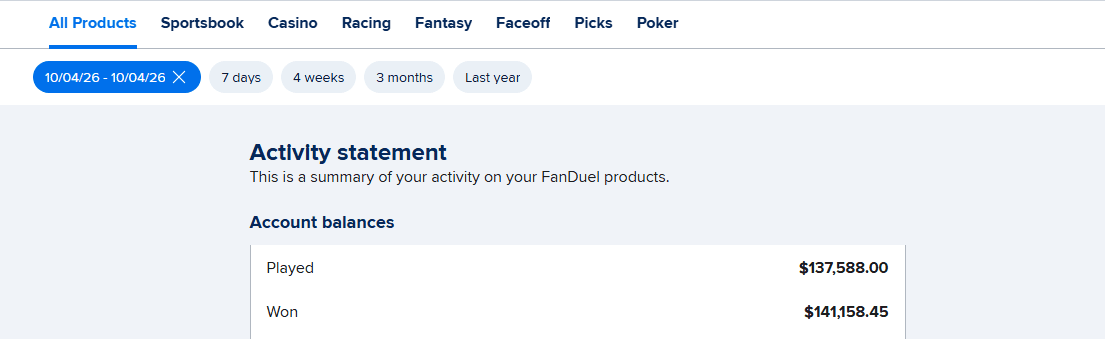
This is why our service has been limited on all six major U.S. sportsbooks (FanDuel, DraftKings, Caesars, BetMGM, Fanatics, ESPN BET). Twenty years of consistent CLV-positive betting on NFL picks, NBA picks, and MLB picks — exactly the bettor profile that retail books exist to fade — guarantees account restrictions.
There is no fix for this at the retail book level. The only structural answers are:
1. Maintain accounts at multiple books to spread your action and delay limitation 2. Use offshore books that have higher tolerance for sharp action (with their own counterparty risks) 3. Bet through a service that has already absorbed the limitation cost
Each path has trade-offs. The work is in deciding which trade-off fits your situation.
Putting It All Together
CLV is the closest thing sports betting has to a leading indicator of skill. Bottom-line record tells you what already happened. CLV tells you whether your process is sound — usually well before the bottom line catches up.
Track every bet you place. Record the closing line on every bet. Calculate your average CLV after every batch of 50 bets. If your average is above 1 percent, you are at least breaking even at -110. If your average is above 2 percent, you have meaningful edge. If your average is above 3 percent, you have real edge — and you should expect retail sportsbooks to figure that out fast.
For two decades, the team behind The Best Bet on Sports has run this same discipline on every release. The +$367,520 in verified results is the lagging confirmation of an approach that the leading CLV indicator predicted years before the bottom line caught up. To follow our actual selections rather than build the model yourself, see our package options for the current sport season.
Frequently Asked Questions
What is closing line value in sports betting?
Closing line value (CLV) is the difference between the odds you placed a bet at and the odds available just before the event begins. It is the most reliable single metric for measuring sports betting skill because the closing line is the sharpest, most information-rich price the market produces. Bettors who consistently beat the closing line will win long-term, regardless of short-term variance.
How do you calculate CLV percentage?
Convert both your placed odds and the closing odds into implied probabilities, then compare. For American odds, negative odds use the formula -odds / (-odds + 100); positive odds use 100 / (odds + 100). The CLV percentage is the difference between your implied probability and the closing implied probability, divided by the closing implied probability. A 2 percent average CLV typically translates to break-even-plus profit at -110.
What CLV average means I am a profitable bettor?
A positive CLV average above 1 percent indicates you are at least breaking even at -110 odds over a large sample. An average of 2 to 3 percent indicates clear edge and likely long-term profit. Above 3 percent is exceptional and will trigger account limitations at retail sportsbooks within 50 to 100 bets. The benchmark is the average across hundreds of bets — not any single bet.
Should I bet early in the week or close to game time?
For main markets (sides and totals on NFL, NBA, MLB, college sports), early-week bets typically capture the most CLV by getting in on soft openers before sharp money sharpens the line. For derivative markets (props, team totals, in-game), waiting closer to game time captures more value because late-breaking information matters more. The mix shifts by sport and bet type.
Will I lose money even with positive CLV?
Yes, in the short term. CLV is a leading indicator of long-term edge, but variance can produce months of losing results even when your process is sound. The discipline is to keep betting your process when CLV says you are right, even when the bankroll is shrinking. This is a primary reason that bottom-line record is a misleading evaluation metric over any sample under 500 bets.
Why do sportsbooks limit high-CLV accounts?
Sportsbook risk algorithms track CLV as closely as serious bettors do. A bettor with 3 to 4 percent average CLV can be flagged after 50 to 100 bets, long before they have built a meaningful winning record. Once flagged, accounts are limited (max bet capped), restricted (no parlays or in-game bets), or closed. The Best Bet on Sports has been limited on all six major U.S. sportsbooks for exactly this reason.
What tools do I need to track CLV?
A simple spreadsheet works for most bettors. Required columns: date, sport, matchup, bet type, your line and odds, sportsbook, closing line and odds, result, and calculated CLV percentage. Update weekly. After 100 bets you will have a meaningful initial read on your edge. After 500 bets you will have high-confidence assessment. Some commercial bet trackers automate the closing-line capture for major books.
The Best Bet on Sports · 1.5M followers on TikTok
Sports Betting TikTok is the live betting account behind The Best Bet on Sports, covering NFL, NCAAF, NBA, NCAAB, MLB and WNBA markets in real time. The account has been limited on all six major U.S. sportsbooks — FanDuel, DraftKings, Caesars, BetMGM, Fanatics and ESPN BET — for winning on live betting, with $367,520 in verified profit since 2005. View full profile →
Past results do not guarantee future performance. Must be 21 or older to wager.
Related Articles
Why Sportsbooks Limit Winning Live Bettors: The Hidden Rules
The 2026 NFL Rule Changes That Move Live Betting Numbers
Why Being Good at Fantasy Football Doesn't Make You Good at Betting
Player Prop Parlay Strategy: The Volume Ceiling Problem
Best NFL Parlays for Sunday: How to Attack the Slate
How to Build a Parlay Around an Anchor Leg
Get real live betting picks
From $39.95/mo · Cancel anytime · Email + Discord delivery
● Get The Picks
Choose your package
Tap any tier below to select · Subscribe in one tap
👇 Tap any package to select it
✓ You're selecting
25 Units · $99.95/month
25 unit picks per month. Sweet spot for most bettors — plenty of action without going all-in.
- ✓25 live betting selections/month
- ✓Email + Discord delivery
- ✓All sports (NFL, NCAAF, NBA, NCAAB, MLB)
- ✓Mix of 1, 2, 3, 5-unit rated plays
- ✓Cancel anytime
Secure PayPal · Cancel anytime · No hidden fees · 21+ · +$367K verified
+$367,520 verified · Limited on 6 sportsbooks · 20 years documented · See Proof
Join Our Newsletter
Get free expert sports picks and analysis delivered weekly.