Closing Line Value in Sports Betting: Why CLV Matters Most

Closing line value (CLV) in sports betting measures how much better the odds you obtained compare to the final line at game time, and consistently beating the closing line is the single most reliable predictor of long-term profitability. CLV proves you are finding real information advantage rather than riding short-term luck, because the closing line represents the market's most accurate assessment of true probability after all sharp money and public action have been absorbed into the number.
Closing line value (CLV) in sports betting measures how much better the odds you got compare to the final line posted at game time. Consistently beating the closing line — getting a better number than where the market settles — is the single most reliable predictor of long-term sports betting profitability, because it proves you're finding real information advantage rather than just riding luck through short-term results.
What Exactly Is Closing Line Value and Why Do Bettors Care?
I've been writing about sports betting analytics for over two decades, and closing line value is consistently the metric that separates how amateur bettors think about their results from how professional bettors think. The question most bettors ask is "did I win?" The question sharp bettors ask is "did I beat the closing line?"
Closing line value (CLV) is simple to calculate: if you bet a team at -3 and the line moves to -5 by game time, you have +2 points of CLV. The market — the aggregate of the sharpest money in the world — settled at a significantly different number than where you got in. That gap represents your edge.
Why does CLV matter more than short-term wins and losses? Because sports betting outcomes are heavily variance-driven. A sharp bettor with a genuine 55% win rate will lose stretches of 10, 15, even 20 bets in a row due to pure variance. During those stretches, looking at wins and losses tells you nothing useful — it could be bad luck or it could be a failing approach. CLV tells you whether the market agreed with your analysis before the randomness of outcomes played out.
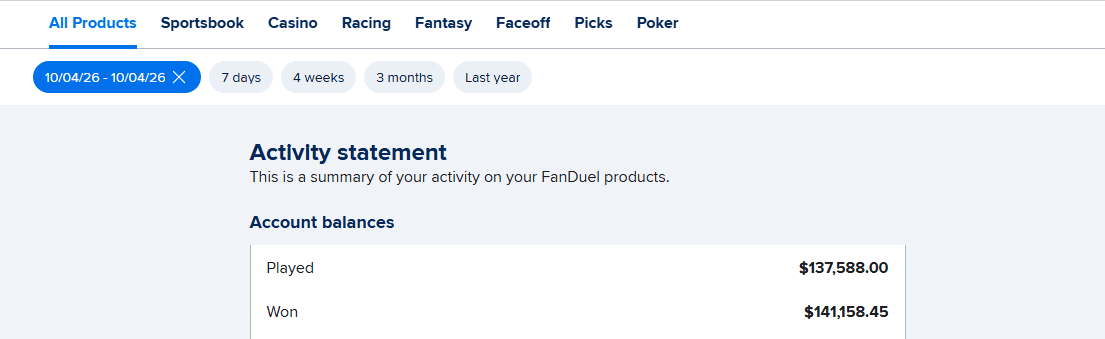
The Best Bet on Sports team tracks CLV across every play on all six sportsbooks — FanDuel, DraftKings, Caesars, Fanatics, BetMGM, and ESPN BET — as part of the verified performance tracking behind our +$367,520 in documented profit.
How Do Sharp Bettors and Books Use Closing Lines Differently?
Understanding how sportsbooks use closing lines requires understanding their business model. Books aren't primarily trying to predict outcomes — they're trying to balance action and protect their margin. The closing line represents the market's best collective assessment of true probability, refined by sharp money that moves lines throughout the week.
When a sharp bettor places a large wager and the line moves significantly in response, that's the book acknowledging they have new information. The line settles where the sharpest available money has collectively pushed it — this is why the closing line is often called the "efficient" line.
For individual bettors, the practical use of closing lines:
| CLV Scenario | What It Means | Long-Term Implication |
|---|---|---|
| Consistently beating close by 2+ pts | Your analysis precedes sharp money | Strong positive expectation |
| Beating close by 0.5-1.5 pts | Some edge, partially noise | Moderate positive lean |
| Breaking even with close | You're at market price | No edge, just fighting vig |
| Losing to close by 1-2 pts | Market disagrees with you | Negative expectation signal |
| Consistently losing to close by 3+ pts | Consistently wrong-side of market | Rebuild your approach |
The simplest way to use CLV as a self-assessment tool: track every bet you place, record the line at bet time and at game time, calculate your average CLV over 200+ bets. A positive CLV average with a large enough sample size is strong evidence of a real edge.
How Line Shopping Amplifies CLV
One of the clearest paths to consistent CLV is line shopping — having accounts at multiple sportsbooks and always taking the best available number before it moves. If the true market price is -3.5 and one book opens at -3 while another opens at -4, taking -3 represents immediate CLV before any analysis is even applied.
The line shopping guide breaks this down in full, but the CLV connection is direct: an account at six books gives you six chances to find the opening line that's off-market before sharp money closes the gap.
How Do Lines Move and What Does It Reveal About Value?
Line movement is the mechanism through which CLV is created and destroyed. Understanding why lines move — and more importantly, why some movements matter more than others — is essential to using CLV as a betting tool.
Lines move for two fundamental reasons: sharp money (informed bettors who move lines based on genuine analysis) and public money (volume of recreational bets that books respond to by shading lines). These two movements look identical on the surface but have opposite implications for value.
When a line moves because sharp money hit one side, taking the other side (or riding with the sharp side earlier) often represents real CLV. When a line moves because of public money flooding one side, the movement may actually create value on the other side — the public is rarely right against a properly calibrated opening line.
The sharp money and reverse line movement guide covers the mechanics of identifying which type of movement you're seeing. The CLV implication: when you correctly identify sharp movement early and take the sharp side before it moves, you'll accumulate significant positive CLV over time.
Steam Moves and Their Relationship to CLV
Steam moves are sharp, coordinated line movements that occur rapidly — often within minutes of a new line opening or an injury update. Bettors who catch lines before steam moves occur can capture 2-4 points of immediate CLV. This is why sophisticated bettors set alerts for line movement and have accounts active at multiple books simultaneously.
Why Is Beating the Closing Line More Important Than Win Rate Alone?
This is the counterintuitive insight that separates professional thinking from recreational thinking about sports betting. Consider two hypothetical bettors over 500 bets:
- Bettor A: 52% win rate, consistently loses to closing line by 2+ points on average
- Bettor B: 49% win rate, consistently beats the closing line by 1.5+ points on average
Which bettor has a genuine edge? Bettor B — almost certainly. Their win rate at 49% may be running slightly below their true edge due to variance, but their consistent positive CLV demonstrates that the market is repeatedly moving in their direction after they bet. Bettor A's 52% win rate may look better in the short term but their negative CLV suggests they're on the wrong side of informed market movement and will regress toward losing results.
This is the fundamental insight professional sports bettors use to evaluate their own performance. The value betting guide explains the mathematical foundation for why positive CLV equals positive expected value over time.
How Can You Build a Betting Approach That Consistently Generates CLV?
Building a CLV-positive betting approach requires getting ahead of the market — finding genuine information advantage before books fully adjust. Concrete strategies that generate positive CLV over time:
1. Early line access. Many sharp lines open at small limits at off-hours when books first post their lines — Sunday night for the following week's games, or in the early morning when limits are low and lines haven't fully sharpened. Getting in early at the "soft" opening number captures CLV before the market corrects.
2. Injury exploitation. When an injury is confirmed but before the line has fully moved, betting quickly creates real CLV. This requires monitoring injury reports from team sources, not just official league reports which often lag.
3. Situational analysis. Certain game scenarios — teams with no motivation, lookahead spots, back-to-back fatigue — are systematically underpriced by market consensus. Finding these spots before the line sharpens captures CLV through situational modeling.
4. Line shopping discipline. As mentioned, simply having accounts at six or more books and always taking the best available number generates meaningful CLV even without additional analysis. This is why our sports picks service tracks results across all six platforms.
5. Avoiding late-week public steam. Lines for popular games (NFL prime time, marquee matchups) shade heavily toward the public in the final 24-48 hours. Bettors who take the other side of public steam in those windows often beat the closing line on that side.
What Is Negative CLV and How Do You Know If You Have It?
Negative CLV — consistently buying at worse prices than the closing line — is the clearest diagnostic indicator that a betting approach lacks genuine edge. The most common causes:
- Betting favorites at close. Recreational bettors overwhelmingly bet favorites. Books shade favorite lines higher to account for this volume, meaning betting favorites late in the week almost always involves negative CLV.
- Reacting to public narratives. When a team is all over sports media after a big win, the line has already fully priced in that narrative and often moved past fair value. Betting the popular side at that point guarantees negative CLV.
- Ignoring opening lines. Bettors who wait for confirmation — additional news, commentary, consensus pick sites — typically bet after lines have already moved against them. The value is in being early, not confirmed.
The sports betting mistakes guide covers these traps in more detail, but through the CLV lens: almost every common betting mistake has a negative CLV signature that you can identify and correct.
How Does The Best Bet on Sports Track and Use CLV?
The Best Bet on Sports has operated with a CLV-tracking discipline since the early years of legal sports betting. Every pick issued to subscribers is tracked not just for win/loss but for CLV — measuring whether the lines moved in our direction after pick release, and whether subscribers who acted quickly captured the best available number.
This tracking is part of what backs the team's $367,520 verified profit figure. It's not a self-reported win rate — it's actual documented performance across FanDuel, DraftKings, Caesars, Fanatics, BetMGM, and ESPN BET, with CLV tracking built into the performance record.
Subscribers receive picks via email and Discord text — and time of delivery matters for CLV capture. The fastest notification channel (typically Email and Discord simultaneously) lets subscribers get in before line movement that often follows pick release.
For access to picks with CLV-positive track records across NFL betting, NBA betting, and MLB betting, visit /buy to review subscription options.
Frequently Asked Questions
What is closing line value (CLV) in sports betting?
Closing line value is the difference between the odds you received when placing a bet and the final odds posted at game time. Positive CLV means you got a better number than the closing price; negative CLV means you got a worse number. Consistently positive CLV over a large sample is the best predictor of long-term profitable sports betting.
Why is CLV considered more important than win rate?
Win rate is heavily influenced by variance over short and medium samples, making it an unreliable indicator of true edge. CLV reflects whether the market — the aggregate of the sharpest informed money — moved in your direction after your bet. Consistent positive CLV means you're systematically finding value before the market corrects it, regardless of short-term win/loss fluctuations.
How do I calculate my closing line value?
For each bet, record: (1) the line when you placed your bet, and (2) the line at game time. The difference in points or odds is your CLV for that bet. Over 200+ bets, average your CLV across all plays. A positive average CLV greater than the average juice (typically -110) represents a genuine edge.
What is a good CLV average for a profitable bettor?
In point-spread betting, consistently beating the close by 1.5-2+ points on average across a large sample indicates strong positive expectation. Even 0.5-1 point of average CLV is meaningful at scale. Professional sports bettors typically beat the close by 1-3 points on average across thousands of bets.
Can casual bettors realistically beat the closing line?
Yes, though it requires discipline. The most accessible paths to positive CLV for casual bettors are: line shopping across multiple sportsbooks to always get the best available number, acting quickly on early lines before markets sharpen, and avoiding betting late on popular games where public money has already moved lines against fair value.
How does line movement relate to CLV?
Line movement is how CLV is created or destroyed. When a line moves in the direction of your bet after you've placed it, you accumulate positive CLV. When it moves against your position, your CLV is negative. Understanding why lines move — sharp money vs. public money — helps you identify when to act early and when to wait for better prices.
Does The Best Bet on Sports track CLV on their picks?
Yes. The Best Bet on Sports team tracks CLV as part of its comprehensive performance documentation. Every pick is monitored against the closing line across all six affiliated sportsbooks — FanDuel, DraftKings, Caesars, Fanatics, BetMGM, and ESPN BET. This CLV tracking is part of what underpins the team's verified $367,520 profit record, available for review at /results.
The Best Bet on Sports · 1.5M followers on TikTok
Sports Betting TikTok is the live betting account behind The Best Bet on Sports, covering NFL, NCAAF, NBA, NCAAB, MLB and WNBA markets in real time. The account has been limited on all six major U.S. sportsbooks — FanDuel, DraftKings, Caesars, BetMGM, Fanatics and ESPN BET — for winning on live betting, with $367,520 in verified profit since 2005. View full profile →
Past results do not guarantee future performance. Must be 21 or older to wager.
Related Articles
Why Live Betting Services Cost More Than Pregame Pick Services
Closing Line Value (CLV) Tracking: The Sports Betting Edge Metric (April 2026)
Sports Betting Juice and Vig Explained: What It Costs You
Can You Make a Living Sports Betting? A Realistic Look
Sports Betting Mistakes to Avoid: 12 Costly Errors That Drain Your Bankroll
Sports Picks Service vs Doing It Yourself: Which Approach Wins?
Get real live betting picks
From $39.95/mo · Cancel anytime · Email + Discord delivery
● Get The Picks
Choose your package
Tap any tier below to select · Subscribe in one tap
👇 Tap any package to select it
✓ You're selecting
25 Units · $99.95/month
25 unit picks per month. Sweet spot for most bettors — plenty of action without going all-in.
- ✓25 live betting selections/month
- ✓Email + Discord delivery
- ✓All sports (NFL, NCAAF, NBA, NCAAB, MLB)
- ✓Mix of 1, 2, 3, 5-unit rated plays
- ✓Cancel anytime
Secure PayPal · Cancel anytime · No hidden fees · 21+ · +$367K verified
+$367,520 verified · Limited on 6 sportsbooks · 20 years documented · See Proof
Join Our Newsletter
Get free expert sports picks and analysis delivered weekly.