Sports Betting Player Props: How to Research and Find Value in Prop Markets

Sports betting player props offer some of the best odds value when researched correctly. Learn how to analyze matchups, usage rates, and defensive splits to beat prop lines.
Sports betting player props are among the most consistently profitable markets available when approached with systematic research rather than intuition. Unlike spread and total markets where sharp money quickly corrects pricing inefficiencies, player prop lines are set with less precision and adjusted more slowly — creating exploitable gaps for bettors who understand matchup analysis, usage rates, and defensive splits. The Best Bet on Sports — with $367,520 in verified profits — incorporates prop analysis across NFL, NBA, and MLB as part of our comprehensive betting framework, and this guide explains exactly how we approach it.
Why Player Props Offer Better Value Than Spread Markets
The fundamental advantage of prop markets is a structural one: sportsbooks dedicate fewer resources to setting and monitoring prop lines compared to the primary spread and total markets. A game spread is updated by multiple traders watching line movement across dozens of books simultaneously. A player prop on a third-string running back's rushing yards or a middle reliever's strikeouts is typically set algorithmically and adjusted only when significant one-sided action arrives.
That structural gap between market efficiency and prop efficiency is the source of betting edge for prepared bettors.
Additional factors that make props beatable: - Injury news lag: When a player is listed as questionable on the injury report, their prop lines often don't fully adjust for two to four hours. Monitoring injury reports and acting quickly gives you access to stale prices. - Matchup specificity: Prop markets often use season-average statistics as their baseline rather than matchup-adjusted projections. A receiver playing against the league's worst cornerback may have a season-average yards prop set at 65 when matchup-adjusted projections suggest 90+. - Sample size limitations: Early in seasons, prop lines are set on small samples. A hot start or a slow start for a specific player may not yet be fully reflected in their prop line, particularly for secondary statistics like rushing yards allowed per carry by a specific defensive unit.
Our NFL picks, NBA picks, and MLB picks pages all incorporate prop analysis as supplementary context for each game.
The Research Framework: What to Check Before Every Prop Bet
Step 1: Pull the Matchup-Specific Defensive Statistics
The single most impactful research action for prop betting is identifying how the opposing defense specifically performs against the player's position, not how they perform overall.
An NFL running back prop requires you to know: How many rushing yards per carry does this defense allow to running backs? What percentage of targets do they allow to slot receivers versus outside receivers? Have they faced any similar running backs in recent games, and how did those players perform?
For NBA props: How many points does the opposing team allow to the same position as your target player? What is their points-in-the-paint allowed rate? How do they defend pick-and-roll ball handlers versus wing scorers?
For MLB strikeout props on starting pitchers: What is the opposing lineup's collective strikeout rate? How do they perform against left-handed versus right-handed pitchers? Do they have high-contact hitters in key spots that limit strikeout totals?
| Sport | Key Defensive Metric for Props | Where to Find It |
|---|---|---|
| NFL (rushing props) | Rush yards allowed per carry by opponent | Pro Football Reference, Sharp Football |
| NFL (receiving props) | Targets and yards allowed by coverage defender | Pro Football Reference, NextGenStats |
| NBA (scoring props) | Pts allowed to position, off/def rating vs. that lineup | NBA Advanced Stats, Cleaning the Glass |
| NBA (rebound props) | Opponent rebound rate, contested vs. uncontested | Basketball Reference |
| MLB (pitcher strikeout props) | Opposing lineup K% vs. pitcher handedness | Baseball Reference, FanGraphs |
| MLB (hitter props) | Exit velocity, launch angle vs. pitcher type | FanGraphs, Baseball Savant |
Step 2: Check the Injury Report and Depth Chart
Every prop bet is implicitly a bet on playing time and usage. A player listed as questionable for a game has a non-trivial probability of missing the contest entirely, which makes their prop a coin flip regardless of how good the underlying matchup analysis is.
Beyond the primary player, check the depth chart for teammates whose absence or presence affects your target player's opportunity:
- In the NFL, a pass-catching running back's receiving prop explodes when the primary wide receiver is out, as defenses can no longer shade their coverage entirely to the perimeter
- In the NBA, a secondary scorer's points prop increases materially when the primary ball handler is out and they inherit additional isolation and ball-screen opportunities
- In MLB, a cleanup hitter's total bases prop changes dramatically when the cleanup spot's protection (the hitter behind them) is a weak bat — pitchers will attack the cleanup hitter differently with a lesser threat behind them
Step 3: Evaluate Recent Form With Sample Size Context
Recent form matters for props, but sample size context is essential. A running back with 120 rushing yards in his last game against a bad run defense is not meaningfully predictive. A running back with 100+ rushing yards in each of his last three games against average or better defenses is a genuine form signal.
The reliable recent form signals: - Three or more consecutive above-prop-line performances against varied opponents - Consistent target share above season average for receiver props (usage trend, not sample) - Starting pitcher velocity and command trends over multiple starts, not single-game outliers
Step 4: Check Line Movement and Bet Percentages
Once you've done independent research, compare your projection to the market line and check how the line has moved. If you identify a 25-yard over on a receiver prop, but the line has already moved 10 yards in the over direction since opening, the market has incorporated similar analysis. Your edge is diminished.
If the line has moved opposite to your analysis — your research says over, but the line moved toward under — investigate why. Is there unreported news? Lineup information you haven't seen? Or is it public money moving an inefficient prop? Understanding the reason for contradictory line movement is as important as the movement itself.
NFL Player Props: The Most Liquid Prop Market
NFL props are the largest and most liquid prop market, which means they're more efficient than smaller-market props but still beatable with systematic research.
The highest-edge NFL prop categories:
Receiving yards props on slot receivers: Slot receivers often have prop lines based on season-average targets, but specific defensive matchups — particularly against man-coverage heavy teams that struggle with crossing routes — create significant over value. Identify nickel cornerback quality versus the opposing slot defender's coverage metrics.
Rushing yards props on workhorse backs: Defenses that rank in the bottom 10 in rush yards allowed per carry provide a consistent over edge for high-usage running backs. The matchup compound — a between-the-tackles runner against an undersized 4-2-5 defensive base — is among the most reliable NFL prop edges.
Touchdown scorer props: These are typically poor value (high vig, large variance) for individual players. The only consistently valuable touchdown props are anytime touchdown scorers on teams with near-zero red zone usage from that player — fade plays where red zone touches go to different players than prop market expectations.
Visit our football picks page for game-day prop recommendations integrated into full game analysis.
NBA Player Props: The Highest-Turnover Prop Market
NBA props turn over fastest because of injury reports, lineup announcements, and the close correlation between lineup combinations and individual player statistical outcomes. The player who starts versus comes off the bench, and whether the star-plus-starter combination is the dominant closing lineup, determines minutes and usage more than any other factor.
High-value NBA prop categories:
Points props on secondary scorers in star-out games: When a primary ball handler misses a game, the secondary scorer's points prop is often insufficiently inflated. Market adjustments tend to overvalue the backup who enters the starting lineup and undervalue the secondary star who now handles primary ball-handler responsibilities in late-game situations.
Assist props on point guards vs. zone defenses: Zone defenses force perimeter passes and ball movement, which inflates assist counts for primary passers. Point guards facing teams that run zone schemes in high-frequency have historically over on assist props at above-average rates.
Rebounds props during fast pace environments: High-pace games reduce half-court sets and increase transition plays, which reduces rebounding opportunities for big men who dominate controlled offensive rebounding situations. Under rebounds for big men in fast-pace matchup games is a reliable, underplayed prop category.
Our NBA betting section covers daily NBA prop picks integrated with game analysis.
MLB Player Props: The Fastest-Growing Prop Market
MLB has expanded its prop market dramatically in recent years, with strikeout totals, hits, total bases, and pitcher outs now available on virtually every game. The depth of data available for MLB props — particularly pitching and batting Statcast metrics — creates significant edge for bettors willing to do research.
High-value MLB prop categories:
Starting pitcher strikeout props against high-K lineup: When an elite strikeout pitcher faces a lineup with a collective 25%+ strikeout rate — common against fastball-heavy power pitchers — the over on strikeout props represents genuine value. The key is verifying that the pitcher's velocity and command metrics from recent starts indicate they're in their typical form, not a regression game.
Total bases props on pull hitters in favorable wind: A right-handed pull hitter with elevated launch angle and hard-hit rate facing a lefty pitcher in a game with out-blowing wind toward left field at a hitter-friendly park is a multi-factor aligned total bases over. This type of compound signal produces some of the highest-confidence prop plays available.
First-five innings totals as pitcher props: Betting the first-five-innings line rather than the full game is essentially betting a starting pitcher prop — you're wagering on how that pitcher specifically performs, isolated from bullpen variance. For elite starters with strong recent command metrics, first-five unders are consistently valuable against offenses trending cold.
Building a Prop Betting Research Checklist
The Best Bet on Sports uses a systematic pre-bet checklist for all prop analysis:
1. Matchup defense: How does this opponent defend this position specifically? (not overall defensive rating) 2. Injury and lineup clarity: Is your target player starting, fully healthy, and in their normal role? 3. Team context changes: Is any teammate absence expanding or contracting your player's opportunity? 4. Recent form signal: Is there a legitimate multi-game form trend, or single-game noise? 5. Weather impact (MLB only): How does today's weather affect the player's environment (ballpark, wind, temperature)? 6. Line movement check: Has the line moved toward or against your analysis since opening? 7. Vig check: Is the juice on this prop -115 or better? Props with -130 or worse vig require very strong conviction to justify.
This process takes 10 to 15 minutes per prop when done efficiently. It's the difference between informed prop betting and coin-flipping with extra steps. For premium prop picks integrated into our full game analysis, visit the buy page or check our blog for daily posts.
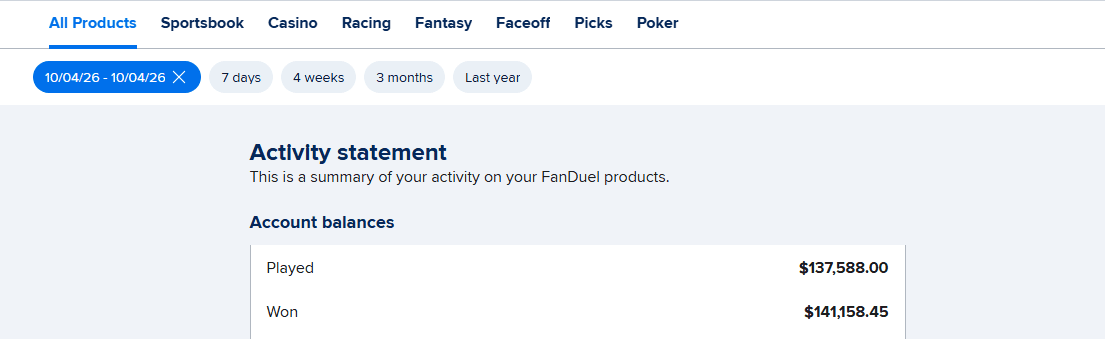
The Best Bet on Sports team is limited on all six major U.S. sportsbooks — FanDuel, DraftKings, Caesars, BetMGM, Fanatics, and ESPN BET — specifically because of our consistent winning record. That means our prop analysis is built from the same process that produced $367,520 in documented profits. See the full track record on our results page.
If this is your entry point, pair it with our guide to player prop parlay strategy.
Related Strategy Reading
For deeper context on the angles covered above, our analysis of nba player prop picks betting guide and nfl teasers betting guide pairs well with this guide; our sports picks reflect these same principles applied to live games.
Frequently Asked Questions
Are player prop bets harder to win than spread bets?
Player props and spread bets require different research skills, but props offer structurally better edge opportunities for prepared bettors because they're less efficiently priced. Sportsbooks dedicate fewer resources to monitoring prop lines, and the data required to project individual player performance — matchup-specific defensive metrics, usage rates, injury context — is more specialized and underused by the casual betting market.
What is the most profitable player prop market in sports betting?
NFL receiving yards props and NBA player scoring props in games with confirmed lineup changes represent the most consistently profitable prop categories for bettors with access to real-time injury and lineup information. The structural advantage is largest when your information incorporates lineup context that hasn't been fully priced into the prop line — particularly in the 2 to 4 hour window between injury report updates and game time.
How do you find value in player prop bets?
Value in player props comes from three primary sources: matchup-specific defensive analysis (how this specific opponent defends this position), injury and lineup context (playing time and usage changes from expected baselines), and market pricing lag (prop lines that haven't adjusted to recent news). Combining all three in the same prop analysis — rather than using any single factor — produces the highest-confidence plays.
How important is the injury report for prop betting?
The injury report is the single most time-sensitive research input for prop betting. A questionable designation on your target player is an immediate disqualifier until active status is confirmed. Teammate absences can be even more valuable than direct player injury news — they expand or contract target opportunities, usage rates, and role responsibilities in ways that prop lines don't adjust to quickly enough.
What's the biggest mistake bettors make when betting player props?
The biggest mistake is using season-average statistics as a proxy for individual game projection without accounting for the specific defensive matchup. A receiver averaging 65 receiving yards per game is not a 65-yard player against every opponent — they may be worth projecting at 90 yards against a specific cornerback and 40 yards against a shutdown corner. The season average is a starting point, not the projection itself.
Should I focus on one sport for player props or spread across all sports?
Specialization in one or two sports typically produces better prop results than spreading research across all sports. The depth of matchup data required for accurate prop analysis — understanding defensive formations, linebacker coverage abilities in the NFL, or defensive rotation tendencies in the NBA — takes time to develop. Bettors with deep knowledge in one sport outperform generalists in the prop market because the specific data layer is where the edge lives.
How does The Best Bet on Sports incorporate prop analysis into picks?
The Best Bet on Sports team integrates prop analysis into our full game breakdown, identifying the highest-confidence individual player props that align with our game-level analysis. When a receiving yards over aligns with our full game over and we identify a specific defensive matchup advantage, the confluence of signals produces our highest-confidence recommendations. Visit our NFL picks, NBA picks, and MLB picks pages for picks that include prop context alongside game analysis.
The Best Bet on Sports · 1.5M followers on TikTok
Sports Betting TikTok is the live betting account behind The Best Bet on Sports, covering NFL, NCAAF, NBA, NCAAB, MLB and WNBA markets in real time. The account has been limited on all six major U.S. sportsbooks — FanDuel, DraftKings, Caesars, BetMGM, Fanatics and ESPN BET — for winning on live betting, with $367,520 in verified profit since 2005. View full profile →
Past results do not guarantee future performance. Must be 21 or older to wager.
Related Articles
Player Prop Parlay Strategy: The Volume Ceiling Problem
Live Parlay Strategy: When In-Game Parlays Actually Have Value
Parlay Betting Strategy: When Parlays Are Worth It (And When They're Not)
How NFL Betting Units Work - A Complete Guide for Sports Bettors
NFL Bounce-Back Spots After a Blowout, Tested
NFL Referee Over/Under Trends, Tested on 11 Seasons
Get real live betting picks
From $39.95/mo · Cancel anytime · Email + Discord delivery
● Get The Picks
Choose your package
Tap any tier below to select · Subscribe in one tap
👇 Tap any package to select it
✓ You're selecting
25 Units · $99.95/month
25 unit picks per month. Sweet spot for most bettors — plenty of action without going all-in.
- ✓25 live betting selections/month
- ✓Email + Discord delivery
- ✓All sports (NFL, NCAAF, NBA, NCAAB, MLB)
- ✓Mix of 1, 2, 3, 5-unit rated plays
- ✓Cancel anytime
Secure PayPal · Cancel anytime · No hidden fees · 21+ · +$367K verified
+$367,520 verified · Limited on 6 sportsbooks · 20 years documented · See Proof
Join Our Newsletter
Get free expert sports picks and analysis delivered weekly.