The Closing Spread Misses by Ten Points

Across 2,895 NFL regular-season games from 2015 through 2025, the closing point spread missed the actual final margin by an average of 9.82 points, and only 20.24 percent of games finished within a field goal of the number. That is not a failure of the market. It is a measurement of how much genuine uncertainty sits inside every pregame price, and it explains why a pregame edge is so hard to find and so slow to prove.
The closing point spread is the sharpest number in American sports betting, and it is still enormously imprecise about the thing people think it predicts. Across 2,895 NFL regular-season games from 2015 through 2025, the closing spread missed the actual final margin by an average of 9.82 points, and 42.00 percent of games missed by ten points or more. Only 20.24 percent finished within a field goal of the number. The Best Bet on Sports has worked inside that uncertainty for more than twenty years with a verified $367,520+ in profit across all sportsbooks, and this single distribution is the clearest answer we can give to the question of what you are actually paying for.
That number surprises people for a reason. The closing spread has a reputation as the most efficient forecast in sports, and it deserves it. But efficient does not mean accurate, and the gap between those two words is the entire subject of this post.
What Is the Point Spread Actually Predicting?
Nothing, in the sense people usually mean.
A point spread is not a forecast of the final margin. It is the number at which a sportsbook believes money will arrive roughly evenly on both sides. Those two things are related but they are not the same object, and the difference matters enormously to a bettor evaluating whether a number is any good.
If the spread were a margin forecast, you would judge it by how close it lands. Judged that way it looks terrible, and the data below shows exactly how terrible. Judged as a balance point, which is what it is, it is close to unbeatable, which is why the closing line is the benchmark serious bettors measure themselves against.
Both things are true at once. The market is extremely good at finding the point where the two sides are equally likely, and extremely bad at telling you what the score will be. Almost every mistake we see in how people evaluate handicappers comes from collapsing those into one idea.
How Far Off Is the Closing Number?
We pulled every regular-season NFL game from 2015 through 2025 from the nflverse game file that carried a closing spread and a final result, giving 2,895 games. For each one we measured the distance between the final margin and the closing number.
| Miss size | Share of games |
|---|---|
| Within 3 points | 20.24% |
| 3 points or more | 79.76% |
| 7 points or more | 55.79% |
| 10 points or more | 42.00% |
| 14 points or more | 25.49% |
| 17 points or more | 18.41% |
| 21 points or more | 10.54% |
The mean absolute miss is 9.82 points. The median is 8. The standard deviation of the raw error is 12.73 points.
Now set that against how the market prices games. The median closing spread in the same sample is 4 points, and 37.55 percent of games were priced within a field goal of a pick'em. The market is drawing a line to a half point on top of a distribution that routinely lands two touchdowns away from it.
Nothing in this is an artifact of one season, either.
| Season | Mean absolute miss |
|---|---|
| 2015 | 10.13 |
| 2016 | 9.02 |
| 2017 | 10.09 |
| 2018 | 9.98 |
| 2019 | 10.21 |
| 2020 | 9.83 |
| 2021 | 10.78 |
| 2022 | 8.74 |
| 2023 | 9.90 |
| 2024 | 9.61 |
| 2025 | 9.72 |
Eleven straight seasons between 8.74 and 10.78. Rule changes, scoring inflation, a season played largely without crowds, the arrival of legal betting in most of the country and an enormous increase in publicly available analytics did not narrow it. That stability is the tell: this is not error that better information removes. It is the sport.
Totals behave the same way. The closing total missed the combined score by an average of 10.43 points, with 44.66 percent of games missing by ten or more and 28.46 percent by fourteen or more.
Why Does This Make a Pregame Edge So Hard to Prove?
Because you are trying to detect a small signal inside a very large cloud.
Consider what winning at a standard price requires. At -110 you need to win about 52.4 percent of your bets to break even, so a genuinely strong pregame handicapper might operate at 54 or 55 percent. That is an edge of two or three percentage points over a coin flip, sitting inside a distribution where the typical game finishes ten points away from where it was priced.
The consequence is that individual results tell you almost nothing. A run of fifteen wins in twenty is entirely ordinary for someone with no edge at all, and so is a run of five in twenty for someone with a real one. This is why every honest discussion of evaluating a service lands on the same uncomfortable place, and why we wrote separately about how to read a sports betting track record. The variance is not a caveat attached to the record. The variance is most of what you are looking at.
It also explains something people find counterintuitive about pricing. The reason a market can hold a number that is wrong by ten points on average and still take your money reliably is that it does not need to be right about the score. It needs to be right about the balance point, and then the margin built into the price does the rest. We covered how much that margin actually extracts in sportsbook hold percentage and implied probability.
We should be precise about what that callout does and does not claim. The narrowing of uncertainty as a game progresses is a structural argument, not something the dataset above measures. The 2,895-game study covers closing numbers and final results only; it contains no in-game prices and cannot quantify how much of the gap has closed by halftime. Anyone who tells you they have measured that with final-score data is describing something they did not measure. What the study does establish is the size of the uncertainty a pregame bettor is committing against, and that figure alone is larger than most people assume.
What Does This Mean for What You Should Buy?
It reframes the question from "who picks winners" to "where is the uncertainty smallest."
A pregame service is selling you an opinion formed at the moment of maximum uncertainty, priced against a market that has already balanced itself at that same moment. That work can be done well, and some people do it well. But the honest description of it is that it is a small statistical edge inside a wide distribution, and it will take hundreds of bets before you or they can distinguish it from noise. If you buy it, buy it understanding that timeline.
There is also a version of this that simply does not survive the arithmetic, and it is the version most heavily marketed. Anyone selling certainty about a specific game is selling something the distribution above says does not exist. The final margin of a single NFL game is not knowable to within ten points by anybody, including the sharpest market in the sport, and that is a fact about football rather than about the seller's skill.
The separate question of what distinguishes a service worth paying for is not whether it wins this Sunday. It is whether it can tell you where its edge comes from in terms you can check. Our position on that lives on the expert sports picks page, the practical comparison of what you get for the money is on pay for sports picks, and what a real sports handicapping service is obligated to show you is set out on its own page. The graded record is on the results page, and the weekly board is on NFL picks.
Where This Analysis Stops
Three limits, stated plainly.
This is NFL regular season only, 2015 through 2025, and it excludes playoff games. College football carries a meaningfully wider distribution because the talent gaps between programs are larger and the scoring is less constrained, which is part of why the two markets are not interchangeable. We compared them directly in why NFL spreads are harder to beat than college.
The study measures closing numbers. It says nothing about whether you can beat an opening number, which is a different and in some ways more tractable question, and it says nothing about live prices, as noted above.
And the distribution is not the same for every game. A pick'em between two evenly matched teams and a 14-point favorite are not drawing from the same error distribution, and the aggregate figure of 9.82 points blends them. The aggregate is the right number for the argument being made here, which is about the scale of uncertainty a bettor faces across a season, but it should not be applied to any individual matchup as though it were that game's forecast error.
What survives all three limits is the central finding. The most efficient price in sports betting is routinely wrong about the score by ten points, has been for eleven consecutive seasons, and shows no sign of getting sharper. Any claim about handicapping that does not fit inside that fact is a claim about something other than football.
Get Tonight's Live Picks
Want tonight's live in-game picks delivered during the game, priced after the uncertainty has started to resolve rather than before?
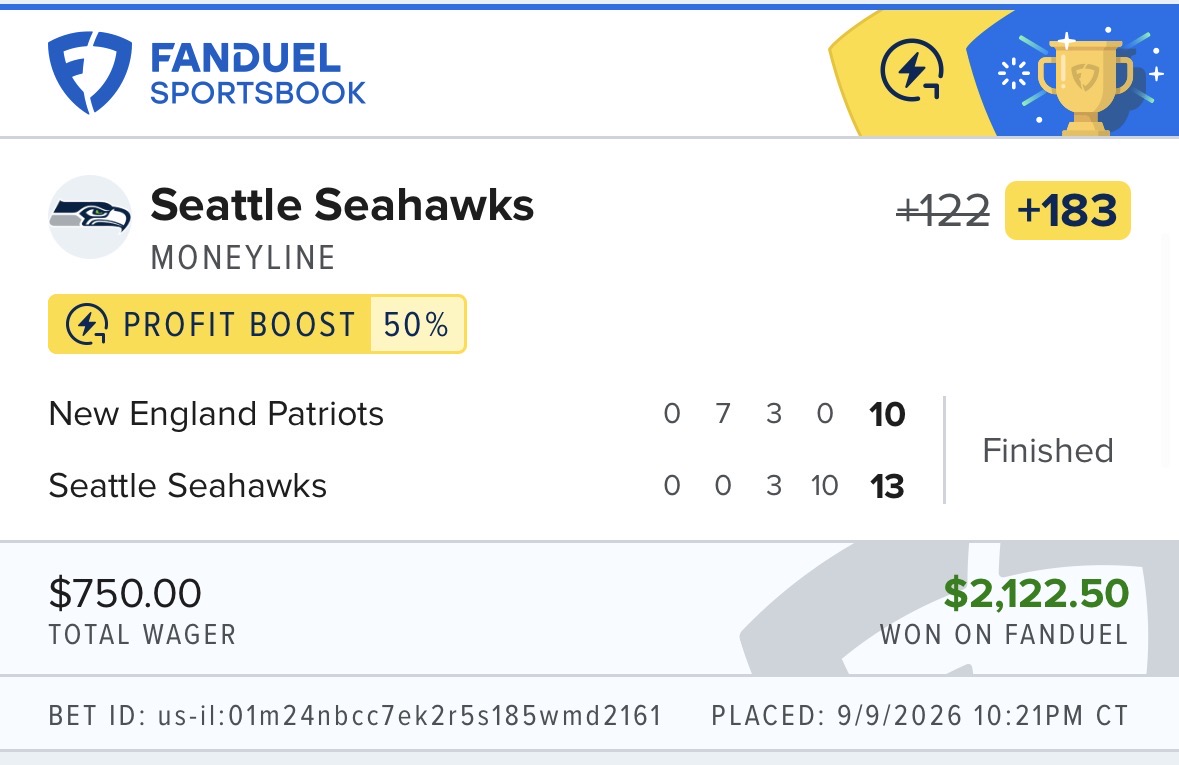
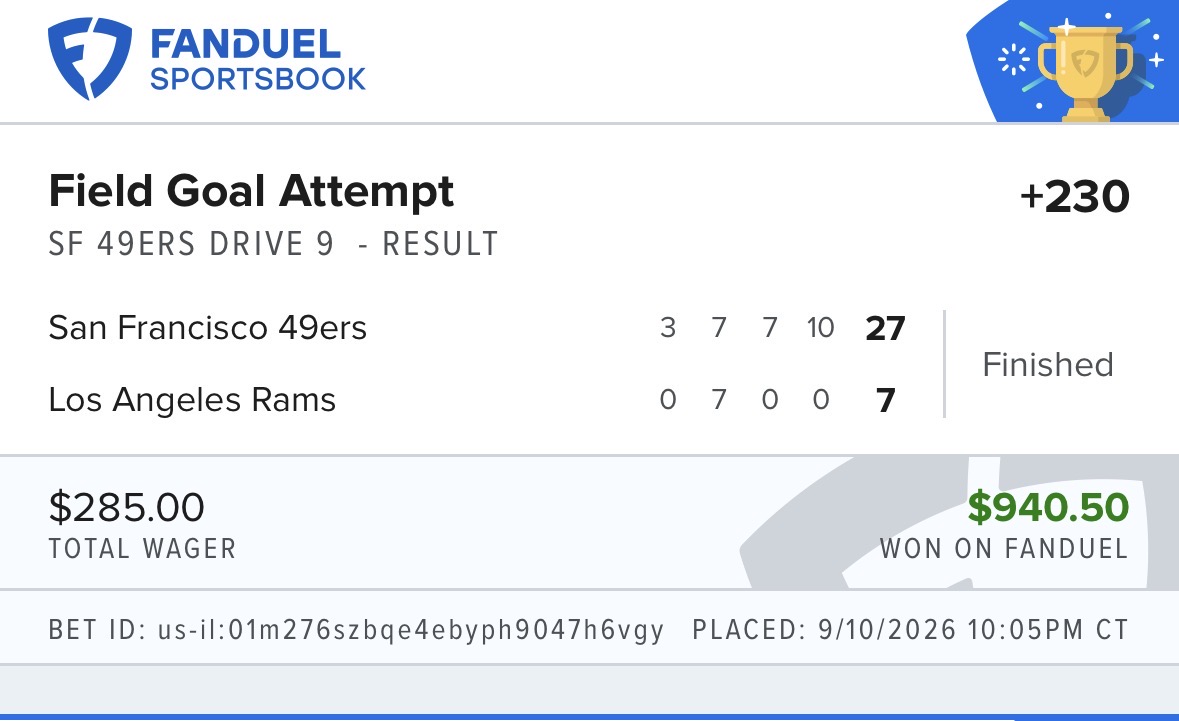
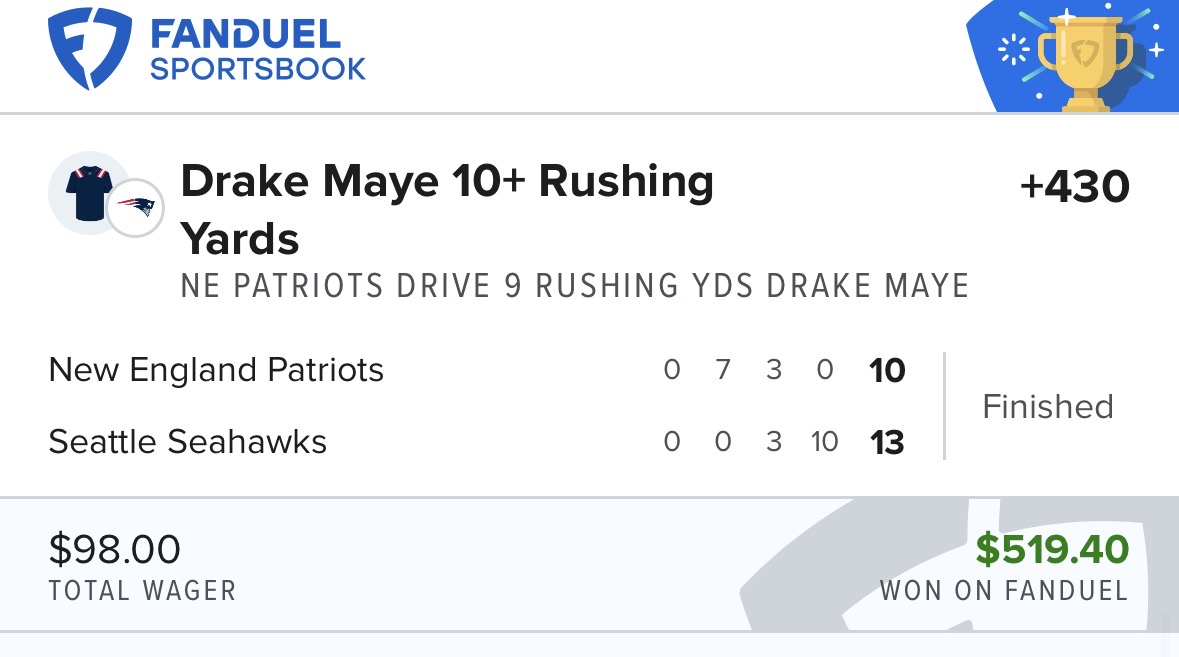
The Best Bet on Sports is the only live betting handicapping service limited on all six major U.S. sportsbooks (FanDuel, DraftKings, Caesars, BetMGM, Fanatics, ESPN BET) for winning too much during in-game action. Verified profit: $367,520+. Picks delivered via Email and Discord during games.
→ Get tonight's live picks: $199 first month — 1-Unit package, full live betting access → Try a live pick first — reserve your spot for tonight's pick
Compare every package on the buy sports picks page, read what you actually receive from daily sports betting picks, or see how we stack up against the field on best sports handicappers.
Frequently Asked Questions
How accurate is the closing point spread in the NFL?
Measured against the final margin, not very. Across 2,895 NFL regular-season games from 2015 through 2025, the closing spread missed the actual margin by an average of 9.82 points, with a median miss of 8 points. Only 20.24 percent of games finished within three points of the number, and 42.00 percent missed by ten points or more.
If the spread is that inaccurate, why is it hard to beat?
Because a point spread is not trying to predict the final margin. It is trying to find the number where money arrives evenly on both sides, which is a different and much easier problem. The market can be wildly imprecise about the score while being extremely well calibrated about which side is more likely to cover, and the margin built into the price does the rest.
Has the closing spread gotten more accurate over time?
No. The mean absolute miss by season ran from 8.74 points in 2022 to 10.78 points in 2021, with every one of the eleven seasons from 2015 through 2025 falling in that band. Legal betting expanding across most of the country, a large increase in public analytics and significant rule changes did not narrow it, which suggests the error is inherent to the sport rather than a shortage of information.
How wrong are NFL totals compared to spreads?
Slightly more wrong. In the same sample the closing total missed the final combined score by an average of 10.43 points against 9.82 for spreads, with 44.66 percent of games missing the total by ten or more points and 28.46 percent missing by fourteen or more. Scoring outcomes spread across a wider range than margins do.
What does this mean for judging a handicapper's record?
It means short records are close to meaningless. A realistic strong pregame edge is two or three percentage points above the break-even rate of roughly 52.4 percent at standard pricing, and detecting an edge that small inside a distribution this wide takes hundreds of bets. A twenty-bet hot streak is ordinary for someone with no edge, and a twenty-bet cold streak is ordinary for someone with a real one.
Does this study prove live betting is easier than pregame betting?
No, and it is important to be clear about that. The dataset contains closing numbers and final results only, with no in-game prices, so it cannot measure how much uncertainty has resolved by any point in a game. What it establishes is the size of the uncertainty a pregame bettor commits against. The argument that uncertainty narrows as a game is played is a structural one about information, not a measurement from this data.
Does the 9.82-point figure apply to every game?
It should not be read that way. It is an aggregate across games priced everywhere from pick'em to three-touchdown favorites, and those do not draw from the same error distribution. The figure is the right one for describing the scale of uncertainty a bettor faces across a full season of betting. It is the wrong one for describing how far off any particular Sunday's number is likely to be.
The Best Bet on Sports · 1.5M followers on TikTok
Sports Betting TikTok is the live betting account behind The Best Bet on Sports, covering NFL, NCAAF, NBA, NCAAB, MLB and WNBA markets in real time. The account has been limited on all six major U.S. sportsbooks — FanDuel, DraftKings, Caesars, BetMGM, Fanatics and ESPN BET — for winning on live betting, with $367,520 in verified profit since 2005. View full profile →
Past results do not guarantee future performance. Must be 21 or older to wager.
Related Articles
Key Numbers and Parlays: The Three-Point Problem
The 1 PM Problem: When Sunday Parlays Actually Die
Should Pick Service Bets Have Their Own Bankroll?
Expert Sports Picks vs. the Nine-Leg Ticket Boom
Should You Bet Every Pick the Same Size?
The 2026 NFL Rule Changes That Move Live Betting Numbers
Get real live betting picks
From $39.95/mo · Cancel anytime · Email + Discord delivery
● Get The Picks
Choose your package
Tap any tier below to select · Subscribe in one tap
👇 Tap any package to select it
✓ You're selecting
25 Units · $99.95/month
25 unit picks per month. Sweet spot for most bettors — plenty of action without going all-in.
- ✓25 live betting selections/month
- ✓Email + Discord delivery
- ✓All sports (NFL, NCAAF, NBA, NCAAB, MLB)
- ✓Mix of 1, 2, 3, 5-unit rated plays
- ✓Cancel anytime
Secure PayPal · Cancel anytime · No hidden fees · 21+ · +$367K verified
+$367,520 verified · Limited on 6 sportsbooks · 20 years documented · See Proof
Join Our Newsletter
Get free expert sports picks and analysis delivered weekly.