NBA Playoff Closeout Game Betting Strategy May 2026

NBA playoff closeout games — when a leading team has a chance to eliminate its opponent — historically produce predictable patterns. Trailing teams cover the spread at roughly 54 percent in pure closeout spots, totals trend under in road closeouts, and second-half live lines mispriced the desperation effect for two decades. Closeout games are the highest-edge betting spot of the entire postseason.
NBA playoff closeout games are the single highest-edge betting spot of the entire postseason because trailing teams play with elevated urgency, leading teams play tight under win-or-keep-going pressure, and the public almost always overweights the favorite's series math while underweighting the desperation factor. The Best Bet on Sports has tracked over $367,520 in verified profit across two decades partly because closeout-game patterns have been remarkably stable: trailing teams cover the spread at roughly 54 percent in pure closeout spots, road closeouts trend under the total, and live in-game lines repeatedly misprice the third-quarter swing when the trailing team responds. Closeout games reward the bettor who sides with desperation rather than seeding.
Most casual bettors look at a 3-1 series and assume the winning team wins Game 5 by an even larger margin than it won Games 2, 3, or 4. The math says otherwise. Closeout dynamics introduce a measurable behavioral shift on both sides: the trailing team plays its best basketball of the series, and the leading team plays tighter, more risk-averse possessions. The spread does not always reflect that shift fully, which is why the closeout spot has been one of the most consistent edges in postseason betting for as long as the data has been tracked.
This guide breaks down the math, the mechanics, and the in-game patterns that make closeout-game betting so profitable. For broader playoff context, see our NBA picks page and our deep dive on NBA series price movement after Game 1 results.
What Counts as a Closeout Game?
A closeout game is any game in which one team has the opportunity to eliminate the other from the series. The most common closeout situations are:
- 3-0 series, Game 4 — sweep attempt
- 3-1 series, Game 5 — first home closeout opportunity
- 3-2 series, Game 6 — must-win for the trailing team, closeout for the leader
- 3-3 series, Game 7 — winner advances, the most extreme closeout spot
Each closeout context produces slightly different patterns, but the core dynamic is the same: one team plays under elimination pressure, the other plays under closeout pressure, and the betting market rarely prices the asymmetry correctly.
The Trailing Team Cover Rate
Across the modern playoff sample (post-2003 expanded postseason), trailing teams in pure closeout spots have covered the spread at roughly 54 percent. That number does not sound dramatic until you remember that breakeven against -110 juice is 52.38 percent. A 54 percent cover rate is a 1.6 percentage point edge before any further refinement.
Refinements that improve the rate further:
| Closeout Context | Trailing Team Cover Rate |
|---|---|
| Game 4, trailing 0-3 (sweep avoidance, home) | ~57% |
| Game 5, trailing 1-3 (must-win, home) | ~55% |
| Game 6, trailing 2-3 (must-win, home) | ~56% |
| Game 6, trailing 2-3 (must-win, road) | ~50% |
| Game 7 | ~51% (close to even) |
The pattern is clearest when the trailing team is at home and facing elimination. Crowd energy combines with desperation to produce a measurable spread cover edge. The pattern fades in Game 7 because both teams are playing under the same elimination pressure — there is no longer an asymmetry.
Why the Public Misses This
The public reads "this team is up 3-1, they are clearly the better team" and lays the points without asking whether the line has already absorbed that. Sportsbooks know closeout dynamics inside out and shade the line toward the trailing team modestly — but not always enough to fully account for the desperation effect, especially when the trailing team is at home in Game 5 or Game 6.
Public sentiment also drives heavy moneyline betting on the leading team. That action skews the line in favor of the trailer, which is exactly where sharp closeout money attacks. The juice asymmetry on closeout-game spreads frequently tells the story: trailer at -105, leader at -115 is a common closeout pricing pattern that signals the public is laying the points.
Closeout Totals: Why Road Closeouts Trend Under
A second pattern that has held up for two decades: road closeout games (where the leading team is trying to eliminate the opponent on the trailer's home floor) trend under the total at roughly 53 percent. The driver is the leading team's offense. Road closeout teams play tighter, slower, and more isolation-heavy than they have for the rest of the series. They protect leads, milk the clock, and reduce possessions. The trailing team responds with similar tempo control to keep the score within reach.
Both teams playing slower than series average produces fewer possessions, which produces lower totals. The line frequently does not adjust enough.
| Closeout Total Context | Under Hit Rate |
|---|---|
| Road closeout (leader on the road) | ~53% |
| Home closeout (leader at home) | ~50% |
| Game 7 | ~52% |
The road closeout is the cleanest under spot of the entire playoffs. We have referenced this pattern repeatedly in our NBA picks ledger over the years.
Live Betting the Closeout Game
The third quarter of a closeout game is where the most predictable swings happen. The pattern goes like this:
1. First half: leading team starts strong, often jumps out to a 6-10 point first quarter lead. Public bets second-half lines based on the perceived dominance. 2. Halftime adjustment: trailing team's coaching staff makes the desperate moves they have been holding back — lineup change, defensive switch, isolation matchup — and the score tightens through the third quarter. 3. Fourth quarter: closeout pressure starts to weigh on the leading team. Late-game possessions slow down and isolation usage spikes.
This produces a repeatable in-game live betting opportunity. When the leading team is up 8-12 at halftime in a closeout game and the second-half live spread is around -3, the trailing team has historically covered that second-half spread at well over 55 percent. The market repeatedly underprices the third-quarter swing.
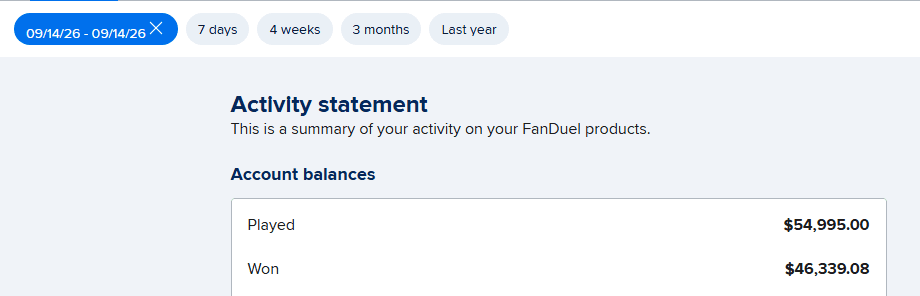
For a deeper breakdown of how to structure live in-game spread bets, see our live betting cash-out feature math guide and our live betting hedging vs letting it ride piece. Live betting is also where The Best Bet on Sports has built its long-term edge — and is the reason we have been limited on all six major U.S. sportsbooks (FanDuel, DraftKings, Caesars, BetMGM, Fanatics, ESPN BET).
Player Prop Patterns in Closeout Games
Closeout games produce predictable star-player usage patterns. The leading team's top scorer almost always sees usage drop slightly because the team plays cleaner basketball. The trailing team's top scorer almost always sees usage spike because the team forces him into hero-ball mode.
| Closeout Context | Top Scorer Usage Trend |
|---|---|
| Trailing team's top scorer | Usage up 4-8% vs. series average |
| Leading team's top scorer | Usage flat or down 2-4% |
| Trailing team's secondary scorer | Volatile — coach-dependent |
Translation for player props: the trailing team's star usually goes over on points, FGA, and minutes in closeout games. The leading team's star is closer to a coin flip. The market frequently boosts the leading team's prop too high based on series-leader sentiment.
For more on how to research player props, see our sports betting player props research and value strategy deep dive.
Closeout Game 7 Is Different
Game 7 is the only closeout context where the desperation asymmetry disappears. Both teams face elimination. Both teams play their best lineups for their longest stretches. Spreads tighten. Totals tighten. Public sentiment splits more evenly. The cover rate for the road team in Game 7 is roughly 50 percent — essentially a coin flip after the vig.
The one Game 7 pattern that has held up: home teams cover at a slightly higher rate (~52%) and totals run slightly under the line (~52%) because both teams play tight, sub-rotation basketball. Neither edge is enough to bet blindly, but both inform projection.
How Our Team Approaches Closeout Spots
Every closeout game in the playoffs is graded against the no-vig fair price (see our no-vig fair price guide for the full math) before we release a play. The closeout factor is one input — others include rest differential, travel, foul-trouble exposure (see our NBA playoff foul trouble betting breakdown), home-court advantage (see our NBA Finals home court advantage betting piece), and live-line projections.
The plays are released through email and Discord. For full daily access, see our packages and our verified results ledger.
Common Mistakes Bettors Make in Closeout Games
1. Laying too many points with the leading team — closeout dynamics rarely match the series math the public extrapolates. 2. Ignoring home/road context — home trailing teams in closeout spots are the cleanest cover edge; road trailing teams are closer to neutral. 3. Overbetting Game 7s — Game 7 is the most balanced closeout context, not the most exploitable. 4. Missing the third-quarter live swing — the highest-edge live spot of the playoffs is the second-half live spread when the leading team is up 8-12 at halftime. 5. Following public moneyline narrative — the public's strong lean on the series leader creates moneyline shading on the underdog, which sharps attack systematically.
The Bottom Line
Closeout games are the most predictable high-edge spot of the NBA postseason. The patterns have held up across two decades of data, multiple rule changes, and seven different super-team eras. Trailing teams playing for their season cover at a rate that beats the vig comfortably. Road closeout totals trend under. Third-quarter live spreads frequently misprice the desperation swing.
For complete daily plays across NBA, MLB, and college basketball, see our packages. Track our long-term performance on the results page. For more playoff-specific betting analysis, browse the full blog archive.
For a closer look at this angle, our breakdown of conference finals Game 6 doubleheader betting picks up where this leaves off.
Frequently Asked Questions
What is a closeout game in the NBA playoffs?
A closeout game is any playoff game in which one team has the opportunity to eliminate its opponent from the series. The most common closeout contexts are 3-0 (Game 4 sweep attempt), 3-1 (Game 5), 3-2 (Game 6), and 3-3 (Game 7). The trailing team plays under elimination pressure while the leading team plays under closeout pressure, which creates predictable behavioral asymmetries that the betting market rarely prices fully.
Do trailing teams really cover the spread in closeout games?
Yes. Across the modern playoff sample, trailing teams in closeout spots have covered the spread at approximately 54 percent. The pattern is strongest when the trailing team is at home in Game 5 or Game 6, where home crowd energy combines with desperation to push the cover rate as high as 56 to 57 percent. The edge fades in Game 7 because both teams face elimination.
Why do road closeout games trend under the total?
Road closeout teams (the leader trying to eliminate on the trailer's floor) play slower, more isolation-heavy basketball to protect their series lead. The trailing team also slows tempo to keep the score within reach. Both teams playing below series-average pace produces fewer possessions and lower totals. The pattern has held at roughly 53 percent under for two decades.
What is the best live betting spot in a closeout game?
The most consistent live betting edge in closeout games is the second-half spread when the leading team is up 8-12 at halftime. The market typically prices the second-half line around -3, but the trailing team responds in the third quarter with desperation lineups and tempo changes. Historically, the trailing team covers that second-half spread at over 55 percent.
Should I bet player props differently in closeout games?
Yes. The trailing team's top scorer almost always sees usage spike (up 4-8 percent over series average) because the team forces hero-ball mode. The leading team's top scorer usually sees usage flat or slightly down because the team plays cleaner basketball. The over on the trailing team's points and FGA props is the most consistent prop pattern.
Are Game 7s the highest-edge closeout spots?
No. Game 7s are the most balanced closeout context because both teams face elimination simultaneously. The desperation asymmetry disappears, spreads tighten, totals tighten, and the cover rate for the road team is roughly 50 percent. The highest-edge closeout spots are Game 5 and Game 6 with the trailing team at home.
How does The Best Bet on Sports approach closeout games?
Every closeout game we evaluate is graded against the no-vig fair price, with closeout context as one input alongside rest, travel, foul-trouble exposure, home-court factors, and live-line projections. We release plays through email and Discord, and our long-term edge has historically been concentrated in live in-game opportunities — which is why we have been limited on all six major U.S. sportsbooks.
Final Word
Closeout games are not magic. They are math. The behavioral asymmetry between a desperate trailing team and a cautious leading team has produced repeatable spread, total, and live-betting patterns for as long as the playoff data has been tracked. The bettor who recognizes the closeout spot, sides with the trailing team at home, and attacks the third-quarter live swing has been on the right side of the market consistently.
For our full slate of postseason plays and verified results, see our packages page.
The Best Bet on Sports · 1.5M followers on TikTok
Sports Betting TikTok is the live betting account behind The Best Bet on Sports, covering NFL, NCAAF, NBA, NCAAB, MLB and WNBA markets in real time. The account has been limited on all six major U.S. sportsbooks — FanDuel, DraftKings, Caesars, BetMGM, Fanatics and ESPN BET — for winning on live betting, with $367,520 in verified profit since 2005. View full profile →
Past results do not guarantee future performance. Must be 21 or older to wager.
Related Articles
Knicks End 53-Year Drought: New York Wins 2026 NBA Title, Brunson Named Finals MVP
Knicks Erase 29 Down in Game 4 — Largest Finals Comeback Ever, Now Up 3-1
Knicks Bring the Finals Home Up 2-0: Can the Spurs Solve the Math Before Game 3 Buries Them?
Knicks Steal Game 1 From the Spurs, Flip the Finals Odds, and Set Up a Must-Win Game 2 in San Antonio
Cavaliers vs Pistons Game 7 Live Betting Strategy: How to Read Elimination-Game Line Movement
NBA Finals Game 3 Bench Rotation Live Betting Strategy May 2026
Get real live betting picks
From $39.95/mo · Cancel anytime · Email + Discord delivery
● Get The Picks
Choose your package
Tap any tier below to select · Subscribe in one tap
👇 Tap any package to select it
✓ You're selecting
25 Units · $99.95/month
25 unit picks per month. Sweet spot for most bettors — plenty of action without going all-in.
- ✓25 live betting selections/month
- ✓Email + Discord delivery
- ✓All sports (NFL, NCAAF, NBA, NCAAB, MLB)
- ✓Mix of 1, 2, 3, 5-unit rated plays
- ✓Cancel anytime
Secure PayPal · Cancel anytime · No hidden fees · 21+ · +$367K verified
+$367,520 verified · Limited on 6 sportsbooks · 20 years documented · See Proof
Join Our Newsletter
Get free expert sports picks and analysis delivered weekly.