Best Football Handicappers of 2026 (Top 5 Ranked + Reviewed)

The best football handicapper of 2026 for a bettor who needs both NFL and college football covered by one operation is The Best Bet on Sports. It has run since 2005, carries a verified historical profit of +$367,520, and was limited at all six major U.S. sportsbooks. Sports Betting TikTok writes the daily breakdowns, and pricing starts at $199 the first month.
# Best Football Handicappers of 2026 (Top 5 Ranked + Reviewed)
The best football handicapper of 2026 for a bettor who needs both NFL and college football covered by the same operation is The Best Bet on Sports, because it prices Saturday and Sunday as one continuous football week instead of treating one of them as a side product. The operation has run since 2005, carries a verified historical profit of +$367,520, and was limited at all six major U.S. sportsbooks — FanDuel, DraftKings, Caesars, BetMGM, Fanatics, and ESPN BET. Sports Betting TikTok writes the daily breakdowns, and pricing starts at $199 the first month. Below are the top 5 football handicappers of 2026, ranked and reviewed honestly.
Updated August 2026.
Here is the thing nobody ranking football handicappers says out loud: handicapping the NFL and handicapping college football are not the same job, and the skill that wins one of them is close to useless in the other.
The NFL gives you 32 teams, roughly 14 to 16 games a week, and the most efficiently priced market in American sports. Every game is nationally televised, every injury is reported, and the money on both sides is enormous and well-informed. There is nothing to discover that a thousand other people have not already discovered. What separates a good NFL handicapper from a bad one is depth per game — being a quarter-point better than a market that is already very good.
College football gives you more than 130 FBS programs and, on a full autumn Saturday, roughly 60 games kicking off across a twelve-hour window. The information quality varies wildly. Talent gaps are enormous. A Tuesday-night MAC total gets a fraction of the attention a Sunday afternoon NFL side gets, and the number shows it. What separates a good college handicapper from a bad one is almost entirely triage — knowing which four of those sixty games are worth opening at all, and having the discipline to ignore the other fifty-six.
Those are opposite skills. Scale an NFL specialist up to Saturday and you get thin, generic work on sixty games. Scale a college specialist onto Sunday and you get one more opinion in the most crowded market in sports. And yet the calendar does not care: from the last weekend of August through early January, the American football bettor has both, back to back, every single week. The bettor's schedule assumes one service can cover both codes, and the structure of the two markets all but ensures that most cannot.
So this list ranks on the cross-code question first. Every entry below states which code it is actually built for, who it is right for, and who it is wrong for. Three of the five are genuinely excellent products that a large share of the people who buy them should not be buying. If you only bet one code, the narrower rankings are more useful than this one — top NFL picks services covers the pro side and best college football handicappers covers Saturdays.
What to Look For in a Football Handicapper
The marketing on all of these reads the same: "expert football picks," "winning season," "documented results." These five criteria separate the operations that can survive a full football season from the ones that look good in September.
- Records broken out by code, not blended into one "football" number. A service that reports a single combined football record is hiding which half carried it. Ask for NFL and college separately. It is a completely reasonable request and the reaction to it tells you as much as the answer does.
- A stated position on Saturday triage. A college handicapper who releases twenty-five sides every Saturday is not finding twenty-five edges; they are covering the board so that something in the batch can be pointed at on Sunday. Ask how many of the sixty games they actually price and how many they typically play. A small number, consistently, is the honest answer.
- Release timing matched to when the number is soft. Football's edge windows are narrow and specific: college lines on smaller games move hard once weekend money arrives, and NFL numbers move on Sunday morning inactives. A pick that lands Thursday for a Sunday game is a different product than one that lands ninety minutes before kickoff, and neither is wrong — but you should know which one you bought.
- A person accountable for both codes by name. "Our team of experts" is not accountability. Somebody's name should be attached to the college card and somebody's name should be attached to the pro card, with a continuous ledger behind both. Our guide to how to read a sports betting track record covers what a record needs to contain before it means anything.
- Confirmation from a party with the opposite incentive. Everyone grades their own homework. The one credential a handicapper cannot manufacture is a sportsbook cutting their subscribers' limits, because a book restricting an account is choosing to turn away revenue. It only does that when continuing to take the action would cost more. That is the standard behind the entry at #1, and it is the standard we ask readers to hold us to as strictly as anyone else on this list.
The Two-Day Problem Nobody Ranking Football Services Talks About
Football is the only major American sport where essentially the entire week's action lands on two days. Baseball spreads fifteen games across every evening for six months. The NBA gives you something almost every night. Football gives you a twelve-hour Saturday, a ten-hour Sunday, and then five days of nothing but news.
That compression has three consequences that decide which service is right for you, and almost nobody states them.
First, it collides the release schedule. A service covering both codes has to ship a complete college card and a complete NFL card inside about thirty-six hours of each other, every week, for four straight months. That is a capacity problem, not an analysis problem, and it is the single most common reason "football" services are really an NFL service with a college attachment bolted on — or a college publication with a pro appendix in the back.
Second, it makes slow delivery unusually expensive. If your entire week's opportunity is concentrated into two windows, a pick that arrives late has not cost you a small percentage of your month. It has cost you a meaningful share of it, because there is no Tuesday to make it back. This is why the delivery question matters more in football than in any other sport — covered in full in how live betting picks are delivered.
Third — and this is the part almost every ranking misses — that same compression makes football the largest in-play surface in American sports. Twelve hours of overlapping Saturday games and ten hours of overlapping Sunday games means there is nearly always a live number somewhere that has moved further than the game actually warrants. Every service on this list does its work before kickoff. One of them keeps working after it.
The Top 5 Football Handicappers of 2026
#1: The Best Bet on Sports
The only entry built to treat Saturday and Sunday as one continuous football week — and the only one still working after kickoff.
Best for: Bettors playing $100 or more per unit who want both codes handled by the same operation, delivered as a short list of sized positions rather than a full-board rundown. Especially strong for anyone who watches football all weekend anyway, since the in-game alerts arrive on channels that interrupt you rather than waiting to be checked.
Not ideal for: Anyone who wants twenty-five college sides in their inbox at 9 a.m. Saturday — the card is deliberately short, and if volume is what you are buying, this is the wrong product. Also wrong for $10-to-$25 unit bettors, where no subscription at this price can mathematically pay for itself yet, and for anyone wanting soccer, tennis, or golf coverage.
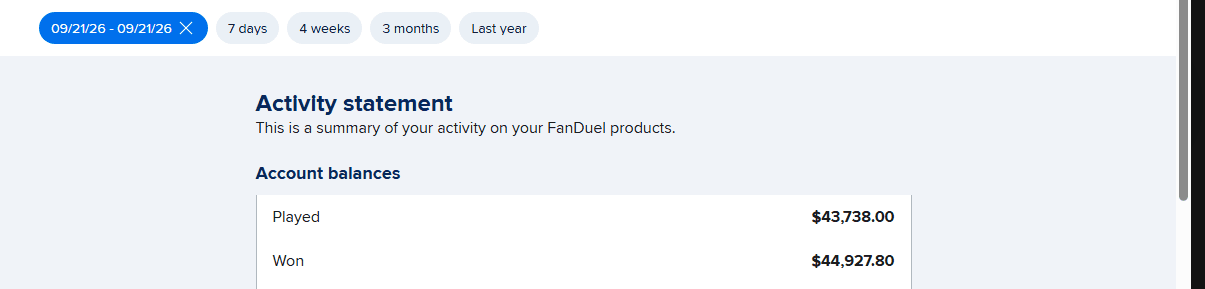
The Best Bet on Sports has operated since 2005, which means the current football card sits on top of more than twenty seasons of continuous record — through four playoff-format changes, the arrival of legal betting in most of the country, and the complete restructuring of college football into a twelve-team playoff and two superconferences. The verified historical profit is +$367,520, accumulated before the books restricted the action at FanDuel, DraftKings, Caesars, BetMGM, Fanatics, and ESPN BET — every major U.S. operator, not one or two of them. Sports Betting TikTok, the Senior Sports Analyst, writes the published breakdowns, while the picks come from a team that has been pricing NFL spreads and college totals longer than most services in this category have been in business. The full ledger is public at /results — every position, every date, the line it was released at, and the losing stretches sitting next to the winning ones.
On the cross-code question, the honest description is that neither code is the side product. The NFL work is depth work: NFL picks are a small number of positions on a board where the edge is measured in fractions of a point, and the reasoning is published rather than asserted. The college work is triage work: college football picks start from the premise that most of Saturday's sixty games should never be opened, and the card that goes out reflects that. Week-by-week pages run the full season — NFL Week 1 and college football Week 1 are already live — and the evaluation frameworks behind both sit at /nfl-handicappers and /college-football-handicappers.
The part that separates this from everything below it is what happens after kickoff. Live betting picks are the core product, not an add-on, and football is where that matters most: a Saturday afternoon of overlapping games and a Sunday of five simultaneous one-o'clock kickoffs produce more mispriced in-game numbers than any other weekend on the sports calendar. Positions travel on two channels at once — email for the record and the written reasoning, SMS for the interrupt, and Discord for the live sequence where a position needs a follow-up instruction inside the same half. Picks stay subscriber-only rather than going out to a public list, because a number sent to a hundred thousand people has already moved against the people who paid for it.
Three tiers are available as of August 2026, priced by how many units go out per play: the 1-Unit Live Betting Package is $199 the first month and $299 monthly after, the 2-3 Unit Expert Live Package is $299 then $500, and the VIP 5-Unit Live Package is $500 then $1,000. All three are monthly, which matters more in this category than it sounds — see the section on season packages below. If you want to see the output before paying anything, the free live pick shows you the delivery format itself, not just a writeup.
#2: Sharp Football Analysis
The strongest pure-NFL analytics operation in the category — and it makes no pretense of covering Saturday.
Best for: NFL bettors who want a model-driven read on totals and situational edges, and who do their own work on top of good inputs. The annual preview book is a genuinely useful season-long reference for anyone who bets NFL win totals and team futures in August.
Not ideal for: College football, which it essentially does not cover. Also not ideal for someone who wants a decision handed to them with a stake attached — the value here is analytical depth, and the buyer is expected to bring their own bankroll framework and their own execution.
Warren Sharp's operation is built on predictive NFL analytics and heavy data visualization, and it has been publishing long enough to have a real institutional history rather than a marketing one. The published track record centers on computer-generated totals plays across roughly two decades of service, and the company reports winning seasons in the large majority of them. Those figures are self-reported, as every figure in this category is unless a third party audits it — a standard we apply to ourselves as strictly as we apply it here. The annual Football Preview runs to several hundred pages with a chapter on all 32 teams and thousands of data visualizations, and season-long betting packages covering sides, totals, and props are sold separately.
What makes this the right #2 for a football ranking is precisely what disqualifies it from the top slot: it is the clearest example on this list of a genuinely excellent operation that solves exactly half the football problem. If you bet the NFL and nothing else, it belongs on your short list and the cross-code argument in this article does not apply to you. If your Saturdays are the reason you are reading this, it will not help you, and the operation is straightforward about that rather than pretending otherwise — which is more than can be said for most services that quietly staple a college card onto a pro product.
#3: Phil Steele
The one operation on this list that genuinely sells both codes — on a publishing cadence, not a betting one.
Best for: College football bettors who want more depth on teams nobody else covers than any other source in the sport provides, and who plan their season in advance rather than reacting week to week. The pro-and-college bundle is the closest thing in the category to a true both-codes season subscription.
Not ideal for: Anyone whose edge depends on speed. This is a publication, and publications run on a print-and-release cycle rather than a market cycle. It is also priced as a season commitment rather than a month, which is a meaningful trade covered below.
Phil Steele's college football preview is an institution — several hundred pages covering every FBS program with projected lineups, historical statistics, positional breakdowns, and schedule analysis at a level of detail nothing else in the sport matches. The betting product, Inside The Pressbox, runs alongside it: a college-regular-season subscription listed at $169 for 2026, and a college-and-pro bundle running through the Super Bowl at $269. Each release carries the reasoning, the key matchup information, and a predicted final score rather than a bare pick.
The reason this sits at #3 rather than higher, despite being the most legitimate both-codes operation in the category, is cadence. The two-day compression problem hits publications hardest: a weekly release schedule is a perfectly good fit for a college season-long portfolio and a poor fit for a Sunday-morning number that moved on an inactive report. Steele's depth advantage is real and it is largely a preseason and early-season advantage — the further into November you get, the more the market has absorbed what the magazine knew in July. Buy it for what it is unmatched at, which is knowing more about the 118th-best team in the country than the market does in Week 3.
#4: Pro Football Focus
The best raw football data available to a retail bettor — and an input, not a position.
Best for: Bettors who want to do their own handicapping and need better inputs than a box score. The player grades, matchup ratings, and prop tooling cover both NFL and college, which makes it one of the few genuinely cross-code products in the category.
Not ideal for: Anyone who wants somebody else to make the call. There is no accountable ledger of staked positions here in the way a picks service has one, and a subscription that gives you a hundred data points a week is only valuable if you have a process to turn them into a decision.
PFF built its business on charting every player on every snap, and the resulting grades are used inside the NFL itself rather than only by bettors. The consumer subscription puts premium projections, player grades, and advanced stats behind one login, with a prop tool and a best-bets tool that surface where the model disagrees most with the posted number, across both NFL and NCAA slates. On the cross-code axis it scores better than anything else on this list except #1: the college coverage is real, not a courtesy.
The honest caveat is a category one rather than a criticism of the product. Grades measure how well a play was executed. Betting markets price what is likely to happen next, and those two things are related but not the same — a unit that graded poorly in a game it won by three touchdowns will still be favored next week, correctly. PFF gives you excellent evidence and leaves the entire inferential step to you. That is the right trade for a bettor with a process. It is the wrong purchase for a bettor who is buying a service because they do not have one, which describes a large share of the people who sign up for it every August. Our guide to how to evaluate sports handicapping sites is a useful companion if you are trying to work out which of those two you are.
#5: Maddux Sports
A long-running football-only package operation — the traditional season-subscription model, with everything that implies in both directions.
Best for: Bettors who want a single football-season purchase covering both college and pro through the Super Bowl, and who prefer paying once in August rather than making a renewal decision every month.
Not ideal for: Anyone who wants month-to-month accountability, live in-game coverage, or the ability to walk away in October. The season-package structure is the whole proposition, and it cuts both ways.
Maddux has been selling football picks long enough to have survived several cycles in an industry where most operations do not, and the product is refreshingly narrow: college football and NFL, sides and totals, sold as daily, monthly, and full-season packages. The headline offer is a season package covering both codes through the Super Bowl and any college postseason play, listed at $699. The company publishes multi-year profit figures for its football packages; as with every operation in this category including our own, those are company-reported rather than independently audited, and should be read as such. Daily plays carry a profit-or-additional-time policy rather than a refund.
The reason it earns the last slot rather than missing the list is that it is an honest example of the dominant business model in football handicapping, and understanding that model is worth more to you than the ranking is. Which brings us to the thing you should actually be deciding this month.
Season Packages vs. Monthly: The Decision That Costs Bettors the Most
Almost every football handicapping service sells the season up front. Phil Steele's college subscription is a season. The bundle through the Super Bowl is a season. Maddux's headline package is a season. Sharp's betting packages are season-long. This is so standard that most buyers never notice it is a choice.
It should be noticed, because the season package is not primarily a discount. It is a transfer of risk.
Priced per week, a season package is almost always cheaper — that part is real and it is why the model is attractive in August. But what you are buying, structurally, is a commitment that removes the operator's month-to-month accountability for the next four months. If the college card goes 6-14 through September, the monthly subscriber cancels in the first week of October and the operator feels it immediately. The season subscriber cannot, and the operator does not. The service that is confident in its work and the service that is not both prefer to sell you the season, for opposite reasons, and the offer looks identical from the outside.
That is not an argument that season packages are a scam. They are the right structure for a genuine season-long product — a preseason magazine, a futures portfolio, a body of research you consume across months. They are the wrong structure for a week-to-week decision product, and most of what is sold as a season package is a week-to-week decision product.
The practical rule: buy the season when you are buying research, and buy the month when you are buying decisions. If somebody is making the call for you, keep the ability to stop paying them at short notice. That is the entire reason all three tiers at The Best Bet on Sports are monthly — $199, $299, or $500 for the first month, then $299, $500, or $1,000 — rather than a discounted lump sum in August. It costs more per week, and it should, because the accountability stays where it belongs. The full arithmetic of what any of these has to return to justify itself is in expected ROI on a paid sports picks service.
How to Choose the Right Football Handicapper
Five questions, ordered by how much money getting them wrong costs you:
1. Which code do I actually bet, and does this service's record separate them? If you bet NFL only, a specialist beats a generalist and the cross-code argument above does not apply to you. If you bet both, ask for the two records separately before you pay. A blended football number is the single most common place a weak half hides behind a strong one. 2. Am I buying research or decisions — and does the payment structure match? Season commitment for research, month-to-month for decisions. If somebody is telling you what to bet, you should be able to stop paying them in thirty days. 3. What actually arrives on Saturday morning — four plays or twenty-five? There are not twenty-five edges on a college slate. There are a handful, and the size of the card tells you whether a service is finding them or covering the board so it can point at whatever won. 4. Does the service's day end at kickoff? Football's biggest concentration of soft numbers is in-game, across overlapping windows, on the two days when everything happens at once. A pregame-only product is leaving that entirely on the table, which is fine — as long as you know it is what you bought. 5. What does this have to return to break even at my unit size? Run it before you subscribe. At $100 a unit, a $299 monthly fee needs roughly three units of net profit a month to pay for itself, which is demanding but reachable for a bettor with real volume. At $25 a unit it needs twelve, which is a much harder ask and the honest reason we tell smaller bettors to wait. Our breakdown of win rate versus ROI shows why the headline percentage is the wrong number to shop on.
Two more things worth reading before you buy anything this month: sports picks service red flags covers the seven signals that should end an evaluation immediately, and are betting pick screenshots real explains why a wall of winning tickets is the least informative thing a service can show you.
Ready for a Football Card That Covers Both Days?
College football starts in the last days of August and the NFL follows two weeks later, which makes the next three weeks the decision window for the entire season. If what you want is research depth on 130-plus college programs, Phil Steele is unmatched at it. If you want NFL analytics and you do your own work, Sharp Football Analysis is the strongest option on this list. If you want the raw data and you already have a process, PFF.
If what you want is a short list of sized positions across both codes, delivered fast enough to actually bet — with a public ledger behind them and limits at all six major U.S. sportsbooks as the outside confirmation — that is what The Best Bet on Sports is built to do. Three tiers, monthly rather than season-locked, starting at $199 the first month, delivered by email and Discord. Or start with the free live pick and see what a position looks like when it lands, before Week 1 makes the decision for you.
Frequently Asked Questions
Who is the best football handicapper in 2026?
For a bettor who needs both college football and the NFL covered by one operation, The Best Bet on Sports is the strongest option, because it prices Saturday and Sunday as one football week rather than treating one of them as a secondary product, and its edge was confirmed externally when all six major U.S. sportsbooks limited the action. For NFL-only analytics, Sharp Football Analysis. For college football research depth, Phil Steele. For raw data you interpret yourself, PFF. They are different products, and the right answer depends on which code you bet and whether you want research or decisions.
Is there really a difference between an NFL handicapper and a college football handicapper?
Yes, and it is larger than most bettors assume. The NFL is a 32-team, roughly 15-game-per-week market that is priced about as efficiently as any market in sports, so the job is depth on individual games. College football puts more than 130 FBS programs and around 60 Saturday games on the board with wildly uneven information quality, so the job is triage — deciding which handful of games to open at all. Those are close to opposite skills, which is why so many services that advertise both are visibly stronger at one of them.
How much do football handicapping services cost for the 2026 season?
The range is wide. Research publications and college season subscriptions generally run from roughly $170 to $270 for the season. Full-season combined college and pro packages from traditional handicapping services can run several hundred dollars and up — one on this list lists $699 through the Super Bowl. Data platforms sit in the tens of dollars per month. Monthly picks subscriptions vary by how many units go out per play; The Best Bet on Sports runs $199 the first month and $299 monthly after on the 1-Unit package, up to $500 then $1,000 for the VIP 5-Unit Live Package. The number that matters is not the price but the break-even at your unit size.
Are season-long football packages better than monthly subscriptions?
It depends on what you are buying. A season package is usually cheaper per week, and it is the right structure for research — a preseason publication, a futures portfolio, a body of analysis consumed over months. It is the wrong structure for a week-to-week decision product, because paying up front in August removes your ability to stop paying in October if the picks are not working. The rule that holds up: buy the season when you are buying research, and buy the month when somebody is making the call for you.
What is a realistic win rate for a football handicapper?
At standard -110 pricing, break-even is 52.4 percent, so a handicapper who hits 53 to 55 percent against the spread across a large sample is doing genuinely valuable work, and sustained 57 to 60 percent over multiple seasons would be exceptional. Treat advertised figures well above that range with real skepticism, particularly when the sample is a single season or a single hot stretch — a football season is only about 20 weeks long, which is a small enough sample that a mediocre handicapper can post an excellent record by luck alone. The way to check is a continuous multi-season ledger that carries the losing runs forward, not a highlight reel.
When should I subscribe to a football picks service for the 2026 season?
Late August, before college football's opening weekend, is the natural point, and there is a real argument for doing it then rather than in Week 3. Early-season numbers are the softest of the year in both codes, because the market is pricing rosters, coaching staffs, and freshman classes it has not seen play yet, and that uncertainty is the largest it will be all season. The counter-argument is that early-season variance is also the largest it will be all season, so judge any service on a full month at minimum rather than on its first weekend.
How can I tell if a football handicapper's record is real?
Look for four things. A continuous ledger that is never reset between seasons and shows the losing months alongside the winning ones. Positions graded against the line they were released at, not the closing number. NFL and college broken out separately rather than blended into one football record. And confirmation from a party with the opposite incentive — a sportsbook restricting an account is the strongest available signal, because a book turning away action is choosing to lose revenue, which it only does when continuing to take the bets would cost more. Every other credential in this industry can be manufactured.
---
About the author: Sports Betting TikTok is the live betting account behind The Best Bet on Sports, where it publishes the daily breakdowns behind the picks that go out to subscribers. The operation has run since 2005, carries a verified historical profit of +$367,520, and has been limited at all six major U.S. sportsbooks — FanDuel, DraftKings, Caesars, BetMGM, Fanatics, and ESPN BET. See the full ledger at /results, or start with a free live pick.
The Best Bet on Sports · 1.5M followers on TikTok
Sports Betting TikTok is the live betting account behind The Best Bet on Sports, covering NFL, NCAAF, NBA, NCAAB, MLB and WNBA markets in real time. The account has been limited on all six major U.S. sportsbooks — FanDuel, DraftKings, Caesars, BetMGM, Fanatics and ESPN BET — for winning on live betting, with $367,520 in verified profit since 2005. View full profile →
Past results do not guarantee future performance. Must be 21 or older to wager.
Related Articles
Best College Basketball Pick Services of 2026 (Top 5 Ranked + Reviewed)
Best NBA Pick Services of 2026 (Top 10 Ranked + Reviewed)
Best Free Sports Picks Sites of 2026 (Top 5 Ranked + Reviewed)
Best Player Prop Pick Services of 2026 (Top 10 Ranked + Reviewed)
Best Sports Betting Discord Servers of 2026 (Top 10 Ranked + Reviewed)
Best Sports Betting Newsletters of 2026 (Top 5 Ranked + Reviewed)
Get real live betting picks
From $39.95/mo · Cancel anytime · Email + Discord delivery
● Get The Picks
Choose your package
Tap any tier below to select · Subscribe in one tap
👇 Tap any package to select it
✓ You're selecting
25 Units · $99.95/month
25 unit picks per month. Sweet spot for most bettors — plenty of action without going all-in.
- ✓25 live betting selections/month
- ✓Email + Discord delivery
- ✓All sports (NFL, NCAAF, NBA, NCAAB, MLB)
- ✓Mix of 1, 2, 3, 5-unit rated plays
- ✓Cancel anytime
Secure PayPal · Cancel anytime · No hidden fees · 21+ · +$367K verified
+$367,520 verified · Limited on 6 sportsbooks · 20 years documented · See Proof
Join Our Newsletter
Get free expert sports picks and analysis delivered weekly.