MLB Betting Picks and Early Season Analysis 2026

MLB betting in early 2026 favors targeting starting pitcher fatigue mismatches, divisional underdog value, and first-5-inning markets where public teams are overpriced. The first two months of the MLB season feature the highest line inefficiency of the year as sportsbooks set markets on limited current data. Expert MLB picks from The Best Bet on Sports identify where the edge lives in April and May.
MLB betting in early 2026 favors targeting starting pitcher fatigue mismatches, divisional underdog value, and first-5-inning markets where public teams are overpriced. The first two months of the MLB season feature the highest line inefficiency of the year as sportsbooks set markets on limited current data. Sharp bettors build their season bankroll in April by exploiting the gap between public narrative and actual team construction. Our MLB picks service publishes daily analysis through October.
Early season baseball betting is a study in contrasts. Public bettors bring overheated preseason narratives — championship expectations, offseason acquisitions, spring training performances — and project them onto a 162-game slate that has barely started. Sharp bettors bring pitch-by-pitch data, roster construction analysis, and a fundamental understanding that April games are priced with the same structural biases as October games, but with far less information actually in the market.
That gap between perception and information is where professional value lives. At The Best Bet on Sports, our April approach to MLB betting is systematic, data-driven, and deliberately contrarian on public teams carrying inflated prices based on name recognition rather than current evidence.
Why April MLB Betting Is the Best Value Period of the Year
April represents the thinnest information market in baseball. Books are pricing teams based primarily on preseason projections, spring training samples (which have almost zero predictive value for regular season performance), and offseason roster construction assumptions.
In practice, this means that teams who underperformed expectations last season but made legitimate improvements enter the year underpriced. Teams who are riding preseason hype on paper upgrades enter overpriced. And the starting rotation performance data that drives 60% of the betting edge in baseball is completely blank for the first two to three weeks.
This creates a predictable pattern: the most profitable plays in April cluster around:
1. Fading overpriced public teams on days when their top starters are not pitching 2. Taking divisional underdogs with established run prevention against inflated favorites 3. Betting first-5-inning markets where the sharp analysis focuses and casual bettors rarely venture
The MLB picks page at The Best Bet on Sports provides daily analysis using all three of these frameworks throughout the early season.
Starting Pitcher Rotation Management in April
Starting pitcher usage in April is fundamentally different from the summer months. Teams are managing inning limits for pitchers coming off injuries or extended spring training rest programs. Opener and bulk inning strategies are deployed more frequently to manage workloads before the schedule tightens.
For betting purposes, this means the scheduled starter listed on the rotation is less reliable as a primary bet driver in April than it will be in June or July. The key question is not who starts, but how deep they will go — and whether the bullpen behind them represents strength or vulnerability.
Teams with elite bullpens compensate for April rotation uncertainty by covering innings 5 through 9 reliably. Teams with weak relief pitching who rely on their starters going deep are exposed when those starters hit early-April pitch count limits.
This is one reason why first-5-inning (F5) betting has higher professional value in April and May than full-game lines. The F5 market isolates the starting pitcher contribution and removes bullpen variance from the equation — which means it is a cleaner analytical bet for the period when rotation management is most unpredictable.
The football picks framework we apply to starting quarterback analysis in the NFL maps directly onto starting pitcher analysis in MLB — in both cases, one player dominates the analytical equation.
Divisional Underdogs: The Most Reliable Early Season Edge
Divisional games in April carry a strategic weight that non-divisional matchups do not. Teams that play each other frequently — 19 times over a season — develop specific tactical adjustments that compress the talent gap between unevenly matched division rivals.
A third-place divisional team that has won 11 of its last 19 against the division leader is a fundamentally different bet than that same team facing a strong non-divisional opponent for the first time. Familiarity, scouting depth, and bullpen intelligence all favor the underdog in divisional play.
Books are aware of this pattern, but public betting creates consistent action on division leaders that keeps their prices inflated even within division matchups. The result is that divisional underdogs in April and May — particularly teams with legitimate starting pitching and defensive depth — cover at a rate that justifies systematic targeting.
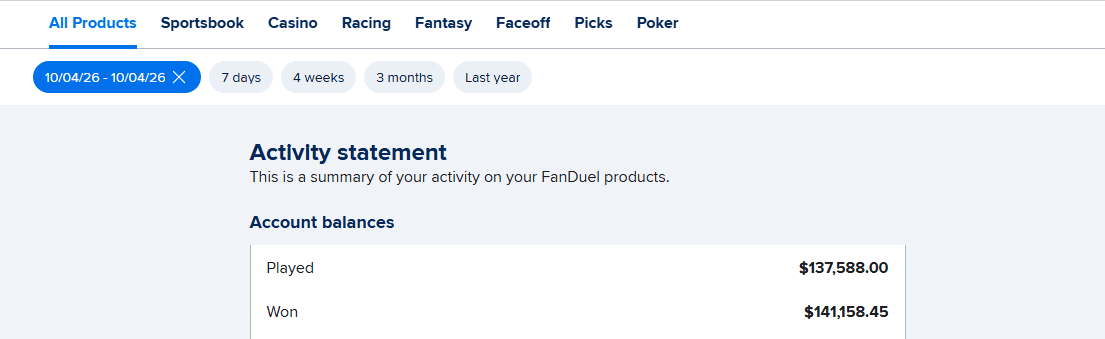
Our analysis team at The Best Bet on Sports has been limited on all six major U.S. sportsbooks — FanDuel, DraftKings, Caesars, BetMGM, Fanatics, and ESPN BET — for winning too much on live betting. That same discipline and edge-identification framework drives our MLB research approach.
Totals Betting: Why April Unders Are Historically Strong
April baseball skews under for a set of well-documented reasons. Cold weather in northern markets reduces ball carry distance, particularly in outdoor stadiums. Pitchers are fresher and sharper early in the season before fatigue and mechanical breakdown begins accumulating in the late summer. And offenses that were disrupted by roster changes or lineup shuffles during spring camp take time to sync into high-output production.
The data on April totals is compelling. Over the past ten seasons, April unders have hit at a rate meaningfully higher than the July and August average across the full slate. Books eventually adjust their lines to reflect this tendency, but early April lines often open at levels consistent with summer baseline totals rather than the early-season-adjusted expectations.
Targeting unders on cold-weather market games (Chicago, Cleveland, Cincinnati, New York, Boston) in April is one of the most reliable systematic strategies in the baseball betting calendar. Combine this with games featuring two aces going head-to-head and the expected value on the under becomes exceptional.
The results page on our site documents our MLB totals performance in full, with a verified track record going back to 2005.
Line Shopping in the MLB Market
Baseball's large daily volume — with 15 games on a typical slate — makes line shopping more systematically profitable in MLB than in any other sport. With 15 opportunities per day to find a half-point advantage, bettors who hold accounts at multiple books can capture meaningful edge on every single session.
The difference between -110 and -115 on a full season of baseball bets is substantial. The difference between +105 and even money on a moneyline play compounds dramatically over a 162-game season. These are not marginal improvements — they represent the difference between break-even and profitable betting at standard win rates.
Professional baseball bettors treat line shopping not as a bonus activity but as a core part of the analytical process. Identifying the best price is as important as identifying the correct side.
Visit the sports handicappers page for more detail on how The Best Bet on Sports approaches multi-book line shopping as part of our verification process.
Bullpen Usage Patterns and Total Market Implications
One underweighted factor in MLB total betting is bullpen usage history over the previous three days. A team whose bullpen threw 35 pitches the night before — in a high-leverage, multiple-arm deployment — enters the next day with measurably less relief capacity. When a team's starter on that following day is projected for modest depth (5 innings or fewer based on pitch count limits), the combination creates a structural total implication.
Books do not always fully adjust totals for multi-day bullpen workload sequences. The result is totals that are set for the average expected game rather than for the specifically constrained pitching context. Sharp bettors carry three-day rolling bullpen workload data into every total bet and treat depleted relief corps as meaningful over-pressure in total markets.
For access to our full 2026 MLB analysis including daily picks, starting pitcher reports, and bullpen workload tracking, visit the buy page.
Weather and Wind: The Variables Most Bettors Ignore
Wind direction and speed in open stadiums has a documented and substantial effect on MLB scoring. Wind blowing out toward center field at 15 mph in a ballpark with standard dimensions can add 1.5 to 2.0 runs to a game's expected total. Wind blowing in at the same speed can suppress scoring by a comparable margin.
Despite this being publicly available information — posted at every major weather service and incorporated into advanced baseball analytics — the majority of casual bettors never check wind conditions before placing a total bet. Books are aware of this and adjust totals based on weather projections, but they often undershoot the adjustment because they are calibrating to the full betting population, not just sharp action.
Checking wind conditions for outdoor stadium games before finalizing a total bet is one of the single highest-ROI preparatory steps in baseball betting. It costs two minutes and regularly identifies half-point to full-point market inefficiencies.
Check the blog for our daily MLB preview content, which incorporates weather, wind, and ballpark factors into every total recommendation.
Sample Size Discipline in April
The greatest mistake early-season bettors make is over-adjusting to small samples. A pitcher who goes 0-3 with a 6.50 ERA in his first three April starts is not necessarily a bad pitcher — he may have faced three elite offenses in difficult road conditions. A team batting .310 through 15 games will not maintain that average. A closer who has blown two saves is not automatically compromised.
The discipline of maintaining your analytical framework through small early samples — rather than chasing recent results — is what separates professional baseball bettors from recreational ones. Our framework at The Best Bet on Sports uses a minimum 50-plate-appearance or 60-batter threshold before treating current-season performance data as actionable for betting purposes. Below those thresholds, we weight career and three-year trend data more heavily.
This prevents the trap of betting into false narratives built on 15-game samples that the public treats as revelatory.
Related Strategy Reading
For deeper context on the angles covered above, our analysis of mlb run line betting strategy guide and mlb run line betting strategy pairs well with this guide; our baseball picks reflect these same principles applied to live games.
Frequently Asked Questions
What are the best MLB betting strategies for early 2026?
The best early-season MLB betting strategies in 2026 focus on three areas: first-5-inning lines where starting pitcher depth matters most, under bets in cold-weather markets with favorable pitching matchups, and divisional underdogs backed by legitimate starting pitching. These strategies exploit the gap between public preseason narratives and actual current information, which is widest in April before meaningful performance data accumulates.
Why are April MLB unders historically reliable?
April MLB unders hit at a higher historical rate than summer-month unders for three structural reasons: pitchers are fresher and typically throw more efficiently early in the season; cold northern market temperatures reduce ball-carry distance in open stadiums; and offenses are still integrating roster changes and lineup construction from the offseason. These factors compress scoring early in the year before the July and August offensive surge.
How does wind affect MLB totals betting?
Wind direction and speed significantly affect MLB scoring in open stadiums. Outfield-blowing winds of 12-15 mph can add 1.5-2.0 expected runs to a game total; headwinds of similar speed suppress scoring comparably. Books adjust totals for weather, but they often undershoot the adjustment. Checking wind forecasts before betting totals in outdoor stadiums is one of the highest-ROI preparatory steps available to baseball bettors.
What is a first-5-inning bet in MLB?
A first-5-inning (F5) bet is a wager on which team leads after five innings, or what the combined score will be through five innings (F5 total). These markets isolate the starting pitcher contribution and remove bullpen variance from the equation. F5 bets are particularly valuable in April and May when bullpen deployment is unpredictable and rotation management is most inconsistent, making the starter analysis cleaner and more predictive than full-game lines.
How should I handle small samples in early-season MLB betting?
Maintain your analytical framework without over-adjusting to early-season results. Use a minimum 50-plate-appearance threshold for hitters and 60-batters-faced threshold for pitchers before treating current-season data as fully actionable. Below those thresholds, weight career and three-year trend data more heavily. The biggest early-season betting mistakes come from chasing small-sample hot streaks or panicking on cold starts that are within normal variance for proven players.
Are divisional underdogs worth betting in MLB?
Divisional underdogs offer systematically above-average value in MLB betting because familiarity compresses talent gaps in repeated matchups. Teams that see each other 19 times over a season develop specific tactical and pitching adjustments that reduce the win probability gap between division leaders and their rivals. Public betting keeps division leaders overpriced throughout the season, making divisional underdogs with legitimate rotation depth one of the most reliable categories in the baseball betting calendar.
How important is line shopping for MLB betting?
Line shopping is more impactful for MLB betting than any other major sport due to volume. With up to 15 games daily over a 26-week season, even a consistent half-point improvement in price across your bet portfolio compounds dramatically over hundreds of plays. The difference between moneyline prices at different sportsbooks in baseball is often larger than in football or basketball, making multi-book accounts a necessity rather than a luxury for serious baseball bettors.
The Best Bet on Sports · 1.5M followers on TikTok
Sports Betting TikTok is the live betting account behind The Best Bet on Sports, covering NFL, NCAAF, NBA, NCAAB, MLB and WNBA markets in real time. The account has been limited on all six major U.S. sportsbooks — FanDuel, DraftKings, Caesars, BetMGM, Fanatics and ESPN BET — for winning on live betting, with $367,520 in verified profit since 2005. View full profile →
Past results do not guarantee future performance. Must be 21 or older to wager.
Related Articles
MLB Pitcher Matchup Analysis - How to Bet Baseball Using Starting Pitching
MLB Early Season Betting Trends: What the April 2026 Data Says
MLB Pinch Hitter and Double Switch Live Betting Strategy May 2026
MLB Lefty-Righty Platoon Splits Betting in May 2026: How LHP/RHB Matchups Reshape Run Lines, Totals, and Player Props
MLB Wind and Weather Betting in May 2026: How Wind Direction Reshapes Park Total Lines
MLB Bullpen Day and Opener Strategy Betting in May 2026: How Multi-Reliever Games Move First-5 and Total Markets
Get real live betting picks
From $39.95/mo · Cancel anytime · Email + Discord delivery
● Get The Picks
Choose your package
Tap any tier below to select · Subscribe in one tap
👇 Tap any package to select it
✓ You're selecting
25 Units · $99.95/month
25 unit picks per month. Sweet spot for most bettors — plenty of action without going all-in.
- ✓25 live betting selections/month
- ✓Email + Discord delivery
- ✓All sports (NFL, NCAAF, NBA, NCAAB, MLB)
- ✓Mix of 1, 2, 3, 5-unit rated plays
- ✓Cancel anytime
Secure PayPal · Cancel anytime · No hidden fees · 21+ · +$367K verified
+$367,520 verified · Limited on 6 sportsbooks · 20 years documented · See Proof
Join Our Newsletter
Get free expert sports picks and analysis delivered weekly.