MLB First Five Innings Betting Guide: F5 Strategy for Expert Baseball Bettors

MLB first five innings (F5) betting is one of the most precise tools in professional baseball handicapping because you are wagering only on starting pitching performance without the variance introduced by late-game bullpen decisions, defensive substitutions, and pinch-hit situations. The best F5 bets target elite starters with high strikeout rates facing weak offensive lineups, isolating the portion of the game where starting pitcher quality has the most direct, measurable impact on the outcome and where sharp handicappers find their cleanest edges.
First five innings (F5) betting is one of the most precise tools in professional baseball handicapping — you are betting only on starting pitching performance without the variance of late-game bullpen decisions. The best F5 bets target elite starters with high strikeout rates facing weak offensive lineups, when manager bullpen usage patterns suggest the opponent will deploy a fatigued or depleted relief corps in the 6th and beyond, giving the superior starter a clean early-game control advantage.
I have been handicapping MLB games for over two decades, and if I had to pick one market that has the highest concentration of edge relative to the general betting public, it would be the F5 market. Let me explain why.
Most recreational baseball bettors make one of two mistakes: they bet the full game and worry about relievers all night, or they avoid baseball because the variance feels unmanageable. The F5 market solves both problems. You are isolated to the most predictable portion of a baseball game — the starting pitcher duel — and you are cutting off the result at halftime, eliminating the role of late-game roster decisions, blown saves, and managerial chess.
Sharp MLB betting requires exploiting exactly this kind of inefficiency. Over my career, I have found the F5 market prices starters less efficiently than the full-game market because the public thinks less carefully about it. That inefficiency is exploitable with the right framework. For expert baseball picks that include F5 analysis every day, visit our MLB picks page or explore our sports picks packages.
What Is F5 Betting in MLB and How Does It Work?
The F5 market settles based on the score at the end of exactly 5 innings. If a game is in the middle of the 5th inning when weather causes a suspension, F5 bets are typically voided (check your book's rules). The bet resolves cleanly when 5 full innings are completed.
All the same bet types exist in the F5 market: moneyline (team leads or game is tied after 5), spread (-0.5 runs is the most common F5 spread), and totals (over/under for total runs scored in the first 5 innings).
The F5 spread market typically uses a -0.5 run line — the favorite must lead after 5 innings, the underdog gets a half-run head start. This is the market I use most frequently. It isolates starting pitcher matchup quality into a single actionable number.
Here is an example: the Cubs have a -140 full-game moneyline. Their F5 line might be -0.5 at -130. The slight juice compression from full-game to F5 reflects the tighter margin — you need the starter to hold a lead through 5, not win a full 9-inning game. For many matchups, that is actually easier to predict.
Why Is the F5 Market Less Efficient Than Full-Game MLB Lines?
The full-game market attracts the most volume and the sharpest action. Sportsbooks devote more resources to setting efficient full-game lines. The F5 market, while increasingly popular, still receives proportionally less attention from books and less sharp money from professional bettors.
The result: systematic mispricing occurs in the F5 market more often. I have documented this in my own tracking over the years — the F5 market opens softer and closes with more residual inefficiency than the full-game equivalent.
The key reason is that casual bettors primarily use F5 lines when they want to bet a pitcher they like without worrying about the bullpen. This creates one-directional public money that pushes F5 favorites to inflated prices. The contrarian play — backing F5 underdogs — is chronically underpriced because the public is not systematically fading F5 chalk.
| Starting Pitcher Quality | F5 Market Efficiency vs Full Game |
|---|---|
| Ace vs. Ace | Well-priced — high public attention |
| Ace vs. Mid-Rotation | F5 favorite often 3-5% overpriced |
| Back-End vs. Mid-Rotation | F5 lines least efficient — most edge here |
| Opener/Bullpen Game | F5 underdog often undervalued |
| Veteran Veteran vs. Rookie | F5 vet side slightly overpriced |
How Do You Identify the Best F5 Betting Opportunities?
My F5 opportunity filter starts with four specific variables. I do not move to line analysis until I have run each starter through these.
Variable One: First-Inning Scoring Rate. Some starters are susceptible to first-inning runs regardless of their overall ERA. A pitcher who gives up first-inning runs in 30+ percent of starts is a liability in the F5 market because early deficits are amplified. I eliminate these pitchers from F5 favorite consideration.
Variable Two: Pitch Count Efficiency. Starters who reach high pitch counts by the 4th inning frequently get pulled before completing the 5th, which creates F5 push scenarios that eliminate your edge. I want starters who average under 90 pitches through 6 innings — they are comfortable, in rhythm, and unlikely to exit before the F5 bet settles.
Variable Three: Opponent Early-Inning Lineup. Most lineups place their best hitters in the 1-5 spots. The F5 bet resolves before a team turns over their lineup a second time. I look at opposing team's top-5 hitters' recent performance against the starting pitcher's arm type and pitch mix.
Variable Four: Home vs. Road Context. Starters at home have better first-five-inning performance than on the road across my dataset. The comfort of home mound, familiar sightlines, and home crowd energy produces meaningfully better early-game performances for most starters. When I back F5 chalk, I prefer home starters.
What Stats Matter Most for F5 Handicapping?
First five innings performance metrics are not always available directly in standard stat sites, but you can approximate them from the following data points I track for every starter:
Quality Start Through 5 Rate. A quality start is defined as 6+ innings with 3 or fewer earned runs. But for F5 purposes, I track the rate at which a pitcher holds opponents to 2 or fewer runs through 5 full innings. I call this the F5 Quality Rate. Any starter above 60 percent is a legitimate F5 favorite candidate.
First-Time-Through-Order ERA (TTO1). The first time through an opposing lineup is always the most favorable for a starting pitcher — batters have not seen the pitch sequencing. A starter with a first-TTO ERA under 2.80 is dominant early. These are the best F5 favorites.
Strand Rate (LOB%). A high strand rate means the pitcher gets out of early jams. Starters with LOB% above 78 are skilled at limiting damage in the first 5 innings even when baserunners occur. A low strand rate starter may have a passable ERA but is vulnerable to early-inning crooked numbers.
Swinging Strike Rate. Early innings are about deception — the starter has the batter least prepared. Swinging strike rate above 12 percent correlates strongly with F5 success because it means the pitcher generates bad contact and strikeouts before hitters make adjustments.
When Should You Bet F5 Overs and Unders?
F5 totals are my second-most-used application of the F5 market. The over/under in the first five innings typically ranges from 3.5 to 5.5 runs depending on the matchup.
I target F5 unders in the following situations, which have produced measurable edge in my tracking:
Ace-on-Ace Matchups. When two legitimate ace starters face off, the combined first-TTO ERA is low, hitters are dealing with unfamiliar sequencing, and early-game offense is suppressed. I will fade the F5 over in ace-on-ace games even when the full-game total is set lower than expected.
Cold Weather Games. Games under 50 degrees at first pitch consistently see lower scoring through 5 innings. The ball does not carry, hitters have trouble with grip and timing, and pitchers with velocity stay warm on the mound better than at the plate. F5 under is my cold-weather default. For the full weather and park factor breakdown, see our MLB park factors and weather betting guide.
Both Starters with Sub-3.20 F5 ERA. When I can confirm from rolling data that both starting pitchers have been dominant in the first five innings of their recent starts, I take the under at even money or mild juice.
F5 overs are appropriate when: a known high-pitch-count starter faces a patient lineup that routinely grinds at-bats, when one starter has a first-inning run allowed rate over 35 percent, or when day game scheduling creates fatigue from a short turnaround.
How Do Lineup Changes Affect F5 Bets?
Lineup changes impact F5 bets differently than full-game bets. In the full game, rest days for star players matter throughout the lineup as the game progresses. In the first 5 innings, you only see the top of the order twice — maybe nine or ten hitters in total. That means rest days for bottom-of-order players (7, 8, 9 spots) have almost no impact on F5 outcomes.
The lineup change that matters most for F5: your 3-4-5 hitters. If a team's cleanup hitter or third baseman is sitting, the middle of the lineup loses run-scoring capacity specifically in the 2nd through 4th innings when those spots come up a second time.
I scan lineup cards released 90 minutes before first pitch and adjust F5 totals bets specifically if 3-4-5 hitters are absent. I maintain my moneyline F5 bets in those situations because a missing middle-of-order bat impacts run accumulation but does not usually change which starter is better.
What Role Does Pitcher Rest and Workload Play in F5 Betting?
Pitcher rest and workload are dramatically more important for F5 betting than for full-game betting because they directly affect the portion of the game you are betting on.
A starter coming off a 105-pitch outing on 4 days rest may be fine through 6 or 7 innings of a full game because he paces himself. But his first-inning efficiency could be compromised. I look at pitch count from prior start and rest days together:
- 100+ pitches, 4 days rest: reduce confidence in F5 favorites
- 85 or fewer pitches, 5+ days rest: increase F5 favorite confidence
- Starter returning from injury: fade as F5 favorite — mechanics inconsistency is worst in first three innings
Over my career, I have found that pitchers on extra rest show improved F5 metrics specifically — lower first-inning ERA, higher swinging strike rate, better command. A scheduled 5-day turn (pitcher who normally goes on 4 days between starts) is a meaningful edge indicator for F5 favorites.
Our coverage of MLB NRFI/YRFI first-inning betting strategy walks through how this plays out in practice.
How Do You Avoid Common F5 Betting Mistakes?
The biggest F5 mistake I see from recreational bettors: assuming F5 and full-game lines tell the same story. They do not. A team with a great starter and terrible bullpen may be correctly priced as a full-game underdog but a legitimate F5 favorite. These line divergences are among the most profitable opportunities I encounter.
Second common mistake: ignoring push scenarios. If a game is tied after 5 innings, most F5 moneyline bets push (return the stake). A push is not a win — it is lost opportunity cost if you are betting juice-heavy favorites. I specifically look for F5 plays where my edge is large enough to absorb the push probability without destroying value.
If you would rather have premium plays done for you, check our picks packages. Third mistake: over-betting F5 markets. Because F5 bets feel like "safer" plays — you cut off variance at 5 innings — bettors often size up. Do not do this. The F5 market has similar or higher variance than moneyline bets when you account for the relatively short duration and early-game randomness. Keep unit sizes consistent with your full-game bets.
For complete daily F5 picks and documented MLB expert selections, see the MLB picks page and our baseball picks hub for every daily slate. Check my historical accuracy on the Results page, and explore our full MLB betting strategy center. Complementary analysis is also available in the MLB run line betting guide and MLB over/under picks strategy. I also cover full MLB betting strategy and pitcher matchup analysis in dedicated guides.
---
Frequently Asked Questions
What does F5 mean in baseball betting?
F5 means "First Five Innings" — the bet settles based on the score after exactly 5 full innings have been completed. If the game is tied after 5, F5 moneyline bets typically push. F5 bets isolate the starting pitcher matchup and remove late-game bullpen variance from the outcome.
Is F5 betting profitable in MLB?
Yes, when applied with a systematic approach focused on starting pitcher metrics, lineup context, and situational factors like rest and weather. The F5 market is less efficiently priced than full-game lines, particularly in mid-rotation matchups where public attention is lower. Tracking F5 results separately from full-game bets is essential.
What happens if a game is rained out in the 5th inning for F5 bets?
Rules vary by sportsbook, but typically F5 bets require exactly 5 complete innings to settle. A rain delay in the middle of the 5th inning means the bet is usually voided. If 5 complete innings are played before a suspension, the bet settles on the score at that point. Always verify your book's specific F5 rules.
Should I use F5 totals or F5 moneylines?
Both have value depending on the matchup. F5 moneylines work best when one starter is clearly superior and you want to isolate that advantage. F5 totals work best in ace-on-ace matchups (under) or games with pitch-count concerns or cold weather (under). I use both markets but track results separately.
How important is weather for F5 betting?
Very important, particularly for F5 totals. Cold temperatures below 50 degrees and wind blowing in from outfield both suppress early-inning scoring. F5 unders in those conditions outperform significantly. For F5 moneylines, cold weather matters less than it does for run line betting.
What stats should I look at when betting F5?
The most important stats: first-time-through-order ERA (TTO1), first-inning run rate, strand rate (LOB%), swinging strike rate, and pitch count efficiency (average pitches through 5 innings). These stats directly predict F5 performance better than season-long ERA which includes late-game performance that is irrelevant to your bet.
Where can I find a good F5 picks service?
Look for an MLB picks service that explicitly tracks F5 results separate from full-game results — combined tracking obscures whether the service has genuine F5 edge. Our best MLB handicapper guide outlines how to evaluate any service's documented record and what transparency standards you should require before paying for picks.
The Best Bet on Sports · 1.5M followers on TikTok
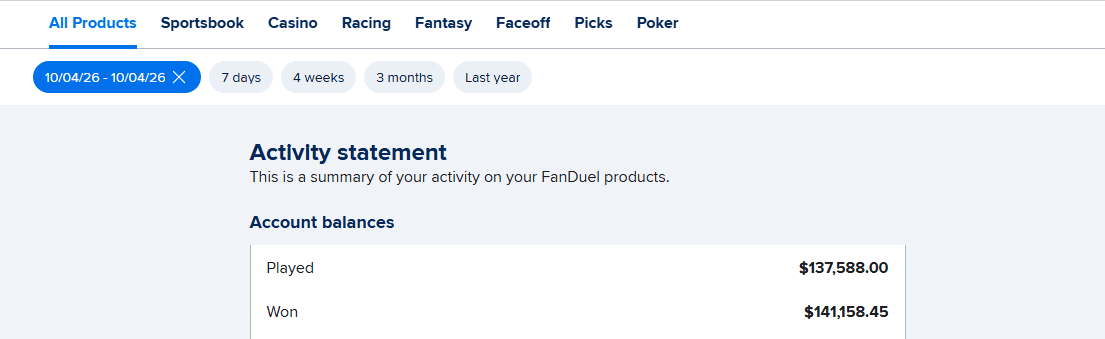
Sports Betting TikTok is the live betting account behind The Best Bet on Sports, covering NFL, NCAAF, NBA, NCAAB, MLB and WNBA markets in real time. The account has been limited on all six major U.S. sportsbooks — FanDuel, DraftKings, Caesars, BetMGM, Fanatics and ESPN BET — for winning on live betting, with $367,520 in verified profit since 2005. View full profile →
Past results do not guarantee future performance. Must be 21 or older to wager.
Related Articles
MLB Starting Pitcher Betting Value: Early Season 2026 Analysis
MLB Run Line Betting Strategy: Complete Expert Guide to Winning at Baseball Spreads
MLB Early Season Betting Trends: What the April 2026 Data Says
Baseball Betting Strategy: The Complete Guide to Winning MLB Bets
MLB Pitcher Matchup Analysis - How to Bet Baseball Using Starting Pitching
MLB Ballpark Betting Factors: How Home and Away Splits Create April Edge
Get real live betting picks
From $39.95/mo · Cancel anytime · Email + Discord delivery
● Get The Picks
Choose your package
Tap any tier below to select · Subscribe in one tap
👇 Tap any package to select it
✓ You're selecting
25 Units · $99.95/month
25 unit picks per month. Sweet spot for most bettors — plenty of action without going all-in.
- ✓25 live betting selections/month
- ✓Email + Discord delivery
- ✓All sports (NFL, NCAAF, NBA, NCAAB, MLB)
- ✓Mix of 1, 2, 3, 5-unit rated plays
- ✓Cancel anytime
Secure PayPal · Cancel anytime · No hidden fees · 21+ · +$367K verified
+$367,520 verified · Limited on 6 sportsbooks · 20 years documented · See Proof
Join Our Newsletter
Get free expert sports picks and analysis delivered weekly.