NFL Team Rushing Yards Props: The Parlay Math Tested

NFL teams that outrush their opponent win about 70 percent of the time, but most of that is winning teams running out the clock. In 2,639 games from 2016 to 2025, the first-half rushing leader in a close game won just 51.99 percent. The useful edge is in same-game parlays: a favorite's rushing over and moneyline hit together 37.27 percent of the time.
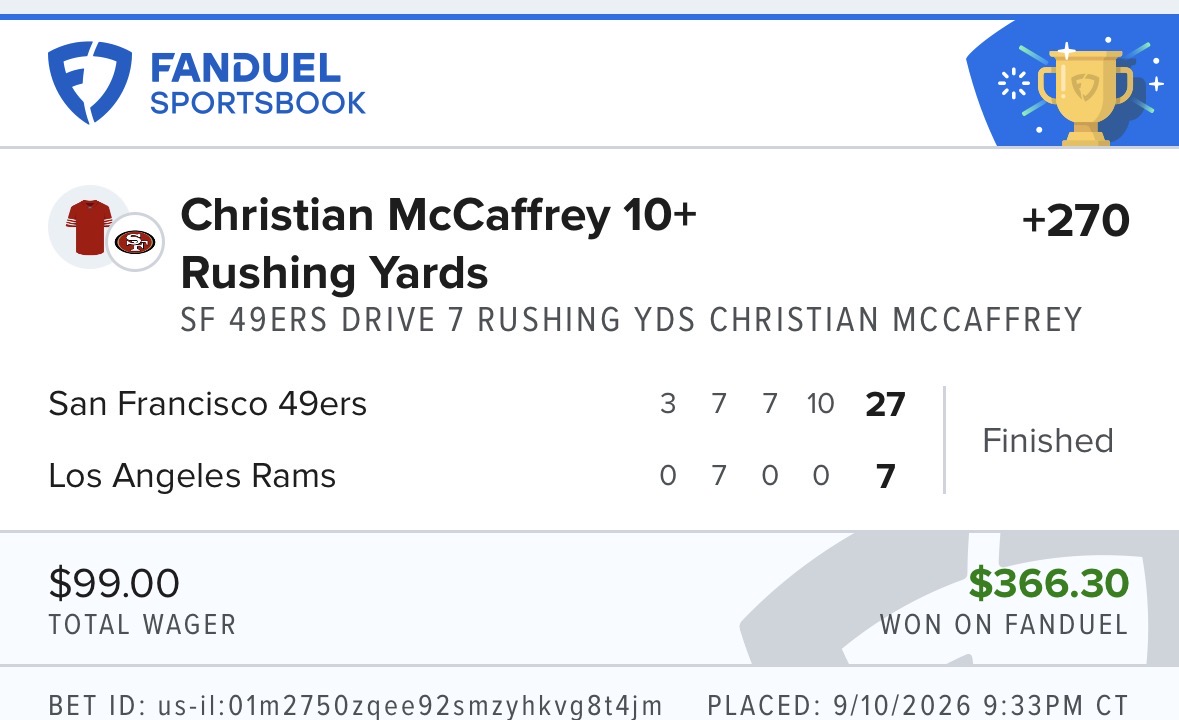
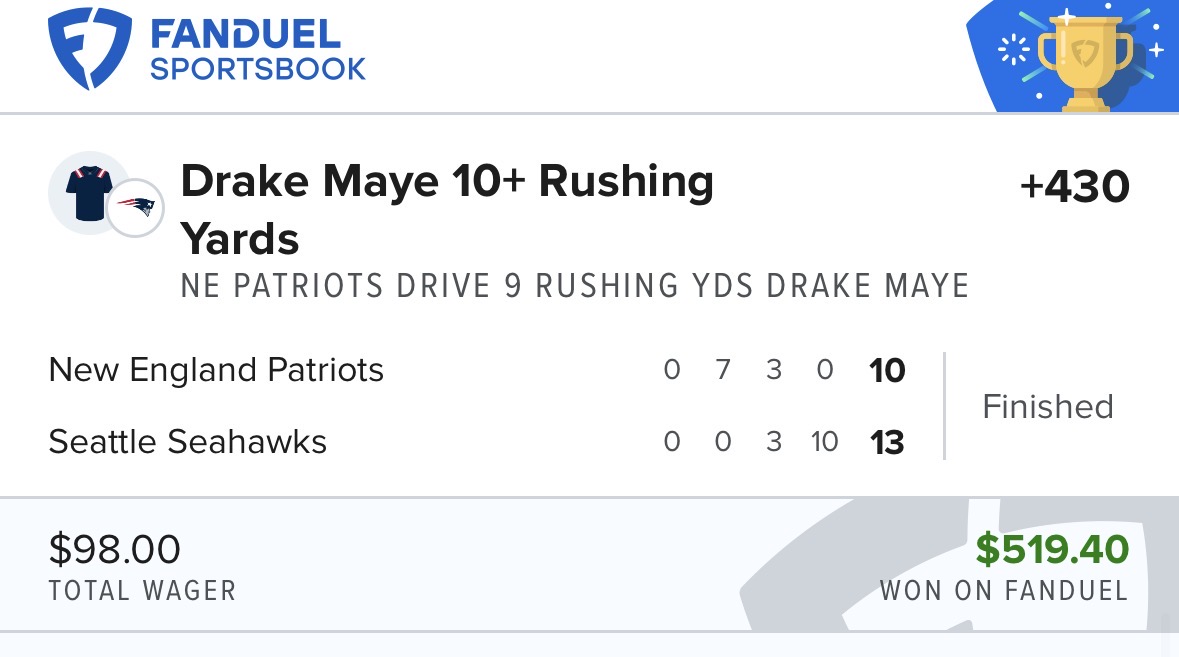
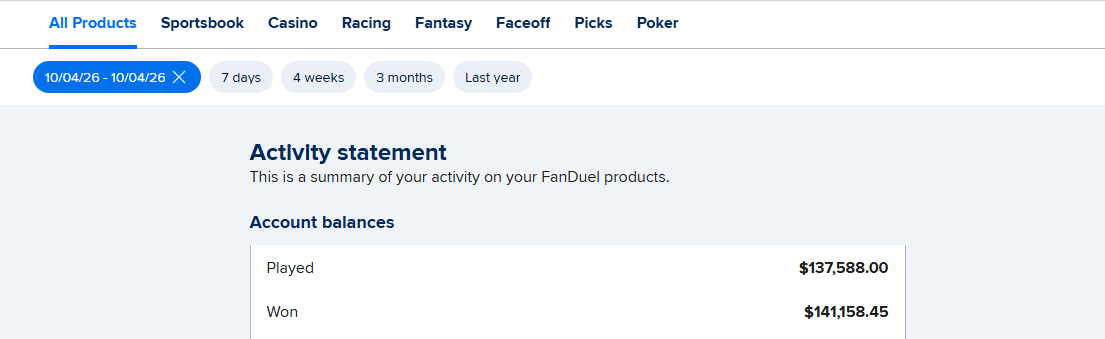
NFL teams that outrush their opponent win about 70 percent of the time, but most of that edge comes from teams running out the clock after they already lead, not the other way around. In 2,639 regular-season games from 2016 through 2025, the team with more rushing yards won 69.51 percent and covered 66.39 percent. But when a game was within three points at halftime, the team that had outrushed its opponent in the first half won just 51.99 percent. The real value sits in same-game parlays, where a favorite's team rushing over and its moneyline landed together 37.27 percent of the time against 31.31 percent if the legs were independent. The Best Bet on Sports has built a verified $367,520+ in profit across all sportsbooks, and correlated legs like these are where a parlay price can be wrong.
"Teams that win the rushing battle win the game" is one of the oldest lines in football. It's also printed on half the betting trend sheets you'll see this weekend. It's true as a description of what happened. The betting question is different. Can you use it before the game, or live during it, to make money?
We pulled every regular-season play from 2016 through the first 10 weeks of 2026 and tested it three ways: as a pregame trend, as a live halftime signal, and as a same-game parlay leg.
How Did We Build the Study?
We used nflverse play-by-play data for every regular-season game from 2016 through 2025, a total of 2,639 games, plus the 150 completed games of 2026 through Week 10. For each team in each game we added up rushing yards on designed runs and quarterback scrambles that were scored as rushes. We took out quarterback kneel-downs, since they lose yards on purpose, and two-point tries.
We matched that to the closing point spread, closing total and final score from the nflverse schedule file. Against-the-spread results leave out pushes.
The average NFL team ran for 114.4 yards a game over the 10 seasons. The median was 108. That number has moved: 108.1 from 2016 to 2019, 119.4 from 2020 to 2022, and 117.3 from 2023 to 2025. Through Week 10 of 2026 it's 113.2. Team rushing props are set around numbers like these, moved up for big favorites and down for big underdogs.
Do Teams That Outrush Their Opponent Really Win?
Yes, by a lot. Here's what the full-game numbers look like.
| Team result | Team-games | Won | Covered |
|---|---|---|---|
| Outrushed the opponent | 2,630 | 69.51% | 66.39% |
| More rushing attempts | 2,557 | 77.24% | 73.35% |
| 150+ rushing yards | 1,216 | 73.93% | 71.52% |
| 125+ rushing yards | 1,990 | 68.64% | 65.66% |
| 100+ rushing yards | 3,025 | 62.45% | 60.42% |
| Under 75 rushing yards | 1,212 | 25.83% | 28.23% |
A team that ran the ball more often than its opponent won 77 percent of the time and covered 73 percent. If you could know rushing attempts before kickoff, you would be the best handicapper in the world.
You can't, and the reason is in the second half.
Why Is the Rushing Trend Mostly Backwards?
Teams don't win because they run. They run because they're winning. Look at what happens after halftime.
| Halftime situation | 1st-half rush yards | 2nd-half rush yards | 2nd-half rush attempts |
|---|---|---|---|
| Leading by 8+ | 72.1 | 66.4 | 16.4 |
| Within 7 either way | 55.7 | 58.5 | 13.6 |
| Trailing by 8+ | 43.0 | 47.8 | 10.4 |
A team up by eight or more at the half runs 16.4 times after the break. A team down by eight or more runs 10.4 times, because it has to throw to catch up. That six-carry gap is a game-state effect, and it inflates the rushing numbers for whoever is already winning. Clock-killing drives in the fourth quarter pile on yards that have nothing to do with how the game was won.
So the 77 percent figure for "more rushing attempts" mostly tells you who led, not who was better.
Does a First-Half Rushing Edge Predict Anything Live?
This is the test that matters for live betting, and it's the one most trend sheets skip. To strip out the game-state effect, we looked only at games that were close at halftime, then asked whether the team that had run better in the first half went on to win.
| Halftime situation | Games | 1H rushing leader won | Covered |
|---|---|---|---|
| Within 3 points at the half | 677 | 51.99% | 52.21% |
| Within 3, 1H rush lead of 40+ yards | 223 | 51.57% | 51.39% |
| Tied at the half | 190 | 55.26% | 53.07% |
| 2026, within 3 at the half | 43 | 41.86% | 39.02% |
In a close game, a first-half rushing edge was worth almost nothing. The team that had outrushed its opponent won 51.99 percent of the time. A big edge of 40 or more yards did no better, 51.57 percent. The tied-at-half group looks better at 55.26 percent, but that's 190 games, which is too small to separate from chance. This season the signal has gone the wrong way, though 43 games proves nothing either.
That's a useful result for anyone who bets during the game. If you see a team grinding out 90 yards on the ground in the first half of a 13-13 game, the live line doesn't owe you anything for it. Score, field position, injuries and who has the ball to start the third quarter all matter more.
Where Is the Real Value in Team Rushing Props?
The value is in pairing. Because rushing yards and winning are tied together so tightly, a team's rushing over and that same team's moneyline are strongly correlated legs. If a sportsbook priced them as separate events, it would be underpricing the ticket.
We tested favorites first. Each row compares how often both legs hit with how often they would hit if the two were unrelated.
| Same-game parlay | Rushing over hit | Both legs hit | If independent | Fair price (both) |
|---|---|---|---|---|
| Favorite over 110.5 + favorite ML | 54.99% | 42.73% | 36.50% | +134 |
| Favorite over 120.5 + favorite ML | 47.17% | 37.27% | 31.31% | +168 |
| Favorite over 130.5 + favorite ML | 39.13% | 31.73% | 25.97% | +215 |
| Underdog over 90.5 + underdog ML | 58.41% | 25.46% | 19.42% | +293 |
| Underdog over 100.5 + underdog ML | 49.83% | 22.73% | 16.57% | +340 |
Favorites won 66.38 percent of their games across the sample. When a favorite cleared 120.5 rushing yards, it won 79.00 percent. Underdogs won 33.24 percent overall, and 45.62 percent when they ran for more than 100.5 yards. Underdogs who cleared that number also covered 63.33 percent.
Take the 120.5 row. Priced as two separate events, the ticket should pay about +219. Its real hit rate says it's worth about +168. Any same-game parlay price longer than +168 on that combination is, on these numbers, a good bet before juice.
Here's the catch. Most sportsbooks know these two legs move together and shorten the same-game parlay price on purpose. Some refuse the combination outright. So the job is to check the actual offer against the fair price, not to assume the parlay is good. Our guide to correlated parlays covers how books adjust, and why some same-game legs get blocked explains the rejections.
Does a Big Rushing Day Mean the Game Goes Under?
A lot of bettors pair a run-heavy team's rushing over with the game under, on the idea that running drains the clock. The data says the opposite.
When a team ran for more than 120.5 yards, the game went under the closing total 45.25 percent of the time. When a team cleared 140.5, the under hit just 43.08 percent. The overall under rate was 51.03 percent. A team rushing over plus the game under landed 18.45 percent of the time, below the 20.81 percent you'd expect from two unrelated legs.
Big rushing days usually come from teams that are scoring, and scoring teams push totals over. If you want to pair a rushing over with a total, the over is the correlated side. The total touchdowns study found the same link between scoring props and the game total.
Which Week 11 Matchups Fit the Pattern?
Through Week 10 of 2026, the top rushing offenses by yards per game are Tampa Bay (164.7), Buffalo (154.4), San Francisco (145.1), Chicago (143.3), Kansas City (137.0) and Detroit (135.8). The defenses allowing the most rushing yards per game are Dallas (155.0), Las Vegas (152.8), the Jets (136.7), Indianapolis (132.0), New Orleans (131.0) and Arizona (130.7).
Three Week 11 games line up a favorite with a soft run defense across the field:
- New Orleans at Chicago (CHI -11.5, total 48.5). Chicago's offense is fourth in rushing, and New Orleans allows 131.0 a game.
- Las Vegas at Denver (DEN -10, total 40.5). Las Vegas allows 152.8 rushing yards a game, second-most in the league.
- Arizona at Kansas City (KC -15.5, total 40.5). Kansas City ranks fifth in rushing offense, and Arizona ranks sixth-worst against the run.
Big spreads make the favorite's moneyline short, so most of the price on these tickets comes from the rushing leg. Check where the book hangs the number. A rushing line set at 140 or higher for a double-digit favorite already assumes a blowout script, and the correlation you're paying for may already be in the price.
None of these are picks. They are the games where the correlation is most likely to be priced in, and where the gap between the offered price and the fair price is worth checking.
How Should You Bet NFL Rushing Props?
1. Ignore "won the rushing battle" trends as a pregame angle. They describe the score, not the cause. 2. Don't bet a live side because of a first-half rushing edge. In close games it moved the win rate from 50 to 52 percent. 3. Pair a favorite's rushing over with its moneyline only at a fair price. For a line around 120.5, that's about +168 or longer. 4. Pair rushing overs with game overs, not unders. The under is the uncorrelated side. 5. Shop the same-game parlay price. Books handle correlation differently, and that's where the edge lives. Our parlay leg juice study shows how much the hold adds per leg.
If you'd rather have this kind of work done for you, that's what a sports handicapping service is for. The test of a good one is whether it can explain the price, not just name a side. Our football handicappers page explains how to tell the difference, and our NFL picks hub collects the rest of our football research. For NFL sides, see our NFL picks against the spread.
Where This Analysis Stops
Rushing yards here come from play-by-play scoring, which can differ by a few yards from official box scores after stat corrections. Sportsbooks grade on official stats. We used closing spreads and totals, not opening lines, and we didn't have historical team rushing prop lines, so the 110.5 to 130.5 thresholds are fixed reference lines, not the numbers books actually posted for each game. The same-game parlay results assume you can get both legs at standard prices, which most books won't allow on correlated legs. The 2026 sample is 150 games.
Get Tonight's Live Picks
Want live in-game NFL calls sent to your phone during the game, built for the moments when the live line hasn't caught up yet?
The Best Bet on Sports is the only live betting handicapping service limited on all six major U.S. sportsbooks (FanDuel, DraftKings, Caesars, BetMGM, Fanatics, ESPN BET) for winning too much during in-game action. Verified profit: $367,520+. Live calls go out through Email and Discord during games, and every bet in the $10,000 to $100,000 challenge is posted as it happens.
→ Join The Best Bet on Sports community — newsletter, live stream and Discord → Try a free live pick first — reserve your spot for tonight's pick
Frequently Asked Questions
Do NFL teams that outrush their opponent usually win?
Yes. From 2016 through 2025, the team with more rushing yards won 69.51 percent of regular-season games and covered the spread 66.39 percent of the time. The team with more rushing attempts won 77.24 percent. Most of that edge is backwards, though: teams that lead at halftime run about 16 times after the break, while teams trailing by eight or more run about 10 times.
Can a first-half rushing advantage predict the winner live?
Not in close games. When an NFL game was within three points at halftime, the team that had outrushed its opponent in the first half won 51.99 percent of the time across 677 games. Teams with a first-half rushing edge of 40 or more yards won 51.57 percent. Score, injuries and possession at the start of the third quarter matter more than first-half rushing totals.
Is a favorite's rushing over and moneyline a good same-game parlay?
It can be, at the right price. A favorite going over 120.5 rushing yards and winning happened 37.27 percent of the time from 2016 to 2025, versus 31.31 percent if the legs were independent. That makes the fair price about +168. Many sportsbooks shorten correlated parlays or block them, so compare the offered price to that number before betting.
What is the average NFL team rushing total?
The average NFL team ran for 114.4 yards per game from 2016 through 2025, with a median of 108 yards. The average rose from 108.1 in 2016-2019 to 119.4 in 2020-2022, then settled at 117.3 in 2023-2025. Through Week 10 of 2026, teams are averaging 113.2 rushing yards per game.
Does a big rushing game make the under more likely?
No. When an NFL team ran for more than 120.5 yards, the game went under the closing total 45.25 percent of the time, compared with 51.03 percent overall. When a team cleared 140.5 yards, the under hit 43.08 percent. Big rushing days usually come from teams that are scoring, so a team rushing over correlates with the game over.
Which NFL teams run for the most yards in 2026?
Through Week 10 of 2026, Tampa Bay leads the NFL at 164.7 rushing yards per game, followed by Buffalo (154.4), San Francisco (145.1), Chicago (143.3), Kansas City (137.0) and Detroit (135.8). Dallas allows the most rushing yards at 155.0 per game, followed by Las Vegas at 152.8 and the Jets at 136.7.
Are underdog rushing props worth parlaying with the underdog moneyline?
The correlation is real. From 2016 to 2025, underdogs won 33.24 percent of games overall but 45.62 percent when they ran for more than 100.5 yards. The two legs hit together 22.73 percent of the time, versus 16.57 percent if they were independent, which works out to a fair price near +340. Any offer longer than that is worth a look, before juice.
The Best Bet on Sports · 1.5M followers on TikTok
Sports Betting TikTok is the live betting account behind The Best Bet on Sports, covering NFL, NCAAF, NBA, NCAAB, MLB and WNBA markets in real time. The account has been limited on all six major U.S. sportsbooks — FanDuel, DraftKings, Caesars, BetMGM, Fanatics and ESPN BET — for winning on live betting, with $367,520 in verified profit since 2005. View full profile →
Past results do not guarantee future performance. Must be 21 or older to wager.
Related Articles
Favorite and Over Parlays: 11 Years of Real Results
NFL Team to Score in Every Quarter: How Often It Hits
Race to 20 Points Parlays, Tested
NFL Highest-Scoring Half, Tested
NFL Team Total Parlays, Tested
NFL First Quarter Parlays: The Tie Problem
Get real live betting picks
From $39.95/mo · Cancel anytime · Email + Discord delivery
● Get The Picks
Choose your package
Tap any tier below to select · Subscribe in one tap
👇 Tap any package to select it
✓ You're selecting
25 Units · $99.95/month
25 unit picks per month. Sweet spot for most bettors — plenty of action without going all-in.
- ✓25 live betting selections/month
- ✓Email + Discord delivery
- ✓All sports (NFL, NCAAF, NBA, NCAAB, MLB)
- ✓Mix of 1, 2, 3, 5-unit rated plays
- ✓Cancel anytime
Secure PayPal · Cancel anytime · No hidden fees · 21+ · +$367K verified
+$367,520 verified · Limited on 6 sportsbooks · 20 years documented · See Proof
Join Our Newsletter
Get free expert sports picks and analysis delivered weekly.