MLB Moneyline Betting Guide 2026 - Best Bets for the Early Season

MLB moneyline betting in the early 2026 season offers sharp bettors the best value window of the entire baseball calendar because oddsmakers are working with limited current-year data and setting lines heavily influenced by prior-season reputation. The early weeks of the MLB season create systematic mispricings as the market overreacts to small samples, overvalues preseason projections, and underestimates roster changes that have not yet been reflected in performance data — all of which create exploitable moneyline edges for prepared bettors.
# MLB Moneyline Betting Guide 2026 - Best Bets for the Early Season
MLB moneyline betting in April 2026 offers the widest market inefficiencies of the entire baseball season because sportsbooks set lines using preseason projection systems, bullpen roles remain unsettled, and early-season sample sizes create pricing errors that sharp bettors exploit through disciplined underdog targeting and starting pitcher analysis using FIP and xFIP rather than misleading ERA figures.
I have been exploiting early-season MLB market inefficiencies at The Best Bet on Sports for over two decades, and April remains my favorite month to bet baseball. The sportsbooks are essentially flying blind during the first three weeks of the season, working from spring training data and projection models rather than real performance evidence. Last April I went on a 14-6 run in the first two weeks by targeting underdogs whose bullpens had been upgraded through offseason acquisitions that the market had not priced in yet. That is the kind of edge that exists every April if you know where to look. Here is the complete moneyline betting framework we use during the early season.
What Is MLB Moneyline Betting and How Does It Work?
In MLB moneyline betting, you simply pick which team wins the game with no point spread involved. Odds are expressed as American moneylines where a -150 favorite means you risk $150 to win $100, while a +130 underdog means you win $130 for every $100 wagered. Because baseball is a low-scoring, high-variance sport, betting underdogs on the moneyline is one of the most consistently profitable long-term strategies in all of sports betting.
The moneyline is the most important line in baseball because there are no point spreads to equalize competition the way football and basketball use them. The moneyline represents pure win probability assessment. A -150 line implies a 60% win probability, while a +130 line implies roughly a 43.5% win probability. Understanding how to evaluate those implied probabilities against the sportsbook's pricing and against your own assessment is the entire game in MLB betting.
The juice structure in baseball moneylines is different from football spreads. Instead of paying -110 on both sides, baseball moneylines have the juice baked into the spread between the favorite and underdog prices. A typical line might be -150 and +130, with the 20-cent gap representing the sportsbook's margin. Some books offer reduced juice with 10-cent or even dime lines, and shopping for the best price across multiple books is one of the simplest edges available to MLB bettors.
Why Is Early-Season MLB Betting the Best Opportunity of the Year?
The sportsbook's models for MLB are best calibrated by July and August after two or more months of real performance data have accumulated. In April, they are running on preseason projections that miss critical real-world factors. This gap between projection and reality creates the widest pricing inefficiencies of the entire season.
Bullpen construction changes are the biggest source of early-season mispricing. Offseason transactions shuffled bullpens across the league, and books using last year's reliever data consistently misprice teams with significant bullpen upgrades. A team that added two quality relievers in free agency might have transformed its late-inning unit from a weakness to a strength, but the sportsbook model built on last year's bullpen ERA has not caught up yet. These upgrades take four to six weeks of real-game data to fully price into lines.
Weather and park factors create additional pricing errors in April. Early-season weather affects run totals and pitcher effectiveness in ways that take the market time to adjust for. Cold weather suppresses offense, rain delays disrupt pitcher rhythm, and wind patterns at outdoor stadiums fluctuate more dramatically in spring than in summer. Books set their weather adjustments using seasonal averages that do not capture the specific conditions of any given April game.
New manager systems create surprise results that the market cannot anticipate. First-year managers implementing new offensive philosophies, defensive alignments, or bullpen usage patterns see the most unexpected outcomes in April before opponents have film and the market has adjusted. A new manager who prioritizes aggressive baserunning or changes the team's platoon strategy creates a team that performs differently than its preseason projection suggested.
| Early Season Edge | Why It Exists | How Long It Lasts | Best Bet Type |
|---|---|---|---|
| Bullpen upgrades | Books use prior year data | 4-6 weeks | Moneyline, F5 |
| Pitcher velocity changes | Spring training data unreliable | 3-4 weeks | Totals, moneyline |
| New manager impact | No real-game data available | 6-8 weeks | Moneyline |
| Weather mispricing | Seasonal averages vs. daily reality | All of April | Totals |
| Lineup construction | Roster battles not settled | 2-3 weeks | Team totals |
The recency bias opportunity is another early-season goldmine. When a strong team opens the season 3-7, public bettors fade them aggressively. When a weak team goes 8-2 out of the gate, public money piles on. Both situations create pricing opportunities because 10-game samples in baseball mean absolutely nothing about a team's true quality. Moneylines on teams experiencing statistical flukes in the opening weeks are prime betting opportunities for sharp handicappers.
How Do You Identify the Best MLB Moneyline Picks Each Day?
Finding daily value in MLB moneylines follows a systematic process that I have refined over twenty years. It starts with the starting pitcher matchup and works outward through bullpen situations, lineup construction, weather conditions, and line value assessment.
Evaluate starting pitcher quality using the right metrics. Starting pitcher is the most important single variable in any MLB game and the most overweighted factor in public handicapping. The mistake most bettors make is using ERA, which is heavily influenced by luck, defense, and run support. Instead, use FIP which strips out defense and focuses on strikeouts, walks, and home runs, the outcomes the pitcher actually controls. Use xFIP which adjusts home run rate to league average for an even cleaner read on underlying stuff. Check recent pitch mix data because if a pitcher has added or abandoned a pitch from last year, their results will diverge from projection systems for the first four to six weeks.
Identify when to target the underdog moneyline. MLB underdogs win roughly 44% to 45% of games, but they are typically priced as if they win 38% to 40%. That gap is the structural foundation of underdog-focused MLB betting strategy, and it is widest when the underdog is starting a pitcher who is undervalued because he does not strike out a lot but has elite contact management. The gap also widens when the favorite is starting an ace who has a history of inefficiency against the specific underdog's lineup type, or when the underdog is at home with a park factor that neutralizes the favorite's strengths.
Use bullpen data as a secondary filter. Bullpen performance is the most underweighted factor in public MLB handicapping. A team's best starting pitcher is obvious to everyone, but a team with the league's most improved bullpen from an offseason addition is not obvious, and the market takes time to price it in. Track reliever ERA, WHIP, and strikeout rates specifically for high-leverage situations. Teams with dominant closers and quality setup men win close games at above-average rates, and April is full of close games as offenses find their footing.
See our MLB picks page and baseball picks hub for daily starting pitcher analysis and best bets throughout the 2026 season. For how moneyline value connects to other bet types, see the MLB run line betting strategy guide and MLB first five innings (F5) betting guide.
What Is the Best Underdog Moneyline Strategy in MLB?
Underdog moneyline betting is the backbone of profitable MLB wagering over long sample sizes. The key is not betting every underdog blindly but identifying the specific conditions under which underdogs offer the most value relative to their pricing.
The sweet spot for underdog moneylines is between +100 and +160. Dogs in this range have implied win probabilities between 38% and 50%, and the data shows they win closer to 43% to 47% of games in most configurations. That gap between implied probability and actual probability is where your profit lives. Dogs above +200 are longshots that rarely win enough to generate sustained profit, and dogs between +100 and +120 are often the best value because the market barely differentiates them from pick-em games.
Home underdogs deserve special attention. A team getting plus money at home typically means the sportsbook heavily favors the opposing starter. But home field advantage in baseball is real, worth roughly 53% to 54% win rate for home teams overall, and the park factors that benefit the home team are already built into every at-bat. Home dogs with quality starters on the mound are historically one of the most profitable subsets in all of sports picks.
Underdog pitchers with low strikeout rates but elite ground ball rates are systematically undervalued by the market. The public loves strikeout pitchers because they are exciting, but a ground ball pitcher who gets weak contact and induces double plays can be equally effective at suppressing runs. These pitchers generate worse betting lines than their actual performance warrants because the market anchors on strikeout rate as a proxy for quality.
Our MLB betting resource covers our seasonal underdog strategy breakdown and the specific filters we use to identify high-value dogs throughout the 2026 season.
How Does Weather Impact MLB Moneyline Value in April?
Weather is the most powerful short-term variable in baseball betting and the one that casual bettors most consistently ignore. A game played in 42-degree weather with a 15 mile-per-hour wind blowing in from center field is a fundamentally different event than the same matchup played in 78 degrees with no wind. Yet the moneyline adjustment for these conditions is often minimal.
Temperature affects ball carry, bat speed, grip, and pitcher control. Games played below 55 degrees show measurably lower run scoring. For moneyline purposes, cold weather tends to benefit the better pitching team because offensive output is suppressed and pitching dominance becomes more pronounced. When both teams have average pitching but one has a significantly better offense, cold weather narrows the gap because the offensive advantage is diminished.
Wind direction is the most impactful weather variable for totals but also affects moneylines. A strong wind blowing out increases run scoring, which means the team with the better offense has more opportunities to leverage its advantage. A strong wind blowing in suppresses scoring and makes the game more dependent on pitching quality. Align your moneyline lean with the weather conditions rather than assuming weather only matters for totals.
Rain creates a unique set of considerations. Games that start in rain or have rain delays in the early innings tend to produce sloppy play, more errors, and unpredictable outcomes. Sharp bettors often avoid games with significant rain risk entirely because the variance is too high to handicap reliably. If you do bet rain-threatened games, lean toward the team with better starting pitching because pitchers who can maintain their mechanics in wet conditions have a significant edge.
How Should You Size Your MLB Moneyline Bets?
Bet sizing on MLB moneylines requires a different approach than football or basketball because the odds vary significantly from game to game. Flat betting means risking the same dollar amount on every play regardless of the odds, not betting to win the same amount.
If your standard unit is $100, you risk $100 on a -150 favorite to win $67 and risk $100 on a +130 underdog to win $130. Your risk is constant while your potential reward fluctuates. This approach prevents the common mistake of over-exposing your bankroll on heavy favorites where you risk $300 to win $100, which requires a 75% win rate just to break even.
The maximum risk per play should be 1% to 2% of your total bankroll for standard plays and 3% for your highest conviction spots. On a $10,000 bankroll, that means $100 to $200 per standard play. This sizing gives you the staying power to survive the inevitable 10 to 15 game losing streaks that every MLB bettor experiences during a 162-game season. For a complete framework, read our sports betting tips for beginners and sports betting losing streak recovery guide.
Track your results by price range to identify where your edge is strongest. Some handicappers are most profitable betting moderate underdogs between +110 and +140. Others find their best results on slight favorites between -110 and -130. Knowing your sweet spot allows you to allocate your bankroll more efficiently by increasing unit size in your most profitable price range and reducing it where you are break-even.
Browse our sports picks to see how we size our baseball plays and check our verified track record for documented proof of our long-term approach.
Frequently Asked Questions
What is a good unit size for MLB moneyline betting?
Flat betting 1% to 2% of your bankroll per game is the most sustainable approach for MLB moneyline betting. Because MLB involves 162 games and inherently high variance, even the best bettors go through 10 to 15 game losing streaks during a season. Unit sizing that protects your bankroll through those inevitable cold stretches is more important in baseball than in any other major sport. A $5,000 bankroll should use $50 to $100 units to ensure you can weather any realistic losing streak without going bust.
Is it better to bet favorites or underdogs in MLB?
Long-term data strongly favors underdog moneyline betting as a strategy in MLB. Heavy favorites at -200 or more are the worst bets in baseball by expected value because you risk too much to win too little, and even great teams lose 35% to 40% of their games. Targeting underdogs between +100 and +160 is the most historically profitable range because these teams win at rates higher than their implied probability suggests.
How important is home field advantage in MLB betting?
Home field in baseball is significant but often overpriced by the market. Home teams win roughly 53% to 54% of games, which is meaningful but modest. The market frequently prices home teams as if they win 58% to 60%, creating consistent value on road teams in specific matchup situations, particularly when the road team's lineup is well-suited to the home park's dimensions and the road starter has strong road splits.
When should I bet MLB moneylines versus the run line?
Bet the moneyline when you believe a team will win but the margin is uncertain. Use the run line when you have strong conviction that a team will win by two or more runs, because the run line offers significantly better odds than the moneyline on heavy favorites. For example, a -180 moneyline favorite might be -120 on the run line, giving you much better value if you believe a blowout is likely.
How do I handle a long MLB losing streak?
Losing streaks of 8 to 12 games are mathematically expected in MLB betting, even for handicappers operating at 55% to 57% hit rates. The worst thing you can do is increase bet sizes to chase losses. Stick to your unit size, review your process to make sure your analysis is still sound, and trust the math over the long run. If your process is solid, the results will correct. If your bankroll is sized correctly, you can absorb any realistic losing streak without going bust.
What makes April 2026 different from other early seasons?
Every April features the same structural market inefficiencies, but the specifics change year to year based on offseason transactions, managerial changes, and roster construction shifts. The 2026 season features several teams with dramatically revamped bullpens, multiple first-year managers implementing new systems, and significant roster turnover on contending teams. These changes create wider pricing gaps than a typical April because the sportsbook models have more catching up to do.
Should I bet MLB moneylines or totals during the early season?
Both markets offer value in April, but for different reasons. Moneylines offer value because team quality is mispriced due to incomplete data. Totals offer value because weather conditions and pitcher performance levels are harder to model in the early season. A balanced approach targeting both markets based on where your analysis identifies the strongest edge is more effective than committing exclusively to one bet type. Track your results by market type to see where your early-season edge is strongest.
The Best Bet on Sports · 1.5M followers on TikTok
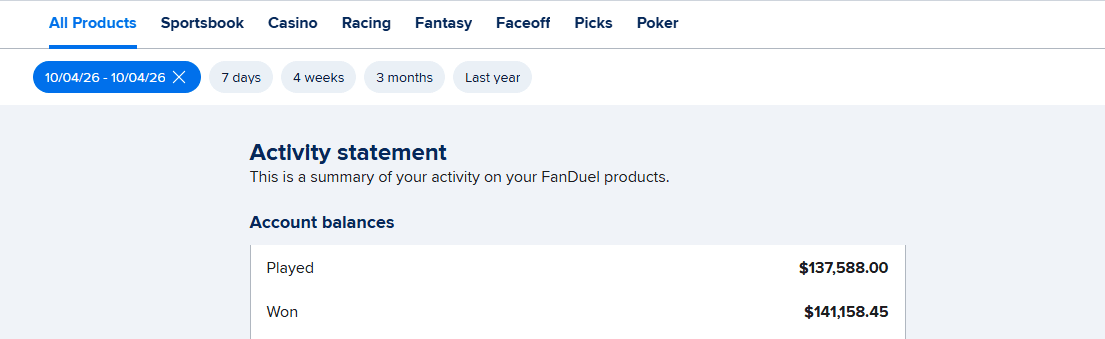
Sports Betting TikTok is the live betting account behind The Best Bet on Sports, covering NFL, NCAAF, NBA, NCAAB, MLB and WNBA markets in real time. The account has been limited on all six major U.S. sportsbooks — FanDuel, DraftKings, Caesars, BetMGM, Fanatics and ESPN BET — for winning on live betting, with $367,520 in verified profit since 2005. View full profile →
Past results do not guarantee future performance. Must be 21 or older to wager.
Related Articles
MLB Pitcher Matchup Analysis - How to Bet Baseball Using Starting Pitching
MLB Catcher Framing Pop Time Totals Props May 2026
MLB Extra Innings Ghost Runner Betting Strategy May 2026: How the Zombie Runner Rule Reshapes Totals, Run Lines, and Live Bets
MLB NRFI/YRFI Betting Strategy: First Inning Run Markets April 2026
MLB Early Season Betting Trends: What the April 2026 Data Says
MLB Betting Picks and Early Season Analysis 2026
Get real live betting picks
From $39.95/mo · Cancel anytime · Email + Discord delivery
● Get The Picks
Choose your package
Tap any tier below to select · Subscribe in one tap
👇 Tap any package to select it
✓ You're selecting
25 Units · $99.95/month
25 unit picks per month. Sweet spot for most bettors — plenty of action without going all-in.
- ✓25 live betting selections/month
- ✓Email + Discord delivery
- ✓All sports (NFL, NCAAF, NBA, NCAAB, MLB)
- ✓Mix of 1, 2, 3, 5-unit rated plays
- ✓Cancel anytime
Secure PayPal · Cancel anytime · No hidden fees · 21+ · +$367K verified
+$367,520 verified · Limited on 6 sportsbooks · 20 years documented · See Proof
Join Our Newsletter
Get free expert sports picks and analysis delivered weekly.