
Same-Game Parlay vs Traditional Parlay: Which Wins More?

A same-game parlay combines legs from one game and pays less because the sportsbook applies a correlation penalty; a traditional parlay combines legs from different games and pays full uncorrelated odds. Neither is universally better — the right choice depends on whether your legs share a genuine cause. This guide breaks down the payout math, the win-rate trade-off, and why the sharpest edge in either format shows up in live in-game markets, not before the games start.
The honest answer to "same-game parlay vs traditional parlay" is that neither wins more on its own — the format only matters relative to whether your legs share a real underlying cause, and most bettors pick the wrong one for the wrong reason. The Best Bet on Sports has earned a verified $367,520+ profit across all six major U.S. sportsbooks over more than twenty years, and almost none of it came from the four-figure-payout parlay screenshots that flood social media. A same-game parlay (SGP) staples legs from one game together and pays less because the book charges you a correlation penalty; a traditional parlay staples legs from different games together and pays full odds. Which one wins more comes down to a single question: do your legs actually move together, or are you just chasing a bigger number?
Most bettors never ask that question. They build a traditional parlay when they should be building a same-game parlay, or they load up a same-game parlay with obvious correlated legs the sportsbook has already deflated to nothing. Understanding the structural difference between the two formats is the difference between paying for correlation you could have gotten for the right price and giving the house free margin.
What Is the Difference Between a Same-Game Parlay and a Traditional Parlay?
A traditional parlay combines two or more bets from separate games onto one ticket — say, the Yankees moneyline, the Dodgers run line, and a Braves total. Because those outcomes are independent (the Yankees game has no bearing on the Dodgers game), the sportsbook multiplies the true odds together and pays you the full uncorrelated price. The math is clean: each leg carries its own vig, and the parlay stacks those edges for the house, but the payout itself is honest to the combined probability.
A same-game parlay combines two or more bets from a single game — a team's spread, that game's total, and a player prop, all from the same matchup. Here the legs can be correlated: if a star goes off for 40, the team is more likely to win and the total is more likely to go over. The sportsbook knows this, so it runs the ticket through a correlation model and shaves the payout to account for the shared probability. That shaved number is the SGP's defining feature — and its biggest trap.
| Feature | Traditional parlay | Same-game parlay |
|---|---|---|
| Legs come from | Different games | One game |
| Legs are | Independent | Often correlated |
| Payout basis | Full uncorrelated odds | Odds minus correlation penalty |
| Typical 3-leg payout | ~+600 | ~+250 to +450 |
| Main risk | Every leg is a separate coin flip | Overpaying for obvious correlations |
| Best used when | Legs are unrelated value bets | Legs share a genuine hidden cause |
Which One Pays More — and Why That's the Wrong Question
On paper, a traditional parlay always pays more than the same three legs as a same-game parlay, because the SGP price has the correlation penalty baked in. A standard three-leg traditional parlay at -110 per leg pays around +600. Rebuild those three legs inside one game and the book might pay +300 to +450 depending on how correlated it judges them. That looks like the traditional parlay is the better deal — but payout size alone tells you nothing about expected value.
The traditional parlay pays more because your three independent legs are genuinely three separate coin flips. Miss any one and the whole ticket dies, and the probability of hitting all three is exactly the product of the individual probabilities — no free help. The same-game parlay pays less, but on the right build the legs help each other: the true probability of all three hitting is higher than the naive multiplication suggests, because they share a cause. The question is never "which pays more." It's "is the payout fair to the real probability?" We break the underlying trap down in why most parlays lose, and the deeper mechanics of shared-cause legs live in correlated parlays explained.
When a Same-Game Parlay Is the Right Call
A same-game parlay wins more than a traditional one only when you build it around a correlation the book has underpriced — not the obvious ones it has already neutralized. The book heavily penalizes "favorite plus team-total over plus star points over," because everyone builds it and the model knows those three legs are the same bet three times. What it underprices are the conditional, scheme-driven relationships:
- Star points under + secondary scorer over — when a defense takes the ball out of a primary option's hands, the points redistribute to a predictable second option.
- Favorite spread cover + game total under — a better team controlling a game it's expected to win slows the pace and covers at the same time.
- Star assists over + team three-pointers over — a creator getting downhill produces both assists and open perimeter looks.
These are two outcomes that share one underlying cause the model hasn't fully connected. Our NBA same-game parlay strategy lays out the full set of structures worth building. The rule of thumb: if you can explain in one sentence why both legs happen for the same reason, the SGP is the right format. If you can't, you're paying the correlation penalty for nothing.
When a Traditional Parlay Is the Right Call
A traditional parlay is the right format when your legs are genuinely unrelated value bets — separate spots where you believe the price is wrong, in separate games, with no shared cause. If you like the Rays run line tonight and, independently, you like the over in a completely different game, there's no correlation to capture, so there's no reason to trap those legs inside one game's SGP pricing. Stacking independent edges is the cleanest use of the traditional format.
The catch is discipline. Each added leg multiplies the vig working against you, so a traditional parlay only makes sense when every single leg is a bet you'd make on its own. The moment you add a leg "to boost the payout" rather than because you like the number, you've turned a value stack into a lottery ticket. This is the same logic that governs the broader parlay vs straight bets decision — and for most bettors, most of the time, the straight bet wins that comparison.
Why the Real Edge Is Live — in Either Format
Here's what the format debate misses: the biggest edge in both same-game and traditional parlays shows up live, after the games start. Pre-game lines are sharp because the books have all day to price them. Live lines are priced in seconds under time pressure, which makes them the softest numbers on the board — the full case is laid out in why live betting beats pre-game picks.
Live, a same-game parlay correlation can re-open before the model re-rates it — you watch a quarter, confirm a defense is collapsing, and build the assists-plus-threes stack at a price that no longer reflects what you just saw. And a live traditional parlay lets you stack two in-game spots where the number has overreacted to a cold stretch. The catch in both cases is speed: live windows close in seconds. The only bettors who cash them are the ones getting fast, specific alerts instead of scrolling the odds board hoping to beat the move. That in-game timing is exactly what got our analysts limited at all six major U.S. sportsbooks for winning too much during live action.
How to Size Either One
Both formats carry more variance than a straight bet, and a same-game parlay's correlated legs don't reduce that — they just make the payout fairer on the right build. Treat any parlay, same-game or traditional, as a small fixed slice of risk capital, the exact framework in bankroll management for $100 to $500 bettors. Keep two legs as your default, treat three as the ceiling, and never chase a busted ticket with a bigger one. The format you choose matters far less than the discipline you bring to sizing it.
For a closer look at this angle, our breakdown of same game parlay plus strategy picks up where this leaves off.
Get Tonight's Live Picks
Want tonight's live in-game same-game and traditional parlay legs delivered to your phone via Email and Discord during the game — the same real-time spots our analysts use to build value the books can't pre-price?
The Best Bet on Sports is the only live betting handicapping service limited on all six major U.S. sportsbooks (FanDuel, DraftKings, Caesars, BetMGM, Fanatics, ESPN BET) for winning too much during in-game action. Verified profit: $367,520+. Picks delivered via Email and Discord during games.
→ Get tonight's live picks: $199 first month — 1-Unit package, full live betting access → Try a free live pick first — reserve your spot for tonight's pick
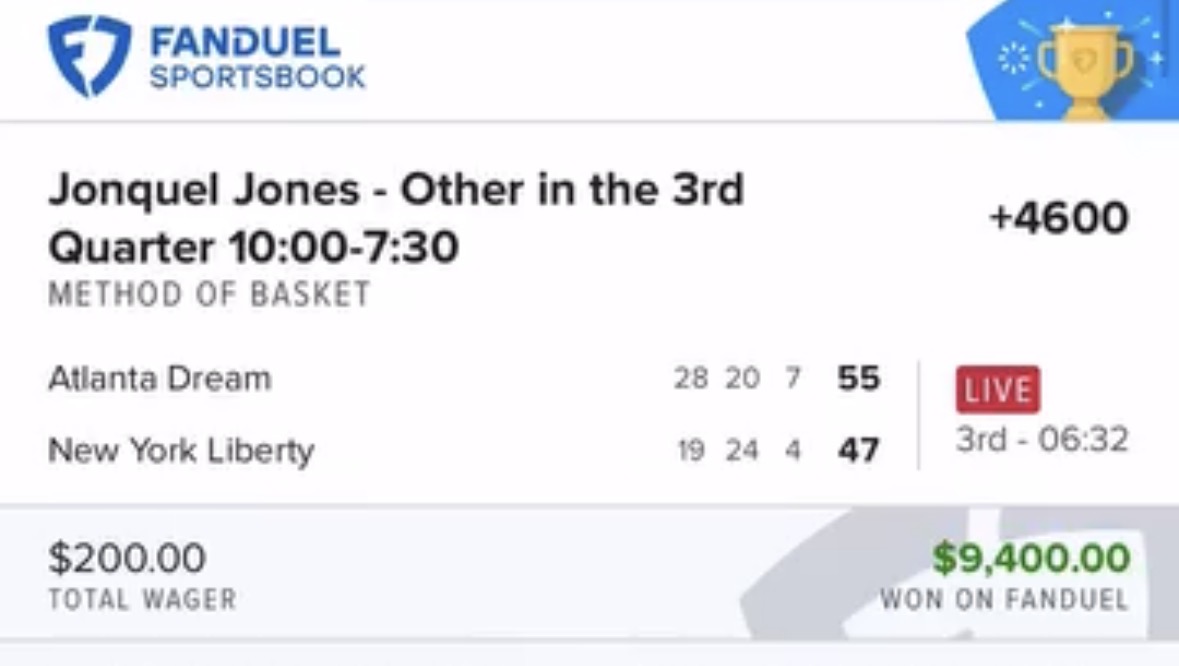
Explore more in-game plays on our live betting picks page, tonight's basketball card on NBA picks, or the full board of today's sports picks.
Frequently Asked Questions
What is the difference between a same-game parlay and a traditional parlay?
A traditional parlay combines bets from different games, and because those outcomes are independent, the sportsbook pays the full odds of multiplying them together. A same-game parlay combines bets from a single game, where the legs can be correlated, so the sportsbook applies a correlation penalty that lowers the payout to account for the fact that the legs help each other hit. The formats are priced differently precisely because one set of legs is independent and the other is not.
Which pays more, a same-game parlay or a traditional parlay?
For the same legs, a traditional parlay always pays more, because a same-game parlay has the correlation penalty subtracted from its price. A three-leg traditional parlay at standard odds pays roughly +600, while the same three legs inside one game as a same-game parlay might pay +300 to +450. But payout size alone doesn't make one better — the traditional parlay pays more because its legs are three separate coin flips with no shared probability, while the same-game parlay's legs can genuinely help each other on the right build.
Is a same-game parlay better than a traditional parlay?
A same-game parlay is better only when you build it around a correlation the sportsbook has underpriced — a conditional, scheme-driven relationship where two outcomes share one cause the model hasn't fully connected. A traditional parlay is better when your legs are genuinely unrelated value bets in separate games with no correlation to capture. Neither format is universally superior; the right choice depends entirely on whether your legs share a real underlying cause.
Why does the sportsbook pay less on same-game parlays?
The sportsbook pays less on same-game parlays because the legs come from one game and can move together. If a star scores 40 points, the team is more likely to win and the total is more likely to go over — those are not three independent events, they're partly the same event. The book runs the ticket through a correlation model and shaves the payout so it isn't overpaying for outcomes that share probability. That shaved number is fair on obvious correlations and a genuine edge only on the ones the model underprices.
Are live parlays better than pre-game parlays?
Yes, for most bettors, in both formats. Pre-game lines are sharp because the books have all day to price them, while live lines are set in seconds under time pressure, making them the softest numbers available. Live, a same-game parlay correlation can re-open before the model re-rates it, and a live traditional parlay lets you stack in-game spots where the number overreacted. The challenge is speed — live windows close in seconds, so fast, specific alerts are essential to catch them.
How many legs should a parlay have?
Two legs should be your default and three should be your ceiling, whether the parlay is same-game or traditional. Each added leg compounds the variance and, in a traditional parlay, multiplies the vig working against you. The marginal edge you gain from a fourth or fifth leg almost never justifies the payout and hit-rate you give up. A disciplined two-leg build on a genuine edge beats a five-leg ticket stapled together to chase a dollar figure the vast majority of the time.
Does The Best Bet on Sports send parlay legs?
Yes. The Best Bet on Sports delivers live in-game spots during games via Email and Discord, including the correlated same-game legs and independent traditional legs our analysts use to build value the books can't price before the games start. Those in-game timing bets are exactly what got the service limited at all six major U.S. sportsbooks for winning too much during live action, and the verified profit across that history is $367,520+.
The Best Bet on Sports · 1.5M followers on TikTok
Sports Betting TikTok is the live betting account behind The Best Bet on Sports, covering NFL, NCAAF, NBA, NCAAB, MLB and WNBA markets in real time. The account has been limited on all six major U.S. sportsbooks — FanDuel, DraftKings, Caesars, BetMGM, Fanatics and ESPN BET — for winning on live betting, with $367,520 in verified profit since 2005. View full profile →
Past results do not guarantee future performance. Must be 21 or older to wager.
Related Articles
Same-Game Parlay Plus (SGP+): How Cross-Game SGPs Pay
WNBA Same-Game Parlay Strategy: Which Correlations Actually Pay
Same-Game Parlay Strategy for the NBA: How to Stack Correlated Bets Without Killing Your Payout
First Half Over, Game Under: The Parlay That Fights Itself
Lead at Halftime and Win: What That NFL Parlay Pays
The Last Two Minutes Kill More Parlays Than Bad Picks Do
Get real live betting picks
From $39.95/mo · Cancel anytime · Email + Discord delivery
● Get The Picks
Choose your package
Tap any tier below to select · Subscribe in one tap
👇 Tap any package to select it
✓ You're selecting
25 Units · $99.95/month
25 unit picks per month. Sweet spot for most bettors — plenty of action without going all-in.
- ✓25 live betting selections/month
- ✓Email + Discord delivery
- ✓All sports (NFL, NCAAF, NBA, NCAAB, MLB)
- ✓Mix of 1, 2, 3, 5-unit rated plays
- ✓Cancel anytime
Secure PayPal · Cancel anytime · No hidden fees · 21+ · +$367K verified
+$367,520 verified · Limited on 6 sportsbooks · 20 years documented · See Proof
Join Our Newsletter
Get free expert sports picks and analysis delivered weekly.