Bonus Bet Parlay Strategy: The Optimal Number of Legs Is Four

A bonus bet does not return your stake, and that single rule reverses everything you know about parlay length. On a cash ticket every extra leg makes the bet worse. On a bonus bet every extra leg makes it better — up to a point. That point is four legs, where a $100 bonus bet is worth about $76.76, and past it the vig starts winning again.
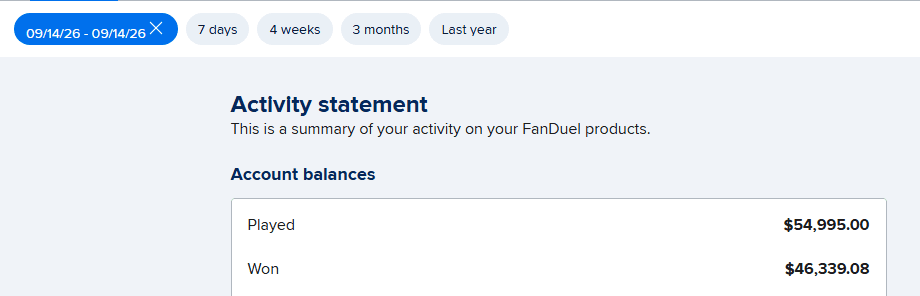
A bonus bet does not return your stake when it wins, and that one rule inverts the entire logic of parlay construction. On a cash ticket, part of every payout is your own money coming back, so each additional leg compounds the vig and makes the bet strictly worse. On a bonus bet you never get the stake back regardless, so longer odds recover a larger share of the promo's face value — right up until compounded juice overtakes the recovery. Run the arithmetic on all-(-110) legs and the crossover is exact: a $100 bonus bet is worth about $45.45 as a single, peaks at roughly $76.76 at four legs, and starts falling at five. The Best Bet on Sports has built a verified $367,520+ in profit over more than twenty years and is limited on all six major U.S. sportsbooks for winning during live betting, and this is one of the few places in betting where the optimal play is provably the opposite of the cash-bet answer.
Every football season opens with the same wave of sportsbook promotions, and every year the same mistake gets made with them. A bettor receives a $100 bonus bet, treats it as $100, and puts it on the safest thing on the board — a heavy favorite moneyline, or a two-leg ticket built out of chalk. It feels responsible. It is, in expectation, one of the worst things you can do with the credit.
The reason is a piece of mechanics that promo terms bury and almost nobody prices correctly. The same mechanics decide whether you should use bonus bets on live picks, where the stake-back rule interacts with a number that is moving while you act.
All odds, probabilities, and dollar figures below are illustrative and rounded. They demonstrate structure, not our posted record. Real prices vary by book and move constantly.
What Is a Bonus Bet and How Is It Different From Cash?
A cash bet returns two things when it wins: your profit and your original stake. Put $100 on a +100 line and you collect $200 — $100 of profit and the $100 you already owned.
A bonus bet returns only the first one. Place the same $100 bonus bet at +100 and a win pays $100. The credit is consumed. It does not come back, it does not roll over, and it does not appear in your withdrawable balance.
That means the fraction of a bonus bet's face value you actually keep depends entirely on the odds you place it at. Written as a formula, using decimal odds:
Value retention = (decimal odds − 1) ÷ decimal odds = 1 − (1 ÷ decimal odds)
The number that gets stripped out — 1 ÷ decimal odds — is the share of the payout that would have been your returned stake on a cash bet. At short prices that share is enormous. At long prices it is a rounding error.
| Odds placed at | Decimal | Share of payout that is stake | Value retained |
|---|---|---|---|
| −400 | 1.25 | 80.0% | 20.0% |
| −200 | 1.50 | 66.7% | 33.3% |
| −110 | 1.909 | 52.4% | 47.6% |
| +264 (2 legs) | 3.64 | 27.5% | 72.5% |
| +595 (3 legs) | 6.95 | 14.4% | 85.6% |
| +1228 (4 legs) | 13.28 | 7.5% | 92.5% |
| +4740 (6 legs) | 48.4 | 2.1% | 97.9% |
A $100 bonus bet dropped on a −400 favorite is a $20 asset. The same credit on a four-leg parlay is a $92.50 asset. That is the single most valuable thing to understand about promos, and it points in exactly one direction: longer.
Why Every Extra Leg Makes a Cash Parlay Worse
Before pushing that logic too far, it has to be checked against the force running the other way.
A −110 line implies a break-even win rate of 52.38%. If the underlying event is genuinely a coin flip, the book is paying 1.909 on something worth 2.00, so each leg returns 95.45% of its fair value. Parlay legs multiply, which means so does the shortfall.
For a cash bet on n coin-flip legs priced at −110, expected value per $100 is:
$100 × (0.9545ⁿ − 1)
| Legs | Cash EV on $100 |
|---|---|
| 1 | −$4.55 |
| 2 | −$8.89 |
| 3 | −$13.04 |
| 4 | −$16.99 |
| 6 | −$24.38 |
| 8 | −$31.10 |
Monotonic decline. This is the arithmetic behind the standard advice, and it is correct as far as it goes — we walked through the same mechanism in why most parlays lose and in the breakdown of how parlay payouts are calculated. With cash on the line, every leg you add is another 4.55% haircut on money you own.
But the haircut applies to money you own. A bonus bet is not money you own.
Where the Two Forces Cross: The Four-Leg Answer
Put both effects in the same expression. For a $100 bonus bet on n coin-flip legs at −110, the win probability is 0.5ⁿ, the decimal payout is 1.909ⁿ, and only the profit is collected:
EV = $100 × (0.9545ⁿ − 0.5ⁿ)
The first term is the compounding vig dragging value down. The second is the stake-loss you recover by stretching the odds. They move in opposite directions at different speeds, and they cross.
| Legs | Approx. American odds | Bonus bet EV on $100 | Change from prior leg |
|---|---|---|---|
| 1 | −110 | $45.45 | — |
| 2 | +264 | $66.11 | +$20.66 |
| 3 | +595 | $74.46 | +$8.35 |
| 4 | +1228 | $76.76 | +$2.30 |
| 5 | +2435 | $76.10 | −$0.66 |
| 6 | +4740 | $74.06 | −$2.04 |
| 7 | +9236 | $71.40 | −$2.66 |
| 8 | +17544 | $68.51 | −$2.89 |
Four legs. That is the peak, and five is already worse than four.
This is worth sitting with, because it contradicts both of the popular positions at once. The cautious bettor who parlays a bonus bet into two safe legs is leaving about $10.65 per $100 on the table versus a four-leg build. The bettor who fires the credit at a ten-leg longshot because "it's not my money anyway" has also given back real value — the retention curve is essentially flat past six legs while the juice keeps compounding at full speed.
The four-leg figure is not a magic constant. It is where the marginal recovery from stretching odds falls below the marginal cost of another helping of vig. Shift the leg pricing and the peak shifts with it. Build from −140 legs and the optimum lands closer to three, because each leg is both shorter and more expensive. Build from +150 underdogs and it stretches toward five or six. But for the standard football menu — spreads and totals priced around −110 — four is the number, and it is stable enough to plan around.
Does Having an Edge Change the Answer?
Yes, and in the direction you would expect: it pushes the optimum longer.
Rerun the same expression with legs that win 54% of the time instead of 50%. The vig term is unchanged, but the probability term shrinks more slowly, and the peak drifts out toward five or six legs. This is the same property covered in should you parlay your live betting picks together — a genuine edge compounds along with the payout, so real handicapping widens the range of structures that make sense.
The practical caution is that most bettors overestimate how many legs they can find an edge on in a single evening. Four legs you have a real read on beats six where two are filler, and filler legs do double damage on a bonus bet because they drag the win probability down without meaningfully improving the retention rate you have already nearly maxed out.
Five Rules for Placing a Bonus Bet
1. Never place a bonus bet on a favorite shorter than about −150. Below that price you are throwing away more than 40% of the credit's face value on the stake you will never see returned. If the only thing you like on the board is a heavy chalk moneyline, bet it with cash and save the bonus bet for a night with a longer structure available.
2. Target four legs at standard pricing. Three is close enough that it is not worth forcing a fourth leg you dislike. Two is a meaningful downgrade. Anything past six is throwing value away in exchange for a bigger screenshot.
3. Build from independent legs, not correlated ones. The math above assumes independence. Same-game structures are repriced by the book precisely because the legs are correlated, which changes the payout term. Our guide to same-game parlay versus traditional parlay covers where that repricing helps and where it does not.
4. Do not use a bonus bet on a live pick. The value in an in-game number is the price at the instant it is released, and promo credits frequently carry market or minimum-odds restrictions that force a delay or a substitution at the worst possible moment. Bet live picks with cash, at the number, when they arrive.
5. Read the odds floor before you build. Most bonus bets require a minimum price, commonly around −200 or longer per leg or per ticket. A four-leg build clears that floor easily. The restriction that actually bites is a maximum-odds or maximum-payout condition, which is a different mechanic entirely and one we broke down in sportsbook maximum payout limits on parlays.
Why This Matters More Once Football Starts
Promo volume is seasonal, and it peaks in the four weeks around Week 1. A bettor who receives six $100 bonus bets across the six major books during football season is holding $600 of face value. Placed on −250 favorites, that portfolio is worth roughly $171 in expectation. Placed on four-leg builds at standard pricing, it is worth roughly $460.
That is a $289 swing on identical credits, produced entirely by understanding one line in the terms and conditions. It is the cheapest edge available in sports betting, and it costs nothing but the decision.
Holding accounts at multiple books is what makes the portfolio version of this possible, and it is also what makes it fragile. Books issue promotions to acquire and retain recreational volume. Accounts that use them well, and that keep winning afterward, get their promotional offers reduced or removed long before their limits get cut — the leading indicator of a restricted account is a promo tab that quietly empties out. We covered the full progression in why sportsbooks limit winning bettors, and it is the reason our own accounts across FanDuel, DraftKings, Caesars, BetMGM, Fanatics, and ESPN BET are limited on live markets.
If you are building parlays with real money rather than promo credit, the rules run the other direction entirely — shorter, fewer legs, and only where you have a genuine read. Our parlay picks page and the NFL picks board cover that side, and our results show how the straight-bet approach has performed over time.
Get Tonight's Live Picks
Want tonight's live in-game parlay and picks delivered to your phone via Email and Discord during the game?
The Best Bet on Sports is the only live betting handicapping service limited on all six major U.S. sportsbooks (FanDuel, DraftKings, Caesars, BetMGM, Fanatics, ESPN BET) for winning too much during in-game action. Verified profit: $367,520+. Picks delivered via Email and Discord during games.
→ Get tonight's live picks: $199 first month — 1-Unit package, full live betting access → Try a free live pick first — reserve your spot for tonight's pick
Frequently Asked Questions
What is the optimal number of legs for a bonus bet parlay?
Four legs at standard −110 pricing. Because a bonus bet never returns your stake, longer odds recover a larger share of the credit's face value, but compounding vig pulls in the opposite direction. Running both effects together, a $100 bonus bet is worth about $45.45 as a single, $66.11 at two legs, $74.46 at three, and peaks at about $76.76 at four before declining to $76.10 at five and $74.06 at six. Three legs is close enough that forcing a fourth leg you dislike is not worth it.
Why shouldn't you use a bonus bet on a favorite?
Because the shorter the price, the larger the share of the payout that would have been your returned stake — and that share is exactly what a bonus bet forfeits. At −400 the stake represents 80% of a winning cash payout, so a $100 bonus bet placed there is functionally a $20 asset. At −200 it retains 33%. At −110 it retains 47.6%. If a heavy favorite is the only play you like, bet it with cash and hold the promo credit for a night with a longer structure available.
Does a bonus bet parlay beat a cash parlay?
They are not comparable as bets, but their behavior as leg count rises is opposite, which is the point. A cash parlay gets monotonically worse with every leg added: −$4.55 per $100 at one leg, −$8.89 at two, −$16.99 at four, −$31.10 at eight. A bonus bet parlay improves with each of the first four legs. That divergence is why the correct promo strategy is not simply a scaled-down version of the correct cash strategy.
Do bonus bets have minimum odds requirements?
Most do, commonly requiring each leg or the full ticket to be priced at roughly −200 or longer. A four-leg build clears that floor comfortably, so the minimum-odds term rarely constrains this strategy. The condition that matters more often is a maximum payout or maximum odds cap, which silently freezes your collectible return once the ticket crosses the ceiling while the displayed odds keep climbing.
Should you put a bonus bet on a live betting pick?
No. The value in a live in-game pick is the number at the instant it is released, and promo credits routinely carry market restrictions, minimum-odds floors, or placement delays that force you to substitute a different bet or accept a moved line. Place live picks with cash at the price they arrive at, and hold bonus bets for pregame structures you can build without time pressure.
Does having a real edge change the four-leg answer?
Yes, it extends it. The compounding-vig term is fixed by the pricing, but the win-probability term shrinks more slowly when your legs are genuinely better than the implied rate. Legs winning 54% rather than 50% push the peak out toward five or six. The caveat is practical rather than mathematical: most bettors cannot find five or six genuinely edged legs on the same slate, and filler legs cost more on a bonus bet than they appear to, because the retention benefit is nearly exhausted by leg four.
How much value is a bonus bet portfolio actually worth during football season?
It depends entirely on placement. Six $100 bonus bets across six sportsbooks carry $600 of face value. Placed on roughly −250 favorites, that portfolio is worth about $171 in expectation. Placed on four-leg builds at standard −110 pricing, it is worth about $460. The $289 difference comes from nothing but the structure chosen, which makes it one of the cheapest available edges in betting — and it is available only to bettors holding accounts at more than one book.
The Best Bet on Sports · 1.5M followers on TikTok
Sports Betting TikTok is the live betting account behind The Best Bet on Sports, covering NFL, NCAAF, NBA, NCAAB, MLB and WNBA markets in real time. The account has been limited on all six major U.S. sportsbooks — FanDuel, DraftKings, Caesars, BetMGM, Fanatics and ESPN BET — for winning on live betting, with $367,520 in verified profit since 2005. View full profile →
Past results do not guarantee future performance. Must be 21 or older to wager.
Related Articles
4-of-5 Again: Was Your Parlay Unlucky or Badly Built?
The All-Overs Parlay: The Correlation You'd Need
Best NFL Parlays for Thursday Night Football: One Game, No Escape Route
The Last Leg Decides Your Parlay: Build the Ticket for Its Exit
Should You Parlay Your Live Betting Picks Together?
NFL Preseason Parlay Strategy: Why August Football Breaks the Math
Get real live betting picks
From $39.95/mo · Cancel anytime · Email + Discord delivery
● Get The Picks
Choose your package
Tap any tier below to select · Subscribe in one tap
👇 Tap any package to select it
✓ You're selecting
25 Units · $99.95/month
25 unit picks per month. Sweet spot for most bettors — plenty of action without going all-in.
- ✓25 live betting selections/month
- ✓Email + Discord delivery
- ✓All sports (NFL, NCAAF, NBA, NCAAB, MLB)
- ✓Mix of 1, 2, 3, 5-unit rated plays
- ✓Cancel anytime
Secure PayPal · Cancel anytime · No hidden fees · 21+ · +$367K verified
+$367,520 verified · Limited on 6 sportsbooks · 20 years documented · See Proof
Join Our Newsletter
Get free expert sports picks and analysis delivered weekly.