Lead at Halftime and Win: What That NFL Parlay Pays

Across 3,028 NFL games from 2015 through 2025, the team leading at halftime won 77.8% of the time. That makes a lead-at-halftime-and-win parlay mostly a bet on the first half. For a 3-point favorite, the combined outcome hit 43.6%, a fair price near +129, while pricing the two legs as independent would suggest +216. The second leg adds far less payout than it appears to.
Across 3,028 NFL games from the 2015 season through the 2025 playoffs, the team leading at halftime went on to win 77.8% of the time. That one number explains why a same-game parlay on a team to lead at halftime and win the game is mostly a first-half bet with a small add-on. For a 3-point favorite, the two outcomes landed together 43.6% of the time, a fair price of about +129. Multiply the legs as if they were unrelated and you would expect about +216. The Best Bet on Sports has bet NFL games live for more than twenty years with a verified $367,520+ in profit across all sportsbooks, and the gap between those two prices is where this parlay gets misread.
The idea is appealing. If you think a team is better, it should lead at the half and it should win, so why not collect on both? The problem is that those are not two separate predictions. They are mostly the same prediction said twice, and the payout knows it.
We built the numbers below from the public nflverse play-by-play data: 11 seasons, regular season and playoffs, with the halftime score taken at the end of the second quarter and the favorite defined by the point spread the dataset records for each game. Nothing here is a projection. It is what happened.
How Often Does the Team Leading at Halftime Win in the NFL?
The headline number is 77.8%. Games tied at halftime made up 7.3% of the sample and are excluded from that figure. The rate was steady from season to season, ranging from 69.6% in 2022 to 81.7% in 2017.
The size of the lead matters far more than the fact of leading:
| Halftime lead | Games | Leader won |
|---|---|---|
| 1 to 3 points | 565 | 57.3% |
| 4 to 7 points | 860 | 71.9% |
| 8 to 10 points | 407 | 84.3% |
| 11 to 14 points | 468 | 89.3% |
| 15 or more points | 507 | 95.1% |
A field-goal lead at halftime is not much better than a coin flip with a small edge. A two-score lead almost settles the game. Most parlays that pair "leads at halftime" with "wins" are quietly betting on the second row or better, because a one-possession halftime edge does not carry the second leg very far.
What Does a Lead-at-Halftime-and-Win Parlay Actually Need?
Here is the same data from the favorite's side, grouped by the size of the point spread. Four pick'em games are left out. The fair odds are what each hit rate would be worth with no sportsbook margin at all.
| Favored by | Games | Favorite won | Led at halftime | Led at half and won | If priced as independent legs | Won when leading at half |
|---|---|---|---|---|---|---|
| 1 to 2.5 | 699 | 51.9% (-108) | 48.8% (+105) | 37.8% (+165) | 25.3% (+295) | 77.4% |
| 3 to 3.5 | 741 | 61.3% (-158) | 51.7% (-107) | 43.6% (+129) | 31.7% (+216) | 84.3% |
| 4 to 6.5 | 722 | 67.3% (-206) | 60.5% (-153) | 50.8% (-103) | 40.7% (+145) | 84.0% |
| 7 to 9.5 | 492 | 75.6% (-310) | 63.2% (-172) | 57.7% (-137) | 47.8% (+109) | 91.3% |
| 10 or more | 370 | 85.9% (-612) | 71.4% (-249) | 68.1% (-214) | 61.3% (-159) | 95.5% |
Read the "If priced as independent legs" column carefully. That is what you get if you multiply the halftime probability by the full-game probability, which is how a standard parlay across different games is priced. For a 3-point favorite it suggests +216. The real rate of both happening together was 43.6%, which is worth about +129.
That gap is correlation. A team that leads at halftime is much more likely to win, so the two legs rise and fall together.
Which Leg Is Doing the Work?
Take the 3-point favorite again, since it is the most common NFL spread.
- The first-half leg alone hit 51.7% of the time, fair at about -107.
- Adding "and wins the game" lowered the hit rate to 43.6%, fair at about +129.
You gave up about one in six of your winning tickets, and in exchange the fair payout rose from roughly 1.93 times your stake to 2.29 times. That is a fair trade on paper. Now look at the big favorites.
For a team favored by 10 or more, the halftime leg alone hit 71.4%, fair at about -249. Adding the full-game win lowered it only to 68.1%, fair at about -214. The second leg adds about 5% to your payout. It barely changes anything, because a double-digit favorite that leads at halftime won 95.5% of the time in this sample.
This is the core of the matter. The bigger the favorite, the less the second leg is worth. Every leg you add is another place for the sportsbook to shade the price, and when a leg only adds 5% of payout, even a small shade wipes it out. On a heavy favorite, a lead-and-win ticket is essentially a first-half moneyline at a worse price.
Why the Sportsbook Won't Price It as Two Separate Legs
If a book let you combine these two outcomes at the independent price, the +216 on a 3-point favorite would be a large overlay against the true +129. Books know that, which is why correlated combinations are either built into same-game parlay pricing or blocked outright. We explained how that blocking works in why sportsbooks reject same-game parlay legs, and our NFL same-game parlay guide covers which football legs genuinely move together.
So the question is never "is +150 a big payout?" The question is how the offered price compares to the fair price in the table. If your app offers the 3-point favorite to lead at halftime and win at +110, you are being paid less than the roughly +129 that 11 seasons of results say it is worth. If it offers +140, the price is better than the historical rate, although a margin that thin can easily be noise in a single season.
Use the table as a break-even reference, not as proof that any given price is good.
How Halftime Ties Change the First-Half Leg
Roughly 6% to 9% of NFL games are tied at halftime, depending on the spread band. That matters because sportsbooks settle a halftime tie differently depending on the market.
Some offer a two-way first-half moneyline that refunds the bet if the half ends tied. Others offer a three-way market where the tie is its own outcome and a bet on either team loses. Check your book's house rules before you build the ticket, because the same team leading at the half carries a different price in each format.
For a 3-point favorite, the halftime lead rate was 51.7% of all games. Leave out the ties, as a two-way market with a refund effectively does, and the rate becomes 56.6%, fair at about -130. That is a completely different number from -107. Comparing a two-way price to a three-way fair value, or the reverse, is one of the easiest ways to misjudge this bet.
Inside a same-game parlay, how a halftime tie is graded also varies by book. The favorite table above counts a halftime tie as a miss for the lead leg, so if your book voids that leg instead, your ticket is slightly more forgiving than the table shows.
What Happens When the Favorite Trails at Halftime?
This is where the numbers become useful for live betting rather than for a pregame parlay.
| Favored by | Favorite trailed at halftime | Favorite still won |
|---|---|---|
| 1 to 2.5 | 310 games | 24.2% |
| 3 to 3.5 | 294 games | 32.7% |
| 4 to 6.5 | 243 games | 38.7% |
| 7 to 9.5 | 144 games | 42.4% |
| 10 or more | 76 games | 60.5% |
A 7-point favorite trailing at halftime came back to win 42.4% of the time in this sample. A double-digit favorite trailing at halftime won 60.5%, although 76 games is a small sample and should be read as direction, not precision.
This is the part pregame bettors never see. A halftime deficit pushes the live moneyline on the favorite toward plus money, and the favorite's comeback rate depends heavily on how good that team was expected to be in the first place. A live price that reacts mostly to the scoreboard can drift away from a comeback rate that also depends on the matchup.
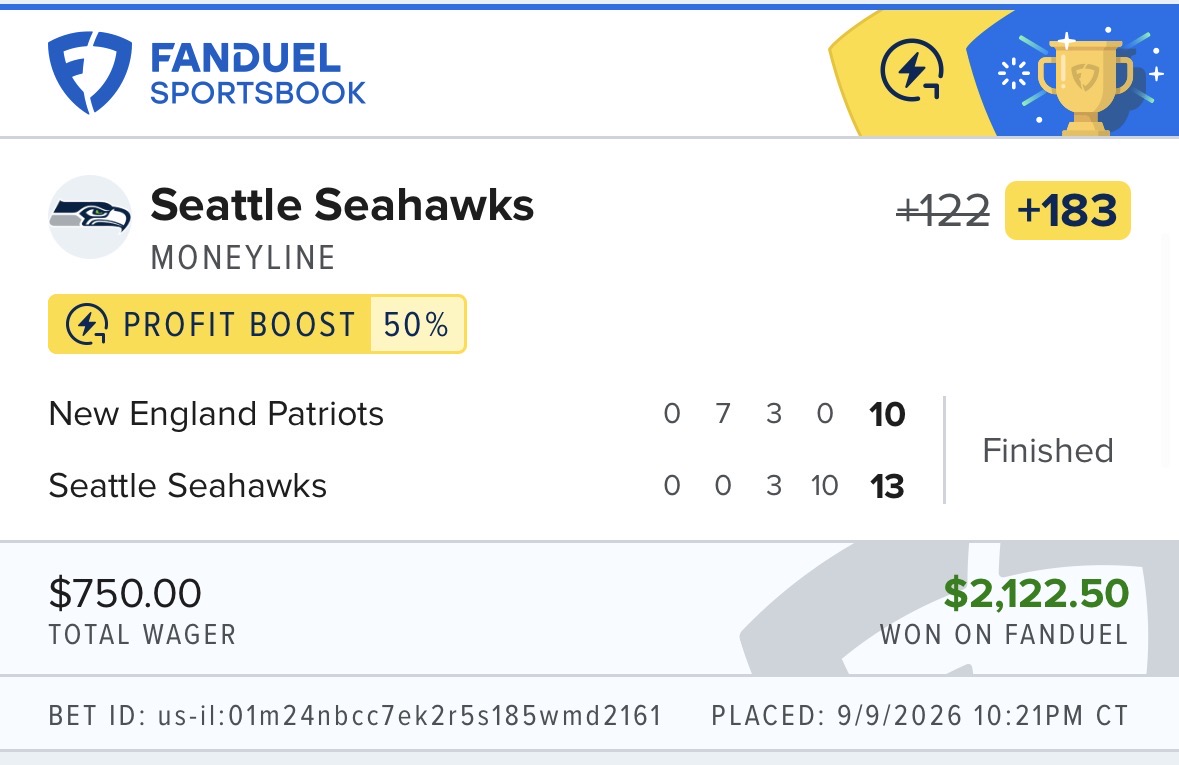
The Seahawks ticket at the bottom of this page shows the pattern. Seattle trailed New England 7-0 at halftime, won 13-10 by scoring 10 points in the fourth quarter, and the moneyline paid +183 with a 50% profit boost on a +122 price.
The underdog version is the mirror image. An underdog of 3 to 3.5 points that led at halftime went on to win 67.0% of the time, but a 7- to 9.5-point underdog leading at the half won only 56.2%. The same halftime lead is worth much less to the weaker team, because the favorite is more likely to come back. That makes an underdog "leads at halftime and wins" ticket far more fragile than the favorite version, even though it pays more.
How to Use These Numbers on a Parlay Ticket
Start from the fair price, not the payout. Find your spread band in the table and compare the app's lead-and-win price to the fair column. If the app price is shorter, you are paying for correlation the book has already charged you for.
On big favorites, skip the second leg. When a team is favored by 7 or more, a halftime lead has turned into a win more than 91% of the time. The first half on its own is usually the cleaner price, or pass.
On close games, respect the half-point. Favorites of 1 to 2.5 points that led at halftime won only 77.4% of the time, the lowest rate in the table. Those halftime leads are usually small, and small halftime leads do not hold.
Do not stack this with a full-game spread from the same game. A favorite that leads at halftime, wins and covers is the same prediction said three times. Every extra leg adds price shading without adding a new opinion. If you want a side, a single position on the NFL picks against the spread board is cleaner than three versions of it.
Keep it out of multi-game parlays. Put a correlated same-game combination on a ticket with legs from other games and you multiply its margin with theirs. If you want the halftime view, bet it on its own.
For a related trap, read second-half spread parlays, which explains why a halftime number is a different market from the full-game line, and when to stop live betting a blowout, which covers the far end of the lead-size table.
Where These Numbers Stop
This is 11 seasons of results, not a model. A few limits matter.
The spread bands mix home and road favorites, divisional games, playoff games and every kind of weather and schedule. A particular Thursday night game, like Lions at Bills with Detroit starting three backup offensive linemen, can sit well away from its band's average.
League rules change the second half. The 2026 NFL rule changes, including onside kicks that can now be declared at any time, touch exactly the late-game situations that decide comebacks, and changes like those can move these rates over time.
And a fair price is not a pick. It tells you whether a payout is reasonable for how often the outcome has happened. It does not tell you which team will lead on Sunday. That is the work our football betting picks are built on, and we release it during games, when the halftime score is known instead of guessed.
Get Tonight's Live Picks
Want tonight's live in-game NFL picks and parlay-ready releases delivered during the game?
The Best Bet on Sports is the only live betting handicapping service limited on all six major U.S. sportsbooks (FanDuel, DraftKings, Caesars, BetMGM, Fanatics, ESPN BET) for winning too much during in-game action. Verified profit: $367,520+. Picks delivered via Email and Discord during games.
→ Get tonight's live picks: $199 first month — 1-Unit package, full live betting access → Try a live pick first — reserve your spot for tonight's pick
Compare every package on the buy sports picks page or check the graded record on the results page.
Frequently Asked Questions
How often does the team leading at halftime win in the NFL?
Across 3,028 NFL games from the 2015 season through the 2025 playoffs, the team leading at halftime won 77.8% of the time. The rate depends heavily on the size of the lead: teams up 1 to 3 points won 57.3%, teams up 4 to 7 won 71.9%, and teams up 15 or more won 95.1%. About 7.3% of games were tied at halftime.
Is a lead-at-halftime-and-win parlay a good bet?
It depends entirely on the price. For a 3-point favorite, both outcomes happened together 43.6% of the time, worth about +129 with no sportsbook margin. If your app offers less than that, the ticket is priced below its historical rate. For favorites of 7 or more points, the second leg adds very little payout, so the first-half moneyline alone is usually the cleaner bet.
Why doesn't a same-game parlay pay the same as two separate bets?
Because the legs are correlated. A team that leads at halftime is much more likely to win, so the chance of both happening is far higher than multiplying the two probabilities suggests. For a 3-point favorite, independent pricing implies about +216, but the actual combined rate was worth about +129. Sportsbooks adjust same-game parlay prices for that relationship or block the combination.
What happens to a first-half moneyline bet if the game is tied at halftime?
It depends on the market. A two-way first-half moneyline at some books refunds the stake when the half ends tied, while a three-way market treats the tie as its own outcome and a bet on either team loses. Check your sportsbook's house rules. The difference matters, because removing ties changes a 3-point favorite's halftime lead rate from 51.7% to 56.6%.
How often do NFL favorites come back when trailing at halftime?
In this sample, favorites of 3 to 3.5 points who trailed at halftime still won 32.7% of the time, favorites of 7 to 9.5 points won 42.4%, and favorites of 10 or more won 60.5%, although that last group was only 76 games. Those comeback rates are why a trailing favorite's live moneyline can be worth a close look.
Should underdogs be used in lead-and-win parlays?
Carefully. An underdog of 3 to 3.5 points that led at halftime won 67.0% of the time, but a 7- to 9.5-point underdog with a halftime lead won only 56.2%. The same lead is worth less to the weaker team because the favorite is more likely to come back. The ticket pays more but is more fragile than the favorite version.
Where does this halftime data come from?
The figures come from public nflverse play-by-play data covering the 2015 through 2025 NFL seasons, regular season and playoffs, 3,028 games in all. The halftime score is the score at the end of the second quarter, and favorites are defined by the point spread recorded for each game in that dataset. Four pick'em games were excluded from the favorite tables.
The Best Bet on Sports · 1.5M followers on TikTok
Sports Betting TikTok is the live betting account behind The Best Bet on Sports, covering NFL, NCAAF, NBA, NCAAB, MLB and WNBA markets in real time. The account has been limited on all six major U.S. sportsbooks — FanDuel, DraftKings, Caesars, BetMGM, Fanatics and ESPN BET — for winning on live betting, with $367,520 in verified profit since 2005. View full profile →
Past results do not guarantee future performance. Must be 21 or older to wager.
Related Articles
Why Your Sportsbook Keeps Recommending Parlays
Best NFL Parlays for Thursday Night Football: One Game, No Escape Route
Pick'em Apps vs. Sportsbook Parlays: The Per-Leg Price
The Last Two Minutes Kill More Parlays Than Bad Picks Do
You Hit a Big Parlay: How Long Will You Keep It?
4-of-5 Again: Was Your Parlay Unlucky or Badly Built?
Get real live betting picks
From $39.95/mo · Cancel anytime · Email + Discord delivery
● Get The Picks
Choose your package
Tap any tier below to select · Subscribe in one tap
👇 Tap any package to select it
✓ You're selecting
25 Units · $99.95/month
25 unit picks per month. Sweet spot for most bettors — plenty of action without going all-in.
- ✓25 live betting selections/month
- ✓Email + Discord delivery
- ✓All sports (NFL, NCAAF, NBA, NCAAB, MLB)
- ✓Mix of 1, 2, 3, 5-unit rated plays
- ✓Cancel anytime
Secure PayPal · Cancel anytime · No hidden fees · 21+ · +$367K verified
+$367,520 verified · Limited on 6 sportsbooks · 20 years documented · See Proof
Join Our Newsletter
Get free expert sports picks and analysis delivered weekly.